Categories
Truly Free Film

The Next Wave Of Media Companies

I don’t like to say I am a “content creator”, because I think it reduces the quality of what I do. I prefer to say I am a “storyteller”, even though I think that sounds a bit smarmy too, and really just covers one aspect of — along with the ultimate result thereof — my endeavors. “Film producer” is certainly a term that no longer is truly applicable to my ambitions, but still probably works best to capture what I do. One day I may finally stumble across the correct term for how I use my labor, but for now I just generate within an industry in total transformation.

We all know that the film industry is changing in many ways. But are we at all prepared for how it is going to change in even more rapid ways in the days ahead?

Categories
Truly Free Film

Guest Post: Hal Siegel “My Film Has a Virus? WTF?”

How do you make your film go viral? That may be one of the questions that filmmakers ask most these days. And today we have the answer for you… sort of.

Hal Siegal guest posted here awhile back and today he explains the concept and practice of social loops. If you want people to engage and share with your work, you best read up now.

In my previous post regarding my experimental social film, HIM, HER AND THEM, I mentioned that I’ve been spending a lot of time thinking about “social loops”. So what the heck is a social loop, anyway? It’s not just an academic or rhetorical question—an understanding of social loops is absolutely critical for any filmmaker looking to build or engage an audience through the use of social media.

The notion of a social loop is derived from the term “viral expansion loop”. These loops or “hooks” are a key driver of the massive growth of many web 2.0 companies including Facebook, Twitter and YouTube, and more recently casual game companies like Zynga. However, the concept is not new: Tupperware parties were an early example of a viral loop in action. A viral expansion loop uses specific ideas from biology that describe the spread of viral diseases and combines this with the more generalized concept of a positive feedback loop (compounding interest in a bank account is the classic example of positive feedback: interest payments add to your balance and the result in turn increases the amount of interest).

What does a social loop look like? Consider the way Facebook works. Facebook is absolutely useless to you unless your friends are on it. Once a few friends have joined it is somewhat useful, and as more friends join, it becomes more useful—and the same thing is true for each friend in turn. The point here is not just that this creates growth, but that it can create exponential growth. (Note that this is just one simple example. Facebook incorporates many loops and even levels of loops—a social game like Cityville contains another set of loops built on top of Facebook itself).

It seems that filmmakers are beginning to understand the potential value inherent in social loops. For example, in support of his latest film NEWLYWEDS, Ed Burns held a crowdsourced poster contest and song contest. At their core, these types of contests employ a simple social loop: a participant submits an entry and then naturally encourages all his or her friends to vote for it. That’s the first half of the loop. The second half is where the friends learn about the contest and then submit their own entries, thus starting the loop over again (and this is where this particular example breaks down—the set of people interested in a given film + having the skills to create a decent original poster or piece of music is relatively small. Filmmakers would be wise to consider other types of social engagement that have lower barriers to entry).

Of course, efforts like these still fall into the realm of marketing. With HIM, HER AND THEM, we took the next step and added a social loop into the film experience itself. This took the form of simple text additions that viewers and their friends could add to the film, thereby customizing and altering it. But of course these text additions are only meaningful if your friends can see them. So viewers are encouraged to invite friends to also watch and add to the film, and in turn they invite their friends to watch and add—and there’s the loop.

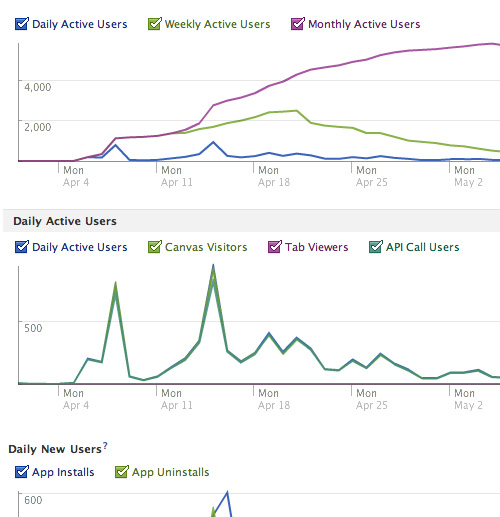
Since the film was released as a Facebook application, we are able to measure our audience engagement in ways that would be impossible in a traditional film. So how did we do with our first project? Our results were mixed. First the positive:

– We had approximately 6,000 viewers in the first month (with zero marketing dollars behind it)
– Of these, 50% interacted with the film socially in some way (by liking, sharing or commenting)
– 25% added to the story
– Average number of visits per user: 2. We assume that most people were viewing the film once, then returning to see what they friends added.

And now the negatives:
– We lost approximately 50% of our inbound viewers at the Facebook Permissions prompt. Ouch. We attribute this to the fact that a large number of inbound links were generated by StumbleUpon where users had no context that this was a Facebook application. This shows the importance of contextualizing your links and marketing. It also shows the hurdle that the Facebook Permissions screen represents—we did predict that this would be an issue.
– We had a lowly 3.33% conversion rate of friend requests to confirmations. This was very disappointing. We attribute it to Facebook’s new notification process and the fact that we weren’t able to invite friends via status updates on their walls or via email (in their defense, Facebook made the changes because social games were getting quite spammy with regards to email and wall notifications).
– Finally, viral growth is measurable as mathematical formula known as the viral coefficient. For growth to be viral, the coefficient has to be greater than 1. Ours was .07. That’s not so great in terms of growth and nowhere near exponential growth. In fairness though, this first project was largely a proof of concept. For our next projects we are thinking about deeper and more sophisticated social loops that will be specifically tailored to the nature of the story.

Social loops are clearly powerful, but the challenge is to use them with consideration and not in an exploitative manner (game mechanics face a similar challenge right now). Designed poorly, social loops will be perceived as a crass and manipulative tool. Designed well, with clear value and meaning for the user, social loops can be a gateway to entirely new kinds of engagement. This is our goal as we explore the possibilities of social films.

Hal Siegel is a partner in Murmur, a hybrid studio/technology company that creates and distributes social films. He wrote and directed HIM, HER AND THEM.

Categories
Truly Free Film

Guest Post: Hank Blumenthal “Towards An Aesthetics Of Producing Indie Movies”

What is a Producer’s “Vision”? How does she keep it all together and manage to lead all the various pursuits to a common goal? Do different approaches assure different results? Does different content require a different process?

Hank Blumenthal is old school NYC production. We’ve known each other a long time. He’s done it all. Recently he went back to school and has been focusing on new media. He’s a regular commenter on this blog; his comments lead me to ask him to take the lead at times, and today he offers us his first guest post.

Ted asked me to write a post about what it means to be a creative indie producer and the aesthetics of producing an independent movie. I can’t fully answer that question but I can start to address the main elements of that creative process and aesthetic. One approach might be to organize our thinking around four aesthetic aspects of producing: vision, community, logistics, and perspective.

A producer must have aesthetic vision. He literally has to be able to see the finished film in his mind’s eye. He has to grapple with the way it will situate meaningfulness in the culture a year in the future. And he must be able to share that vision with people so that they can be inspired enough to invest time, money, or spirit in a project.

Sometimes a film’s vision comes from a producer who conceives an idea, reads a book, or experiences a gestalt; and sometimes he embraces that from another creator. In either case this becomes the aesthetic basis for a project. This is the crucible where meaning is created. This meaning is informed by an argument or dialogue we want to have about how we perceive the world and how we share that understanding. This dialogue is grounded in artistic pleasure, emotional empathy, intellectual discourse, politics and economics.

On my last project, The Ghost Club, the idea for the story and most of the particulars came in a flash of inspiration and few hours of copious scrawling in my journal. My goal was to push the boundaries of storytelling to include a new form I call a storyscape – a story that is greater than the sum of movies, games, experiences and conceived as a whole. The storyscape is the medium, like a novel, that transmedia storytelling plays out on.

I had to conceive a whole universe with rules and connections between media like augmented reality games, websites, ghostpedias, and webisodes. Certainly there were only glimpses of what some of those elements were to be but the vision of the producer is to provide that scaffolding to the other artists – writers, directors, programmers, user experience designers – and to define the map where our efforts would go. Good producing, like modern transmedia, is about leaving gaps for our collaborators to fill in.

The producer must now form the aesthetic community that enforces that vision and interpretation. The key creatives on a movie – director, writer, producer – must disseminate and encompass all the other creative visions – actors, animators, designers, musicians, etc. – to make a community of meaning. The producer must take responsibility for this community and the coordination that scales the cinematic vision to the divisions of labor in making a movie. That is how the set decorator can choose the perfect flower or the composer the amazingly perfect cue. The producer, being responsible for the creation of an aesthetic ecology, must mediate translations of core principles across the various people involved, both communicating the larger vision while still respecting the particular area of the production.

I cannot stress this point enough, the aesthetics of the community’s collaboration is owned by the producer. The producer is responsible for who and how that team comes together. Providing an environment where people can excel and collaborate is fundamental to a producer’s role. Flexibility, openness, and respect for everyone in the process are a critical aesthetic of a producer’s community.

I was fortunate enough to work as a script supervisor with Spike Lee on music videos and commercials and see how he married a clear director’s vision with a producer’s openness to his collaborators to create the best works. Often crew, any crew (occasionally myself), would step up to him and make a suggestion. He would graciously and ruthlessly compare that against his vision and accept or reject it. More often it was rejected but the joy of collaboration was when he said “yes.” Movies are a collaborative medium and the way that process is curated defines the finished work. At the level of production, great indie movies can be traced to well-coordinated aesthetic ecologies, and therefore to careful translation from the producer.

To frame the next point, aesthetics and logistics, consider what Stanley Kubrick said in Sight and Sound in 1972: “I don’t think in terms of big movies, or small movies. Each movie presents problems of its own and has advantages of its own. Each movie requires everything that you have to give it, in order to overcome the artistic and logistic problems that it poses.” The aesthetics of logistics are where the producer’s collaboration with the ecology of production becomes artistic. Choices are not solely artistic but also exist within a larger economy that focuses attention and resources. This is where producing becomes artistic, and that art is not simply creative but economic. Where your resources are applied and to what aesthetic result becomes a large part of what the finished product looks like.

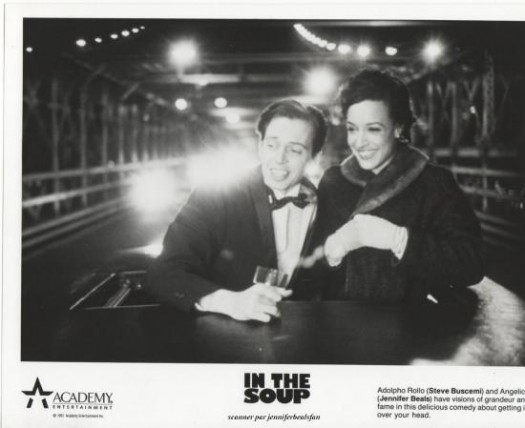
I still kick myself for not spending a thousand dollars (that I didn’t have anyway) on a location for “In the Soup” that was 200 ft closer to a view of Manhattan. The producer balances the artistic demands of the picture and makes hundreds of creative choices about crew, locations, props, sets and wardrobe – not to mention the actors who can have a huge artistic contribution of their own to make. The ability to translate creative vision down the line of production, then, is also the ability to translate final decisions – driven by who, where, how, and how much – to harmonize these points of production.

Finally there is perspective. When everyone else is up to their necks in the muck of production and post production it is essential that someone maintain the agreed upon artistic vision and keep their attention focused on the ultimate goal. The producer is the one who reminds the director of what the vision is as the director sinks into the serendipity of artistic creation often pulled by the brilliant thoughts of his collaborators. The producer is responsible for the direction of the picture through his aesthetic consistency.

Vision, community, logistics, and perspective can provide a beginning for how we can analyze the aesthetics of producing. I hope this can begin a deeper discussion into each of these areas and what that aesthetics entails. As to what a creative producer does, I think this touches on the many areas he must supply the aesthetics and vision. Movie making and meaning making are an ecology of aesthetic choices and the producer defines the nodes of that ecology.

—Hank Blumenthal

Hank Blumenthal is a producer and director of movies (The Ghost Club, In the Soup, Strawberry Fields) a creative director and producer for interactive television and digital media (Microsoft, Google, Viacom, R/GA, Bravo and IFC,) and a PhD student in digital media at Georgia Institute of Technology investigating transmedia storytelling and new paradigms for stories.

Categories
Truly Free Film

What Are Americans Content Consumption Preferences?

Per Hollywood Reporter:

according to a March study from PricewaterhouseCoopers. PwC reported that the Netflix model of mailing DVDs is No. 1 with consumers, with 43 percent of Americans doing it, while the subscription streaming service where Netflix also is dominant is No. 2 at 32 percent. Third is a la carte streaming, fourth is renting a DVD from a kiosk, and fifth is renting from a video store.
The Digital Entertainment Group recently said that while sales and rentals of DVD and Blu-ray discs in the U.S. dipped 6 percent to $16.3 billion in 2010, digital sales and rentals rose 19 percent to $2.5 billion.

Categories
Truly Free Film

Guest Post by Jeffrey Schwarz: “Event-izing By The Master or How To Put Butts In The Seats”

Sometimes it seems filmmakers forget they are in SHOW business. It is never enough to simply make a film or screen a film, and then hope that they will come. You need to create an event about your work and screen it in a context that makes people want to participate.

James Schamus, my former business partner and now President of Focus Features, has long had a poster on display in his office for William Castle’s The Tingler. He is just one of the many disciples of Castle, an auteur of showmanship if there ever was one. For those of us who missed out being Castle-ized back in the day, we are lucky to have Jeffrey Schwarz new doc on William Castle to feast on. And for you, dear reader, we are truly fortunate to have Jeffrey contextualize with a guest post on why Castle matters to us all.

Growing up in the 1970s, I was too young to have experienced firsthand the joys of William Castle and his gimmicks. I didn’t become fully aware of Castle until I read John Waters’ tribute article “Whatever Happened to Showmanship?” It was a revelation. I was delighted with this director’s bravado and chutzpah. Not one to seek the limelight myself, I was fascinated by how a charismatic and ambitious contract director reinvented himself as a larger than life showman and created a persona known across the globe. Luckily, this burgeoning interest coincided with a revival of Castle’s gimmicks at the Film Forum in New York City in the 1980s. The theater rigged up their own Percepto buzzers and invited an audience of hipsters to enjoy the festivities. When Vincent Price announced that the Tingler was loose in the theater, the buzzers went off and a group of jaded New Yorkers started screaming for their lives. I remembered what John Waters said in his essay. “How could film buffs be so slow in elevating this ultimate eccentric director-producer to cult status? Isn’t it time for a documentary on his life?” I decided to take John’s bait and make this film.

The America that William Castle made his films for was a country that prided itself on its regional differences – a far cry from today’s fast food and big box landscape. Unlike today, when a film will open simultaneously on 3000 screens, Castle’s pictures opened city by city. He traveled from place to place and each campaign was tailored for that particular area. It was as if the circus was coming to town and Castle was the jovial ringleader. I feel this fostered a sense of community and allowed folks to make the experience their own. Today’s movie going is becoming increasingly solitary, and I hope this film reminds people of the joy of a shared experience, and how movies can encourage community and connectedness.

Today, the movie business is run by lawyers and accountants, driven by focus groups, obscenely high budgets, and a global distribution network that simply didn’t exist in Castle’s heyday. Show business today places the emphasis on the business, but oftentimes neglects the show. Castle didn’t need a $50 million dollar marketing budget to get his audience excited about his product. Through pure showmanship and the force of his own personality, he made audiences feel they were part of something truly unique that they would remember for the rest of their lives. As this film can attest, they’re still talking about it today.

William Castle’s life is profoundly American. He was an orphan growing up on the streets of New York City who through fast-talking, bravado, and genuine talent made his way to Hollywood and reinvented himself. He put himself on the line financially and emotionally for his films, and for that reason Spine Tingler! is a tribute to dreamers everywhere.

–Jeffrey Schwarz

Jeffrey Schwarz is President & CEO of Automat Pictures, a leading producer of studio EPKs, DVD content, original TV programming, and feature films. He has produced and directed the feature documentaries “Spine Tingler! The William Castle Story,” winner of the AFI 2007 Documentary Audience Award, and “Wrangler: Anatomy of an Icon.” He is currently in production on “Activist: The Times of Vito Russo,” an independent feature documentary about the beloved author of “The Celluloid Closet” and “I Am Divine,” the story of John Waters’ legendary muse.

Check out:
https://www.facebook.com/SpineTinglerMovie
www.spinetinglermovie.com

Categories
Truly Free Film

Guest Post: Felicia Ptolemy “Tool Review: Transcendent Man on The Dynamo Player”

A while back we had Dynamo Player’s founder Rob Millis introduce us to this useful tool for DIY Distribution. But how do the filmmakers using it, feel about the Dynamo Player? Today, Felicia Ptolemy, one of the producers behind one very successful film, Transcendent Man, shares their thoughts on the Dynamo Player.

I look forward to sharing more direct reviews of the tools we use to get our work made and seen. If you are filmmaker using some of the innovative tools and methods that both necessity and opportunity has offered Indie / Truly Free Film recently, let us know your experiences. Write to me and we can run a post for the community, okay?

Transcendent Man is a film about the democratization of technology. Basically, exponentially growing information technologies are allowing for an explosion of new applications that are disrupting entire industries and offering powerful tools to people everywhere. Dynamo is one such tool, affording the filmmaker, directly, the opportunity to offer our audience immediate access to our film and ease of payment, which together create an instantaneous and seamless viewing experience.

With today’s audiences expecting and demanding to watch movies the way they want to watch them, Dynamo introduces the unique convenience of an embeddable video player that can be hosted on any relevant destination. We started by putting the film on our own website – the first place our potential viewers go to learn about Transcendent Man and find out where they can watch it. As a filmmaker, once you capture the interest of a viewer, you want to close the deal. There is so much content out there to distract people and by eliminating the need to go to another site to watch the film, we’ve captured the audience interest at its height. We also simultaneously put up the Dynamo player on our Facebook fan page, where many new and existing fans of the film go daily to share information and debate the ideas – it was a perfect spot to again access a passionate and interested audience (who can also easily share the film with their network) and offer the film for rent right there on the spot. By creating this flexibility and allowing us to embed a player right at the source, Dynamo gave us a tool to combat a primary challenge facing filmmakers today: content over-proliferation.

Also, with exhibitors still demanding a 90-120 day holdback to DVD release, Dynamo offers a more timely opportunity for our fans, which are demanding that a film like Transcendent Man should be available via many portals using any and all new technologies. This is the primary reason we wanted to use Dynamo, who was the first video player application that could accept safe, reliable forms of payment via trusted sites like PayPal. Couple that with the capability of embedding the video player on any website or portal where Transcendent Man is relevant to that site’s content and we have an exponentially growing audience who is not being blindly marketed to, but rather who have found the film naturally through their own likes and interests. Highly democratizing!

For these reasons and many more that we are still learning, Dynamo is a powerful tool for filmmakers and self-distributors. We’ve even had filmmaker friends learn about Dynamo through us and thank us for making them aware of a tool with so much potential. It’s a portal that offers access and convenience to a targeted audience and expands on your existing fan base organically across the web. It transcends the limitations previously put on filmmakers whose goal has always been to just get more people to enjoy their films.

— Felicia Ptolemy

Felicia Ptolemy is an independent producer working in television and film for the past 10 years. She produces under the Ptolemaic Productions banner with her husband, Barry Ptolemy. Her most recent project, Transcendent Man, the documentary about Ray Kurzweil’s life and ideas, is available on DVD and iTunes.

Categories
Truly Free Film

Guest Post: Jennifer Fox “The Next 14 Things I Learned From Our Six-Figure Kickstarter Campaign”

Yesterday, Jennifer Fox shared with us six things she recommends doing BEFORE launching a Kickstarter campaign. Today she brings the list up to twenty. She’s giving us a lot. She’s got a few days left on her campaign. Perhaps you can give back?

The campaign continues and we keep marching forward. There’s nothing like this excitement as we approach our 90-day goal! Doing Kickstarter is not just about the work, but it’s also about creating that right frame of mind. Here are some more tips my team and I have gathered during the last 85 days campaign of Kickstarting:

7. Write, Write, And Write:

As you may have noticed, my writing style can be a bit longwinded. Early on in the process, I would send my eblasts to my team to edit. We thought one page max – so they cut and cut. Then we noticed that we were receiving the most donations following longer, more personal messages. They received overwhelmingly positive feedback. What at first seemed like a weakness, turned out to be one of our strongest tools. Writing became fun. As some of you may know, being on the road with a film can be the one of the most uncreative jobs one does over the course of film. But suddenly, writing these weekly Kickstarter updates and email blasts became a creative outlet for me. That leads us to #8:

8. Turn Your Negatives Into Positives:

I think the key to any creative producing is to turn your circumstances into strengths. In our case, we were really worried that the film was already screening on the festival circuit. I couldn’t change that, so I used it as an excuse to make regular video updates for our website, eblasts and pitches. The other thing I started to do, which I would have never thought appropriate, was talk about our fundraising campaign during every MY REINCARNATIONfestival screening. Here is an example of one video (Part 2 of 2) we posted from the film festival in Singapore. We made postcards with the Kickstarter pitch on one side and the film’s artwork on the other. I hand them out at every screening. I aso privately ask festival programmers to ask me a question on stage about financing during the Q & A, giving me an opportunity to talk about the campaign. I always try to have one of my postcards conveniently in my hand to wave at the audience to remind them! Most of you reading this will not have to raise funds for a completed film that is already touring. But wherever you are in the process, try to use that place to generate stories and images to support your campaign.

9. Evaluate Your Email List.

Thanks to Peter Broderick and many others, every filmmaker should know that you need to build a mailing list to survive as an independent in America. We already had a 7,000-person mailing list built during the theatrical campaign for my previous film, FLYING: CONFESSIONS OF A FREE WOMAN. The problem was that it was not exactly the right list for a Buddhist film! So we had to work hard to broaden that list.

10. Build your mailing list.

Everyone tells you to have people sign up for your mailing list on your website. But I have found that very few people do this. Most people prefer to get film updates from our Facebook page (which we post to frequently). However, many people are not on Facebook, especially the older generation. Building an email list requires active, ongoing work. We ask people to sign up on our website, get names from festivals goers, and as with the NYC Sneak Preview Screening, gather all ticket buyers’ emails addresses. (It is important when making deals with venues to try to get them to agree to this as the Rubin Museum of Art did prior to making a screening agreement.) In addition, we actively built our US mailing list by researching every Buddhist, spiritual, Tibetan, New Age, religious and family organization on the web. We are still building that email list now. When we have the time, we make phone calls to organizations to get them to personally connect with the film and share information about our Kickstarter site with their members.

11. Reach out to Appropriate Partners to Help Blast for your Campaign / Befriend the Tastemakers

The first tier we reached out to were listserves connected to the students of the film’s protagonist, Chögyal Namkhai Norbu. Rinpoche has centers around the world, so we regularly write new, special updates to be blasted to their membership. These letters are less chatty than the ones I send to the general mailing list or post for our Kickstarter patrons. In these letters, we always try to have additional information – such as upcoming festivals or new video clips – so that it is not just another request to donate. We started a web series called OUTTAKES FROM THE FILM (O.F.F.) that we edit and post online and in our Buddhist eblasts to give those communities new video to enjoy and entice them to become more involved with the project. So far we have posted five O.F.F.’s. They have helped assuage Buddhist students around the world, who are anxiously waiting to see MY REINCARNATION and are not so happy that they have to wait for the distribution rollout. The other thing we did – but could only do with the Sneak Preview NYC Fundraising screening – was offer incentives to appropriate organizations to blast their membership on behalf of our campaign. We gave the heads of each organization a free ticket to the screening in exchange for sending out an announcement. And of course, this is laying the groundwork for establishing partners and building and audience for the film down the line.

12. Use Web 2.0: Facebook, Twitter, Bloggers…

This is absolutely obvious in today’s world, but we are posting updates on social networking sites many times a week. We work hard to build up our Facebook and Twitter pages daily. We also post on other organizations’ and individuals’ pages and walls – searching for related topics like “Buddhism,” “Tibet,” “Spirituality,” “Religion,” and “Yoga” – with information about the Kickstarter campaign, new videos, incentives and screenings.

13. Blast Often, Regularly, and Best at the Beginning of the Week

Get those eblasts out on Monday or Tuesday. Later in the week they get lost in people’s over-loaded inboxes. It’s important to keep up the pressure. It’s hard to know what the “tipping point” is for someone to make a donation. It can be the first letter or the twentieth letter that brings them over to the Kickstarter site.

14. Write Personal Letters and Ask Questions

When I write my patrons back on Kickstarter, thanking them for their donations, I ask them where they heard about the campaign. I often get answers back proving the wide reach of the campaign. By asking questions you engage your patrons’ participation. In a post to the entire group, I asked for advice on how to get the message out and I got several good solutions, one of which was to improve our web page and clarify some of the writing. Three of our patrons decided to make it their personal hobby to help get the word out and have been eblasting and working the web. One person wrote a letter on Kickstarter asking everyone to double their donations and several people responded by doing so. When I get an interesting letter, I often post it in an update. It takes a village and this is a community movement.

15. Widen Your Team:

Since many people in the Buddhist Community do not have much disposable income, we wanted to make one of our incentives non-monetary. We created the first level incentive – “Outreach Partner” – at a donation level of $1 for people who want to get involved by spreading the word about the campaign and the film. By spreading the word, they get their name on our “Donor’s Wall” on our website. In fact, every level of donation, large or small gets their name on our “Donor’s Wall,” giving an immediate level of gratification like having your name in the film’s credits.

16. Cultivate A Positive Attitude:

No one asked you to be an artist in the most expensive art form in history. Being a filmmaker is a privilege. Have perspective; some people have “real” jobs. Having to raise funds is a rite of passage. Try to find a way to frame the campaign as fun, playful, and joyous. This is where building a team (Tip #2) really helps. Laughter is key.

17. Stay Away From People Who Are Negative About Fundraising.

There are always people who think asking for money abhorrent and will find all sorts ways to pull you down. Don’t let them inside your head. They can still be friends or lovers, but it’s better to avoid the subject around them. But don’t forget about # 18:

18. Be Aware Of Cultural Differences.

Crowd funding is a very American way to raise money that may seem strange to many outside our borders (although it is slowly coming to Europe). Be ready to explain the system, and back off when your “go-get-em” attitude is too much. We were semi-blacklisted from one main international Buddhist listserve, because the manager felt I was asking for money too much. Rather than confront him and risk being kicked off that site forever, we broke up the territories and tried to get on individual country’s Buddhist listserves. Not as effective, but better than nothing. In certain countries – such as Singapore – donors prefer to give cash or checks than to donate on the Internet. So, we have also accepted some cash donations…

19. Go Beyond Your Limits

Every step of the way on this journey, I have had to go beyond my comfort zone to publicly ask for money: on the web, in emails, in person, on stage – over and over again. At every point, I have had to push through my reticence, fear and a general “I just don’t want to do it again!” attitude. Facing these inner demons is necessary if you are going do this type of campaign. Forgive me, but once again there is a Buddhist teaching in this! We all fear being the fool and being foolish. Believe me, crowd-funding certainly pushes those buttons, but it also requires you to let go and not listen to your ego so much…

My motto is, “Never say die!” Despite years of experience facing rejection, it can still be hard to pick yourself up each time. Somehow we have to find a way not to take rejection personally and move on. Of course, with some potential funders, you just have to give up, back off, and try somewhere else. But I am often reminded of something my Father said when I was making my first film, BEIRUT: THE LAST HOME MOVIE, “No is never no, it’s just maybe.” A person, who says no today, may still say yes tomorrow. If you give them new evidence to change their mind, they often do.

20. Be ready – to be absorbed. It is a full-time job.

I couldn’t have imagined how much work a Kickstarter campaign is. I have had many sleepless night thinking about how we could achieve our goal, but I have also felt enormous glee when a wave of donors contribute. It has been a huge learning experience that I suspect has changed me for the better. I’ve come to realize that time moves differently on the web. When we started, I thought 90 days would never be enough to achieve our goal. But then I noticed how many unique things could happen in 24 hours. Every day provided opportunities to reach out to people. Everyday people wrote us. Most days at least one person (and often more than one) joined the campaign from somewhere new. Even on Sundays. The campaign has shown me how a time limit can work for you. Today is day 84 in our campaign and it seems like I have been doing this for a lifetime.

* * * * * * * * *

In my next post, I’ll talk about how Kickstarter Campaigns create communities that dovetail into distribution and outreach campaigns. I’ll also share important information about the positive things people receive from participating in Kickstarter campaigns: a crucial thing to understand to properly craft a campaign.

Stay Tuned as we countdown towards D-Day… Our Campaign ends on May 28th and we are still hustling to get to those 6 figures!

— Jennifer Fox

Jennifer Fox is an internationally acclaimed, award-winning Producer, Director, Camerawoman. She is known for her groundbreaking work on both documentary features and series, including BEIRUT: THE LAST HOME MOVIE, AN AMERICAN LOVE STORY, FLYING CONFESSIONS OF A FREE WOMAN, and now MY REINCARNATION. She is the subject of three films on filmmaking, TO HECK WITH HOLLYWOOD!, CINEMA VERTE: DEFINING THE MOMENT and CAPTURING REALITY: THE ART OF DOCUMENTARY She has Executive Produced many award winning films, including LOVE & DIANE, ON THE ROPES and UPSTATE. She teaches and consults on directing and producing internationally at institutions such as New York University, the Binger Lab in Amsterdam, the University of Zurich and many others.