

We had a packed house at Lincoln Center for our “New Faces Of NYC Indie Film” panel. It was a good conversation. Sure, my game show idea did not work out, but hey, when you have eleven people up on the stage with you, it means you have eleven people not talking and that’s hard to keep it lively. Luckily, all eleven people had a lot to say and are clearly a group of passionate and committed filmmakers, making sacrifices for the privilege of making their art. If you didn’t get there, now through the miraculous power of the internet, you can give us two hours of your time and see what it is you missed.
Category: Truly Free Film
We are on the verge of a new film culture and infrastructure.
I am moderating the “Some Of The New Faces Of NY Independent Film” panel today to help kick off Lincoln Center’s new theaters. They are truly beautiful and will surely be a must-see destination for all Cinemaniacs throughout the universe. As I believe we will have eleven panelists on the stage with me (it having been determined that that is the magic number required to get me to shut up and let someone else talk), it is going to be a bit of a circus.
Not being one to leave chaos well enough alone, I am going to inject it with some more distortion, just for kicks. I have come up with some rules to turn this panel into a bit more of a game.
A couple of weekends back I was checking out Chuck Wendig’s blog terrible minds. I was blown away — and I know Chuck already. He’s the co-writer on Lance Weiler’s “H.i.M. (Hope is Missing)” that I am producing. That said, the humor, wisdom, and outright generosity of his posts were even more than I had anticipated.
Today, I am pleased to repost that post that got me so excited. I don’t always agree with Chuck (or maybe I do), but I know I love what he shares. Besides, disagreements are what drive us all to find solutions. So get into it. It’s so good I had to say it again.
1. Stories Have Power
Outside the air we breathe and the blood in our bodies, the one thing that connects us modern humans today with the shamans and emperors and serfs and alien astronauts of our past is a heritage — a lineage — of stories. Stories move the world at the same time they explain our place in it. They help us understand ourselves and those near to us. Never treat a story as a shallow, wan little thing. A good story is as powerful as the bullet fired from an assassin’s gun.
2. Effect Above Entertainment
We love to be entertained. Bread and circuses! Clowns and monkeys! Decapitations and ice cream! A good story entertains but a great story knows that it has in its arsenal the ability to do so much more. The best stories make us feel something. They fuck with our emotions. They make us give a flying fuck about characters and places and concepts that don’t exist and won’t ever exist. The way a story stabs us with sadness, harangues us with happiness, runs us through the gauntlet of rage and jealousy and denial and underoo-shellacking lust and fear (together, lust and fear may stir a “scaredy-boner”) is parallel to none. Anybody can entertain. A juggler entertains. A storyteller makes us feel something. Makes us give a shit when we have no good reason to do so. Fun is not the last stop on the story train. The storyteller is master manipulator. The storyteller is cackling puppetmaster.
3. A Good Story Is A Good Story Regardless Of Genre Or Form
Segmentation. Checking off little boxes. Putting stories in the appropriate story slots and narrative cubby-holes. Is it a sci-fi TV show? A fantasy novel? A superhero comic? A video game about duck hunting? An ARG about the unicorn sex trade? We like to think that the walls we throw up matter. But they’re practically insubstantial, and once you get them in your mouth they’re like cotton candy, melting away to a meaningless slurry. Good story is good story. Those who cleave to genre and form — whether as teller or as audience — limit the truth and joy the tale can present. Cast wide and find great stories everywhere.
4. That’s Not To Say Form Doesn’t Matter
Story is also not a square peg jammed in a circle hole. Every tale has an organic fit. The medium matters in that it lets you operate within known walls and described boundaries.
5. Stories Have Shape, Even When They Don’t Mean To
You put your hand in a whirling clod of wet clay, you’re shaping it. Even when you don’t mean to. Sometimes you find a shape the way a blind man studies a face. Other times you know the shape at the outset and move your hands to mold the tale you choose to tell. Neither way is better than the other. But the story never doesn’t have a shape. A story always has structure, even when you resist such taxonomy.

6. The Story Is A Map; Plot Is The Route You Choose
A story is so much more than the thing you think it is. I lay down a map, that map has a host of possibilities. Sights unseen. Unexpected turns. The plot is just the course I… well, plot upon that map. It’s a sequence. Of events. Of turns. Of landmarks. The story goes beyond mere sequence. The story is about what I’ll experience. About who I’ll meet. The story is the world, the characters, the feel, the time, the context. Trouble lies in conflating plot with story. (Even though I’ve done it here already. See how easy it is to do?)
7. On The Subject Of Originality
The storyteller will find no original plots. But original stories are limitless. It’s like LEGO blocks. Go buy a box of LEGO bricks and you’ll discover that you have no unique pieces — by which I mean, these are the same pieces that everybody gets. But how you arrange them is where it gets interesting. That’s where it’s all fingerprints and snowflakes and unicorn scat. Plot is just a building block. Story is that which you build.
8. The Bridge Between Author And Audience
The audience wants to feel connected to the story. They want to see themselves inside it. Whether as mirror image or as doppelganger (or as sinister mustachio’ed Bizarroworld villain!). The story draws a line between the storyteller and the audience — you’re letting them see into you and they’re unknowingly finding you inside them. Uhh, not sexually, of course. You little dirty birdies, you.
9. But Also, Fuck The Audience Right In Its Ear
The audience isn’t stupid. It just doesn’t know want it wants. Oh, it thinks it knows. The desires of the audience are ever at war with the story’s needs, and the story’s needs are, in a curious conundrum, the audience’s needs. You read that right: this means it’s the audience versus the audience, with the storyteller as grim-faced officiant. In this struggle, fiction is born. The conflict of audience versus writer and audience versus itself is the most fundamental conflict of them all. The audience wants the protagonist to be happy, to be well. They want things to work out. They want conflict to resolve. The story cannot have these things and still be a good story. Good story thrives on protagonists in pain. On things failing to go the way everyone hopes. On what is born from conflict and struggle, not merely from the resolution. The audience wants a safety blanket. It’s the storyteller’s job to take that safety blanket and choke them with it until they experience a profound narrative orgasm. … did I just compare storytelling to erotic asphyxiation? I did, didn’t I? Eeesh. Let’s just pretend I said something else and move on.
10. No Tale Survives A Vacuum Of Conflict
Conflict is the food that feeds the reader. It’s a spicy hell-broth that nourishes. A story without conflict is a story without story. As the saying goes, there’s no ‘there’ there. The storyteller has truly profound powers, though: he can create conflict in the audience by making them feel a battle of emotions, by driving them forward with mystery, by angering them. The storyteller operates best when he’s a little bit of a dick.
11. The Battle Between Tension and Release
Tension is how you ramp to conflict, how you play with it, how you maneuver around it, how you tap-dance up to the cliff’s edge, do a perilous pirouette, and pull back from the precipice. You’re constantly tightening the screws. Escalation of tension is how a story builds. From bad to worse. From worse to it can’t get any worse. From it can’t get any worse to, no, no, we were wrong, it’s still getting worse because now I’m being stampeded by horses that are also covered in burning napalm. But it isn’t just a straight line from bad to awful. It rises to a new plateau, then falls. Having just witnessed it, birth is a great (if gooey) analog. Each contraction has its own tension and release, but the contractions also establish a steady pattern upward. Some have said narrative arcs are sexual, ejaculatory, climactic. True, in some ways. But birth has more pain. More blood. More mad euphoria. And stories always need those things.
12. Peaks, Valleys, Slashes And Whorls
It’s not just tension. All parts of a story are subject to ups and downs. Rhythm and pacing are meaningful. A good story is never a straight line. The narrative is best when organically erratic. One might suggest that a story’s narrative rhythm is its fingerprint: unique to it alone.
13. In A Story, Tell Only The Story
The story you tell should be the story you tell. Don’t wander far afield. That’s not to say you cannot digress. Digressions are their own kind of peak (or, in many cases, valley). But those digressions serve the whole. Think of stories then not as one line but rather, a skein of many lines. Lines that come together to form a pattern, a blanket, a shirt, a hilarious novelty welcome mat. Only lines that serve the end are woven into play. Digressions, yes. Deviations, no.

14. Big Ideas Do Well In Small Spaces
The audience cannot relate to big ideas. A big idea is, well, too big. Like the Stay Puft Marshmallow Man. Or Unicron, the giant Transformer-that-is-also-a-planet. (I wonder if anyone ever calls him “Unicorn,” and if so, does that irritate him?) You must go macro to micro. Big ideas are shown through small stories: a single character’s experience through the story is so much better than the 30,000-foot-view.
15. Backstory Is A Frozen Lake Whose Ice Is Wafer Thin
Backstory in narrative — and, ultimately, exposition in general — is sometimes a grim necessity, but it is best to approach it like a lake of thin ice. Quick delicate steps across to get to the other side. Linger too long or grow heavy in the telling and the ice will crack and you will plunge into the frigid depths. And then you get hypothermia. And then you will be eaten by an Ice Hag. True story.
16. Characters Are The Vehicle That Carry Us Into (And Through) The Tale
The best stories are the stories of people, and that means it’s people — characters — that get us through the story. They are the dune buggies and Wave Runners on which the audience rides. Like Yoda on Luke’s back. Above all else, a story must have interesting characters, characters who the audience can see themselves in, even if only in a small way. Failing that, what’s the point?
17. Villains Have Mothers
Unless we’re talking about SkyNet, villains were children once upon a time. Which means they have mothers. Imagine that: even the meanest characters have mothers, mothers who may even have loved them once. They’re people, not mustache-twirling sociopaths born free from a vagina made of fiery evil. Nobody sees themselves as a villain. We’re all solipsistic. We’re all the heroes of our own tales. Even villains.

18. Heroes Have Broken Toys
Just as villains see themselves doing good, heroes are capable of doing or being bad. Complexity of character — believable complexity — is a feature, not a bug. Nothing should be so simple as unswerving heroism, nor should it be as cut-and-dry as straight-up-malefic motherfuckery. Black and white grows weary. More interesting is how dark the character’s many shades of gray may become before brightening.
19. Strip Skin Off Bones To See How It Works
A story can be cut to a thin slice of steak and still be juicy as anything. To learn how to tell stories, tell small stories as well as large ones. Find a way to tell a story in as few beats as possible. Look for its constituent parts. Put them together, take them apart. See how it plays and lays. Some limbs are vestigial.
20. Beginnings Are For Assholes…
The audience begins where you tell them. They don’t need to begin at the beginning. If I tell the story of a Brooklynite, I don’t need to speak of his birth, or the origins of Brooklyn, or how the Big Bang barfed up asteroids and dinosaurs and a flock of incestuous gods. You start where it matters. You start where it’s most interesting. You begin as late in the tale as you can. The party guest who comes late is always the most interesting one. Even still, it’s worth noting…
21. …If You Jump Too Fast Into Waters Too Deep And The Audience Drowns
Jump too swiftly into a narrative and the story grows muddled. We have to become invested first. Go all high-karate-action and we have no context for the characters who are in danger, and no context means we don’t care, and if we don’t care then we’re already packing our bags in the first five minutes or five pages. The audience always needs something very early to get their hands around. This always comes back to the character. Give them reason to care right at the gate. Otherwise, why would they walk through it?

22. Treat Place Like Character
For setting to matter, it must come alive. It must be made to get up and dance, so shoot at its feet. It has a face. It has a personality. It has life. When setting becomes character, the audience will care.
23. Always Ask, Why Do I Want To Tell This?
Storytellers tell specific stories for a reason. You want to scare the kids around a campfire. You want to impress your friends with your exploits. You want to get in somebody’s pants. You hope to make someone cry, or make them cheer, or convey to them a message. Know why you’re telling it. Know what its about — to you above all else, because then you can show everybody else what it’s about. Find that invisible tether that ties you to the story. That tether matters.
24. It’s Okay To Bury The Lede
Every story is about something. Man’s inhumanity to man. How history repeats itself. How karate-ghosts are awesome and how you don’t fuck with a karate-ghost. But you don’t need to slap the audience about the head and neck with it. The truth of the story lives between the lines. This is why Jesus invented “subtext.”
25. Writing Is A Craft, But Storytelling Is An Art
Writing isn’t magic. Writing is math. It’s placing letters and words and sentences after one another to form a grand equation. Writing is the abracadabra — the power word made manifest — but the story that results is the magic. That equation we piece together tells a tale and the arrangement that leads to that tale is where the true art lies, because it takes an ice scraper to pretense and throws an invisible-yet-present tow line from present to past. Writing is craft and mechanics. Storytelling is art and magic.
–Chuck Wendig
Chuck Wendig is equal parts novelist, screenwriter, and game designer. He currently lives in the wilds of Pennsyltucky with wife, dog, and newborn son. His “vampire in zombieland” novel, Double Dead, releases in November, 2011, and his e-book of writing advice, Confessions of a Freelance Penmonkey, is now on sale. He is represented by Stacia Decker of DMLA. You can find him dispensing dubious writing advice at his blog terribleminds.com.
Two weeks ago Jennifer Fox shared with us some of the lessons she learned crowdfunding (1st six here, next 14 here). Since then, she has gone down in the record books for both the number of donations and the amount thereof. If they gave records for quality as well as quantity she probably would have gotten those too.
Jennifer continues her path of profound generosity with another wave of the demystification wand to show how it was done. It is not magic; it’s hard work — but it can be done, and learned from. The best part is, this ain’t all. There’s still more coming next week! Thanks Jennifer.
It was only last week, but I have to admit: I have a bit of nostalgia for
those heady last days of our Kickstarter campaign. Now when I open up
my computer and press gmail, I stare at the few new emails
despondently. I wonder if I will ever wake up again to hundreds of
Kickstarter messages on my computer screen announcing donations. Even
our supporters have written to say they miss the daily excitement of
checking our site to see if – and by how much – the dollars rose.
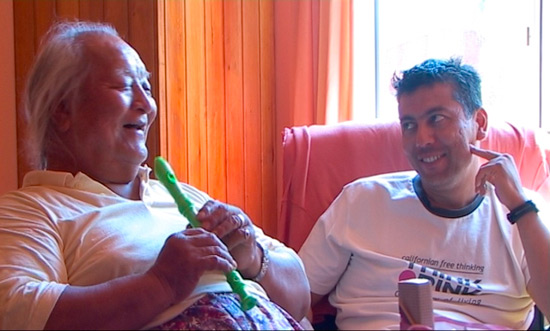
I am reminded of something one of the protagonists of MY REINCARNATION and son of Namkhai Norbu, Khyentse Yeshe, said to me in an interview once:
“Whenever you try to do something difficult, you fail and fail and fail, until you succeed.”
When Yeshi first said this, I didn’t relate at all. The word “failure”
is very un-American. In fact it is something almost extinct from the
American business and political vocabulary. (Have you ever noticed that
no American president has ever failed at anything?) But Yeshi is
Italian and being so he is more comfortable with a wider spectrum of
experience. The more I thought about what he was saying, the more I
realized he was right. It is a very good description of our Kickstarter
campaign: We failed and failed until we succeeded (at the first goal
$50,000) and then we failed again and again until we succeeded and
surpassed our second goal of $100,000. The main thing we did as a team
was to take our failures as key pieces of information, pointing us
towards what to work on next.
Midway through our campaign my cousin, Ken, sent me an article from Tech Crunch,
spouting the success of the new crowd-funding platform, but also
stating that 43% of the Kickstarter projects fail and never reach their
goal. Reflecting on this together in our team helped us recognize some
of the pitfalls when we hit them, and change course so we could
ultimately succeed.
Now that the dust has settled, here are our 9 additional tips (13 more
to come) that we learned doing our campaign to add to our previous 20
(from “Hope for Film” Post 1, Post 2, and Post 3):
21. Kickstarter Is Not For Sissies:
No one can prepare you for the amount of work a Kickstarter campaign
involves. Don’t start your campaign until you make the time, mental
space and have enough pressure on yourself (meaning financial need) to
do so. No one fundraises because they have nothing else to do.
It is the same advice I give to young documentary filmmakers when they
ask me should they make their new film idea? I always say, “If
you can walk away from an idea, do so immediately, because making films
is too hard. Only make the film that you can’t walk away from…”
Same with Kickstarter, if you have any other means to raise money, do
so, because it will be easier. Kickstarter is all encompassing. You
have to be ready to make your campaign your J-O-B.
22. Not Every Film Is A Kickstarter:
One of the first questions a journalist asked me at the end of our
campaign was: Is every film right for Kickstarter? The answer is
absolutely not. But evaluating what will be successful on Kickstarter
is probably very different from the way most broadcasters or
distributors evaluate a potential film.
Kickstarter definitely works best when a clear-targeted audience can be
identified for the project, classically called “niche audiences.” These
audiences are perfect for web based projects because ostensibly you can
identify and reach out to every person with similar interest around the
world. Niche audiences tend to be very devoted to their subject and
therefore passionate about wanting to see a film about their issue,
subject, pastime, or obsession.
In our case, the film MY REINCARNATION
works on two basic levels: First, it is a classic father-son story,
that everyone can recognize, which is why many broadcasters have
already signed on to air it. But this is too general for web-based
fundraising; you can’t find that group and target it (because it’s
everyone). So in this case, the second storyline is crucial:
Since the film is about a Tibetan Buddhist father and son, the Tibetan
Buddhists were an obvious niche to target.
But unbeknownst to many outsiders, the Tibetan Buddhist community is
not one entity. It is divided into little groups of supporters backing
each school and teacher. It is hard to get those not directly
connected to a teacher or school to support a project outside of their
frame. We had to start shifting our campaign and write each
sub-group differently to address this problem. We positioned the film
as a film for all Buddhists, in any school, in fact, anyone interested
in religion. Get to know the sub-groups within your niche and
experiment with the language that best speaks to each group within the
larger whole.
23. The Magic Number:
Our team agonized over how much we could succeed in raising for MY REINCARNATION.
The fact that you don’t get your funds unless you make your goal loomed
heavily. We knew that most people seemed to set their target between
$3,000 and $15,000 on the site. But we had a huge deficit ($100,000)
and this was our last ditch effort to reduce it. If we set the goal too
low, it would only be a drop in the bucket. On the other hand, if we
set the goal too high, we might not get any funding at all. We
estimated that we could comfortably raise $30,000, so we pushed up the
tension and put our goal at $50,000.
Once we made the $50,000 goal in half the time (46 days out of 90) we
felt safe, no matter what we would get the donations, but then we had
another problem: How to reset the goal to keep going? First thing
we did was put new copy on the front page saying the new goal was
$100,000. But that raised a credibility issue. Some who
previously donated wrote to me and asked why we needed more?
In reality, we had always written that we needed to raise $100,000, but
were only going for half. We even said that in a perfect world we
needed to raise $140,000 to 170,000 to include US theatrical
distribution. But that didn’t register to many of the people
donating. It took a lot of emailing and Kickstarter Updates to
clearly explain the situation. I would say the campaign lagged for a
while as it turned this bend and we had to work very hard to reset
people’s minds toward the project.
24. How Many”Web-Days” Is Right For Your Campaign?:
Another nice fact I learned after we finished our campaign came from
one of the Kickstarter staff members, asking me why we decided to set
our time limit at 90 days. She wrote:
“90-day campaigns actually have the lowest success rate of all
durations (with about 30 days typically being the most successful). How
did you find that 90-day duration to work for you?”
This is a perfect example of naiveté working for us. Our team didn’t
realize that shorter durations have higher success rates. We were still
in the old model: More time is more opportunity. We thought that
$50,000 is a lot of money to raise and we were afraid of the time
pressure. Our longer campaign did give us time to reset the goal midway
after achieving our stated amount of $50,00 to $100,000 and then to
find a way to lead people to picking up the challenge a second time.
But it was just that – almost like two campaigns.
What I learned (see previous Tip # 20)
is that web time expands in a way I couldn’t have imagined. Ninety days
could have been a year the way we lived it, how hard we worked, and the
amount we accomplished. To function a campaign has to keep
momentum, which is why less time is easier to handle and stay
strong. Human beings want to follow. If the campaign is
doing badly, people stay away. But if they see the numbers
rising, they want to jump on the boat. Better to have a short
fast-rising campaign than a long campaign that moves little. The
time limit pushes people to make a decision. Push the people
closest to you to act quickly and to help the ball rolling as soon as
possible.
25. Define Your Real Goals – It’s Not Just About Money:
When we started this campaign, if you asked me what I wanted from
potential supporters, I would have bristled and said, “Their money,
stupid!” But I have to say as the campaign evolved, I realized I wanted
and needed more than just money from contributors.
As I mentioned in a previous post, we developed the idea of a donor level called, Outreach Partner (previous Tip #15)
for people who couldn’t give any more than $1. In the beginning we
thought that many people who can’t give money, can get involved by
blasting their friends. Later, I realized we wanted everyone to
do this, and in fact giving more money sometimes made people more
invested in the project than those who couldn’t give much. So
now, in the aftermath of Kickstarter I would say I have different
goals. I want contributors:
– To participate in the campaign in every way they feel they can.
– To feel they have a stake in the film achieving it’s fundraising goal.
– To take up the cause of the film and the message of the film as their
own by passing the news about it onto their friends, relatives,
co-workers, the world…
– To care enough about the film to donate more than once (if necessary to make the goal and they can afford to do so.)
– To become a soldier for the future of the film, so when the film goes
into distribution, the person wants to help it get out in the world
(see next post’s Tip #41).
26. Fundraising Is Not A Passive Act:
This might seem obvious but I have started to notice the number of
organizations that have the button “Please Donate” on their website. It
is sort of the “flypaper” approach: if someone passes by, they may get
caught. In a modern world, where our attention is being competed for
from everyone and everywhere, I doubt many people just happen to press
that “donate” button. Do you?
Running a Kickstarter campaign has made me realize that fundraising
only works if you actively go out to the potential donors and grab
their attention by talking to them directly in a compelling way,
whether virtually via email, facebook, twitter, by phone or Skype or
god forbid, in person.
While doing MY REINCARNATION,
I donated to a few other campaigns, but sometimes when I read their
Kickstarter updates, I wanted to write back to them and ask: “Do you
think that post makes me want to engage more? Does it make me donate a
second time?” I remember reading one filmmaker’s update, announcing the
campaign had made their goal, but that with 3 days left to spare, it
was still possible to donate again. There was nothing in the letter
about why I should give more: What would it buy the film? Why would it
make me feel better than I did the first time I donated? I didn’t anti
up nor did many others. If there is nothing for me to gain – either
through what I will tangibly get, or as a Patron of the arts, in my
desire to help get the film further, I will never give again.
27. Words Are Everything – What Is Your Message?:
In our team, we constantly evaluated our success and changed direction
from each evaluation. One of the very simple things we did was evolve
and adapt the way we wrote about the film in response to what we
learned. We kept rewriting and rewriting our pitches to hone in on what
worked. We also wrote different pitches for different audiences –
Buddhist, Filmmakers, and General/Family population. From years
of watching political campaigns and my own experience with fundraising,
I learned that words are everything.
In the middle of our campaign, I was at my brother’s Passover with my
cousin Ken, a successful entrepreneur (the same one who afterwards sent
me the Kickstarter business article mentioned earlier). I overheard him
talking to my Uncle about this crazy new company that was making
millions, getting people to give them money without any equity in the
final product. He spoke about it like a Ponzi scheme. To my surprise,
he was talking about Kickstarter. Of course, as an artist I never saw
crowd-funding this way. Artists throughout history have survived
through patrons; Kickstarter, and platforms like it, are modern,
democratic forms of arts patronage where people donate money to get art
made. But listening to the way my cousin saw it made me realize that
one of the key hurdles of any crowd-funding campaign is to figure out
how to frame the request.
I slowly began to realize that the word “donation” was the wrong word
to use in a campaign like this. First we changed the word to “Support,”
but even that was not far enough. Finally, we changed it to
“Participate.”
It must be clear that you are making an exchange with your supporters:
they give you money and you give them back something of equal value.
The question to consider is exactly what are you giving back?
28. Start With The SUBJECT of Your Email:
If your emails aren’t being read, you don’t have a prayer in hell of
doing an Eblast, list-serve, based campaign. One of the things I
started to think about is what gets me to open an email. The more
I thought about it, the more I realized that I only open mass mailings
when I think I will receive something: perhaps a new idea, new video
tidbit, new advice, new stories, etc. I noticed the emails I
don’t open are those that say “UPDATE” or “March News” or “Bulletin
#23.” The description in the SUBJECT of your mass email
matters. It had better be interesting; we all know how little
time each of has to read our 6,482 emails per day.
What makes a sexy SUBJECT heading? That of course depends on your film
and your target audience. But it is worth thinking about it with the
same concern you think about your film’s title. There are many
ways to hook someone’s attention: A SUBJECT can be so strange that you
want to open it up to see what’s behind it or it can promise something
inside that the reader wants to read or see. The imagination is
limitless. Also beware that a good SUBJECT can be right for one
target group and not another, so tailor as you go.
There’s a simple test to see how well your SUBJECT headings are doing.
Most mass email services (we use Vertical Response) have an analytic
report where you can see how many emails have been opened and which
links have been pressed. It’s good to get in the habit of using
this as a way to get feedback so you can up your game.
29. So What Are People Really Getting From Participating in Your Campaign?:
I really believe success depends on reframing the campaign from
“taking” to “giving.” First, you select and curate “incentives” which
are gifts that correspond to each donation level and to the film
itself. (See previous Tip #6). This of course gives the contributor the
feeling that he will receive something concrete. However, this is only
the tangible thing people “get” from your campaign – and I would argue
less important. There are so many intangible things people receive from
being part of your film’s Kickstarter Campaign. I think it is important
to be aware of them, so you can build them in your offer:
– They become part of an artistic endeavor outside of their normal
life. One German man wrote me that as a tax accountant he felt little
creative excitement in his life. Suddenly, participating in our
film, he felt a lot of newfound creative joy. He became very active on
our Kickstarter, donated three times, blasted his friends, sent out a
mass email urging all who had previously given to double their
donations, and came to a screening at the Munich Film Festival and met
me.
– One of the things donors “get” is contact with the creator. I wrote
personal mails to everyone, especially in the first three-quarters of
the campaign. We corresponded often throughout the campaign. Since I
was traveling I encouraged people to come to screenings in their
territory and introduce themselves.
– In a world that is increasingly disenfranchised, supporters get to
join a team or group that has similar values to them. They become
part of a community doing something good for the world.
– Supporters are able to get their political and social values out into
the world in the form of the film. They no longer feel invisible and
ineffective as many do in the modern experience. If the film
succeeds, they have succeeded too.
– Many talk about offering donors the chance to participate in the
glitz of filmmaking by getting their name on a film, being invited to a
screening, and meeting the filmmaker. The glitz seems less important
than I would have thought, but nevertheless it is one of the incentives.
Giving something back is also the reason why I began to write longer,
more serious posts. I tried to write stories that let people into the
filmmaking, fundraising, distribution, and festival process. Little
written gifts to thank people for participating in our journey.
Every project is different, but the key is to begin to identify what
you are giving so that you can frame your campaign that way. No one
wants to give without getting back. Too often in fundraising campaigns,
we appeal to people’s selflessness, which rarely works. Even on a
Buddhist film! What does work is appealing to their positive needs and
positive desires.
* * * * * *
Stayed tuned for the next – and I will try to make the last – 13 Tips for making a kick-ass Kickstarter Campaign!
— Jennifer Fox
 Jennifer Fox is an award-winning filmmaker and educator known for her ground-breaking features and series, including BEIRUT: THE LAST HOME MOVIE, AN AMERICAN LOVE STORY, FLYING: CONFESSIONS OF A FREE WOMAN and MY REINCARNATION. She recently co-wrote the half hour television pilot, THE GOOD EGG and is developing the feature script, THE HORSE’S TALE. She has executive produced many films, including LOVE & DIANE and ON THE ROPES. Fox is the film subject in: TO HECK WITH HOLLYWOOD!, CINEMA VERTE: DEFINING THE MOMENT and CAPTURING REALITY: THE ART OF DOCUMENTARY.
I moved to NYC almost three decades ago, but the coolest and most forward thinking movie then had gotten here almost a decade earlier. DAVID HOLZMAN’S DIARY is often described as America’s answer to Godard — and they are talking his early films when they say that. It’s such a fun, smart, provocative film that we needed to wait forty years for history to catch up to it.
Not only do we now have a chance to catch up to it, the technology and it’s various partners have provided us with many ways to appreciate it, but for me it is a special joy to have it’s hero lift it’s curtain, and tell us a bit how it was all done. The multi-faceted L.M. Kit Carson guest blogs today demonstrating that the greatest work often comes from refusing to ask permission and finding a way to make by any means necessary.
David Holzman Was So Far Ahead Of The Parade You Might Have Missed He Was Leading It
Here’s the funny thing – David Holzman (mockdoc mockfilmmaker) won’t quit. Put it this way – end of May on Memorial Weekend I got invited to the Harrisburg Indie-Fest in Penn for screening me and Jim McBride’s first movie: David Holzman’s Diary – and the truly sudden surprise is… now it really plays like a YouTube movie. Say more: the Fest-goers reacted like, well, like it’s a Not-Exactly-1968-Movie, no – but like David was just last week on their computer-screens.
After the screening, later walking around Fest-goers – they acted really familiarly – like they did know me (David?) – nodded; grinned; film-loving femmes silently mouthed: “Hi Guy”… uh… A local FilmProf clues me into this social-action: “David Holzman is the original YouTuber. Watching him now, you’re hit by the beginnings of everyman Net-Cinema.” uh-2…
OK. Got it: like it’s a flashback-and-flashforward-at-the-same-time-movie.
OK, fact is – 1967: Me and Jim McBride were writing the first-ever book about cinema-verite – it was an interview/theory book for New York City’s Museum of Modern Art; we were calling it: THE TRUTH ON FILM. We were interviewing the roster of new-documentary filmmakers from Robert Drew to Leacock and Pennebaker to the Maysles Brothers – including interviewing Andy Warhol for his pop-verite. Halfway through the book-writing, McBride says to me: “There is no Truth on Film. Basically as soon as you turn the camera on – everything changes – to not real – gets like unreal.” So we decide it’s more quote/unquote “un-truth-ful” to write this book – we decide not to write this book.
We take the $2,500.00 book-advance – and over the 10-day Easter Break from college – we make a cinema-verite mock-documentary – we figure it’s the strongest way to question cinema-verite: David Holzman’s Diary.
The Museum of Modern Art was not happy that we did not make the contracted book – until David Holzman’s Diary won the Mannheim, Brussels, and Locarno Film Festivals. Then the Museum arranged for a high-profile Special Screening of the mock-doc – the beginning of a film-series called CINEPROBE – and then added it to the Film Collection of the Museum of Modern Art.
OK, curious fact is – 1991: David Holzman’s Diary is selected to join 250 other films as “American Cinema Treasures” in the U.S. Library of Congress Film Collection. In this collection: Citizen Kane; Gone With The Wind – and the 10-day $2,500.00 mock-doc David Holzman’s Diary. It was noted as quote/unquote “culturally, historically or aesthetically significant” – uh-3…
OK, latest fact is – Summer 2011: NYC’s MoMA sets up a 5-day Special Screening Event in collaboration with distributor KinoLorber’s re-launching a new digitalized + print of this movie on multi-platforms: David Holzman’s Diary June 15-20… check this MoMA link: http://www.moma.org/visit/calendar/films/118
Other funny thing – keep getting un-asked-for Press every time I chat to a journo-friend… …current item in British pop/philosophy-critical-mag The Fortnightly Review… checkit…
…or this in D magazine (Dallas version of NEW YORK)… checkit…
David Holzman won’t quit…
BritCrit friend Denis Boyles notes: “I hope David never quits.” OK. Go with that.
— Kit Carson
Robert PeFilmmaker/Journalist L.M. Kit Carson recently jump-started back to his documentary roots – using Nokia N93 & N95 cellphonecams journeying across Africa to record a digital diary docu-series for the Sundance Channel: AFRICA DIARY. This work combines truth and heart in newsworthy reports set to air on the Sundance Channel’s 3 screens – cable-TV; computer; and cellphones – launching in Fall 2011.
David Holzman’s Diary premieres on Fandor.com on June 15th. Don’t miss it.
Suggestion engines tell you what might appeal to you: i.e. you loved “REPULSION” and “CACHE”, so you will also like “MARTHA MARCEY MAY MARLENE”. But if you are at all like me, you’ve already found enough movies to get you well past your life expectancy rate. It’s now more you crave, but less!
Now that we mastered the “find”, is it time, to start the “ditch”? How do we get rid of that which has no applicability to our lives? Should we remove that which might not be to our liking forever from our discovery threshold?
Categories
The New Digital Repertory Mode
In a recent post on his excellent blog, Ira Deutchman asks
“Why not recreate the repertory cinema model for the digital age–program different strands of films on different nights, day-part them if you will. Why not stage national events to showcase those strands and have audiences feel like that are part of something larger–something they can’t get on TV or from a DVD?”
But Ira not only asks, he explains in detail how he is doing just that with the series FromBritainWithLove.
I am such a believer in this model. Read how it was done.
