

Yes it’s true, we love time lapse photography. We love watching the process of how things come together. It’s really great to see it with a painting though because you can see how the artist’s ideas change over time. They keep their CREATIVITY engine running at all times, taking the painting further. It’s pretty exciting to see what new ideas they come up with along the way.
Year: 2011
Some subjects are truly difficult to confront on film, both from a personal and public perspective. Creativity generally requires confrontations — with oneself, others, and the world at large. Those of us who indulge in these battles, recognize that we — and our work — are better for it. Personally speaking, I think it even extends much further: our culture and our world are better for it too. But that doesn’t make it easy.
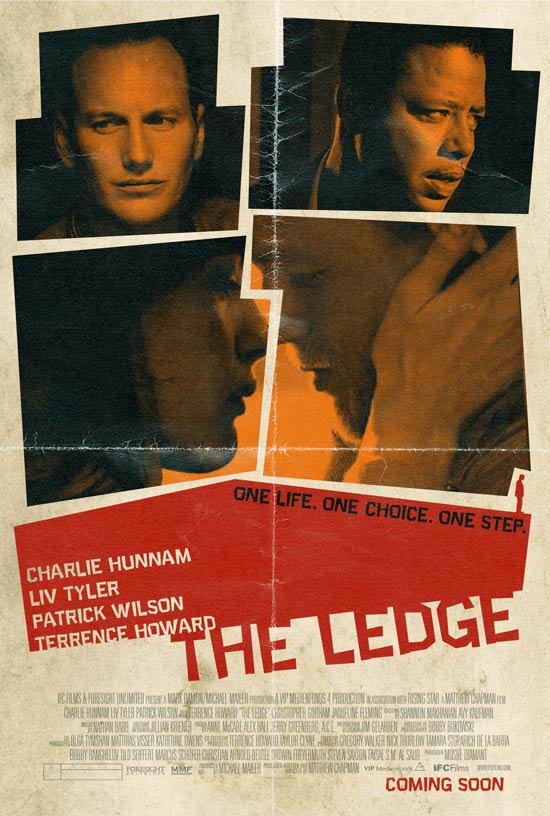
What does make it very satisfying, is to be able to stand back after it all, and recognize that the initial decision, the one to engage, was not just justified, but ours. It is that decision that makes a movie our movie. And it is that decision too, that I think allows a film to speak personally to a veiwer, to help them recognize that this film is not a corporate product, but something truly heartfelt. Writer/Director of THE LEDGE (currently in theaters) Matthew Chapman guests today, and captures that feeling perfectly.
My film, “The Ledge” has been out in theaters for a week, on VOD and iTunes for a little longer. It’s the story of an atheist forced to choose between his own life and someone else’s. It’s a a suspenseful thriller with an internal debate that’s pissed off a lot of people, among them Bill Donohue of The Catholic League. It’s the first film I’ve made in 20 years, and here are some of my thoughts about coming back.
I took my daughter on a ghost train. When it finished, she said, “That was horrible – let’s go again.” This is how I feel about making movies. After forty or fifty long hard days in a row, you say to yourself, “I can’t wait for this to end.” A few days later, you start thinking, “I want to go back and this time do it right.” I stopped directing twenty years ago. I wanted to see my child’s first year of life and knew if I was directing I wouldn’t. I fell into a lucrative groove as a screenwriter and came back to directing only when she was grown up. I look at my movies from before this paternity leave and see the work of a stranger.
By 2008, I’d written two well-received non-fiction books and enjoyed a simple and direct relationship with two literary editors. When it came to writing screenplays, things became harder. No one in the development process was exactly wrong, but they couldn’t all be right. Taking notes from so many people flattened everything. For every risk I took with character, someone would say, “But I’d never do that.” “Quite likely so,” I’d think, “but I would.” Characters became less interesting, so plot became less interesting. I generalize, of course; I had many happy creative relationships, in and out of the studio system, but they occurred despite the system rather than because of it: someone was brave enough to take charge – a strong producer, director, or executive. But as the studios made more tent poles, there was less work and confidence and courage became rarer.
A good script of mine became such a bad movie I took a plane to Belem at the mouth of the Amazon, got on a boat, and headed upriver to avoid the shit I knew would undeservedly fly my way when it opened. One day in a hammock watching Manaus go by, I decided to go back to directing. I was proud of my books, but not of my movies. From now on, if anyone was going to fuck up my writing, I’d fuck it up myself. As much as possible I’d do it on my own terms: for a start, I’d write a script that most likely no one would make because it would reflect who I am (a member of one of the most reviled minorities in America), but I’d enjoy writing it, and if it failed to come alive as a movie, I could at least say, as I could say of my two books, “This is mine.” I realize that to admit defeat before you start is not the American way, but it was liberating.
A poll of American voters found that while 72% would consider voting for a Mormon presidential candidate, 55% for a gay candidate, only 45% (the lowest score out of all the categories) would consider voting for an atheist. Why you’d vote for someone who is credulous enough to believe the peculiarities of the Mormon faith, but feel uneasy about someone who simply requires a little proof before believing stuff seems strange to me, but then I am an atheist.
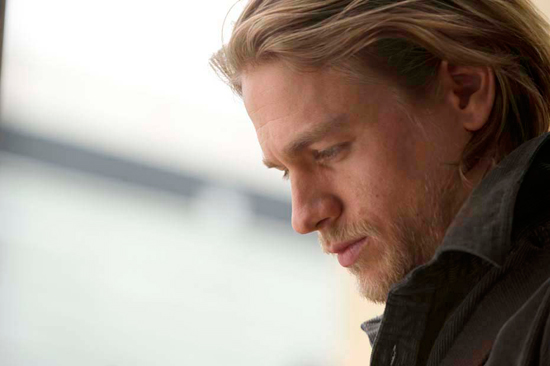
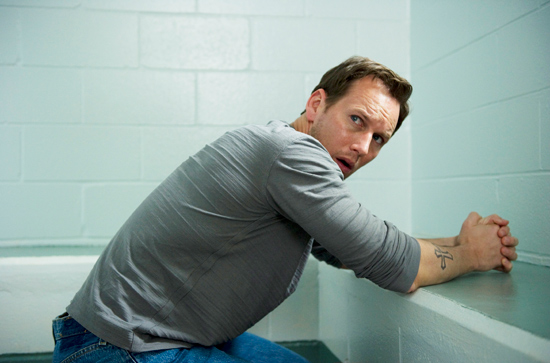
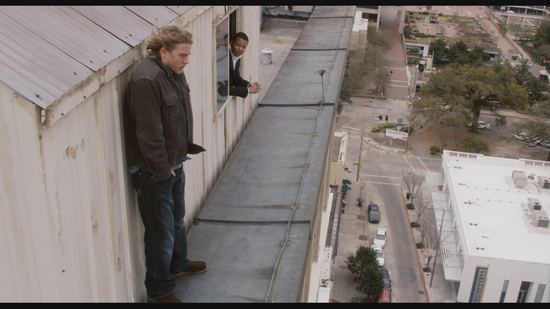
I decided to write a film about an atheist who comes in conflict with a fundamentalist with dire consequences. I wrote it in a form I’m comfortable with, the thriller. The story was stimulated by research trips I’d made for my books. These journeys were in large part explorations of the religious gut of America, forays into heartland beliefs. The fundamentalist (played by Patrick Wilson), is a man I have met many, many times. You don’t find him much in LA or New York, but you find him everywhere else. He’ll tell you that eight ninths of the world’s population, over five billion people, are going to burn in hell for all eternity and that you’re one of them – then he’ll smile pleasantly and ask if you’d like another cup of coffee. Spectacular acceptance of spectacular violence. His wife (played by Liv Tyler) is based on a woman I met in Tennessee who’d taken some beatings, sought comfort in a protective religious marriage, but now found it oppressive. The cop who tries to talk Charlie’s character off the titular ledge is a cross between a New York man and my father, who, like Terrence’s character, raised a child of adultery. The atheist (played by Charlie Hunnam) is based on me. His philosophical views, his past suffering, his mixture of insolence and (I like to think) charm are me. Charlie’s gay room mate (played by Christopher Gorham) is an amalgam of my uncle and his male partner who have been together for five decades and were the best example of a relationship that existed in my childhood. (The film is dedicated to them.)
Accepting defeat from the start, I wrote what I wanted. An often obnoxious, overly seductive atheist? Great! Seven pages of dialogue about faith? Fuck it, why not? An unpopular philosophical viewpoint? An unhappy ending? Who cares, no one was going to see it anyhow.
When the script was finished, it was good enough to attract two wonderful producers and the above actors, and to my great surprise, I suddenly found myself back on the ghost train. After a short but exhausting shoot, I was glad to step off. But now that it’s over, I already want to get back on. I had a wonderful cinematographer, Bobby Bukowski. All the actors were great. Liv Tyler is a revelation: her performance is the birth of a woman cinema actor who will go on working for as long as she wants. Patrick Wilson is, as always, brilliant. In my view he’ll eventually be judged one of America’s enduring greats. Terrence is marvelous. So is Charlie. The film was selected for Sundance to compete in Best US Drama.
In all the screenings I’ve been to, I’ve never seen anyone walk out of the theater except to go to the bathroom. I’ve had emails from people who have changed their views because of the movie. There have been reconciliations between believers and their gay relatives. Atheists from across America have written to thank me and spoken of what it’s like to be a non-believer in America, how hard it is to come out of the closet in communities dominated by religion. Women have written to say how they have been married to men like Joe, the fundamentalist, and how inspiring Liv’s character is to them. A mention of the film on CNN.com engendered over 5000 comments, atheists and believers debating faith. This was so unusual, I was asked to go on CNN myself to talk about atheism and “The Ledge”.
But mainstream critics have largely been in agreement with Bill Donohue of the Catholic League, and not liked the film. I expected this. If 4% of Americans are atheist that means 96% are not and 84% are definitively not! The film does not just attack Christianity, it attacks the whole concept of faith. These are sensitive matters and there’s no reason to imagine critics defy religious statistics to any great degree. Much of their and Bill Donohue’s criticism is focused on the character of Joe, the fundamentalist in my movie. Many of the critics could not believe in a character with such extreme religious views. I know from personal experience (backed up by many comments and emails from people who live away from the coasts and know many people like Joe) that this criticism is just ignorance. Statistics about the Old Testament bent of Christianity in America clearly show that men like Joe are terrifyingly common. Coastal snobbery relegates them to the powerless, irrelevant category of “white trash”, a cartoonish sub-species therefore less real, therefore less frightening. When someone from this category is then portrayed, he is, by circular logic, “cartoonish”, unreal, unbelievable. Of course, few people go around the interior of America asking people what they believe and how fervently. Because of my two books – both dealing with the battle between faith and science – I have done this, and what I found was that people like Joe are not white trash, they’re very human, very wounded, and often very intelligent.
The irony of the release of “The Ledge” is that it is opening theatrically in the two cities in America least likely to appreciate or benefit from it. Religion is not a great force in New York or Los Angeles. The towns that would really understand it are the ones in the middle. It’s great that it’s coming out on VOD and via iTunes and Sundance Now. It is from people who live in the middle of the country who have seen it via these other means that I am getting the most passionate responses, but it’s not the same as a theatrical opening where local media are forced to cover it and debates break out outside the movie theater, in the bars, cafes, and churches.
Has negative criticism depressed me? A little. Has the almost unprecedented debate that’s broken out as a result of the movie made me proud? Very much so. Have the positive, often tearful reactions of atheists, agnostics, abused women, gay people, and young people looking for a new way to live given me joy? More than I can express.
If you asked me “Are you happy with the film?” I’d say “Yes.” I shot it in 20 days and only had a day of rehearsal, but, imperfect as it is, “The Ledge” is a pretty true reflection of who I am. It is, as far as anything can be that’s a result of such a collaborative process, mine. This is the beauty of independent film.
The Ledge is now playing at the IFC Center in New York, and at the Sunset 5 in Los Angeles. For further details visit www.ledgemovie.com
BIO: Matthew Chapman has directed several indie films and written or co-written several screenplays including “Consenting Adults” and “Runaway Jury.” He has also written two non-fiction books, “Trials Of The Monkey – An Accidental Memoir,” and “40 Days and 40 Nights – Darwin, Intelligent Design, God, OxyContin, and Other Oddities On Trial In Pennsylvania.” He is the President and co-founder of ScienceDebate.org, an organization trying to get the presidential candidates to hold a debate on science.
If Indie Film had a person of the year, it would be Kickstarter this year. It’s given more movies the needed boost than anyone else this year (as today’s earlier post can attest.
Thanks to Dan McGuire for the tip on this!
One of my top motivations to make movies was to change the world. It still is true today. Often when I tell people that I want to make movies that either change the world, change cinema, or finance those revolutions, they often think I am joking. But I am quite sincere. To sort of quote the legendary producer Walter Wanger “Film is the world’s ambassador.”
I was not surprisingly thrilled to get Peter Broderick’s latest newsletter, and to find it not just on this subject, but with real info precisely on films that HAVE CHANGED THE WORLD. Peter has kindly agreed to allow me to share it here with you, provided you all NOW sign up for Peter’s Distribution Bulletin, here.
SPECIAL REPORT: HOW FILMS CAN CHANGE THE WORLD
Three new studies assessing the impacts of An Inconvenient Truth, The End of The Line, and Waiting For “Superman” finally prove Sam Goldwyn wrong. The Hollywood mogul famously declared, “If you want to send a message, use Western Union.” These reports highlight the real world results these films sparked and provide a new framework for evaluating the impacts of documentaries and features.
In the past, there was little research or rigorous analysis of powerful films such as Fahrenheit 9/11, Sicko, Super Size Me, and Food, Inc. Instead they were evaluated primarily on anecdotal information and subjective impressions. The appearance of these three new studies finally provides the research and analysis filmmakers need to better understand how to ignite social change.
An Inconvenient Truth, The End of The Line, and Waiting For “Superman” were each made to avert a looming crisis: global warming, the collapse of the world’s fisheries, and the failure of America’s public education system.
This Special Report includes exclusive coverage of the studies of An Inconvenient Truth and Waiting For “Superman,” along with a concise analysis of The End of The Line report.
THE END OF THE LINE – A Social Impact Evaluation
This exemplary report documents the significant changes The End of The Line produced, highlights the importance of brand partnerships, and provides useful lessons concerning social media and coordination with partners.
The film was described by The Economist as “the Inconvenient Truth about the impact of overfishing on the world’s oceans.” Produced in the UK by the invaluable Channel 4 BRITDOC Foundation and financed by the Esmee Fairbairn Foundation, this beautifully designed report is the product of an 18-month study, which used qualitative and quantitative analysis, focus groups, and media analysis. It concludes that the film had a major impact on public awareness of overfishing–directly on viewers and indirectly on nonviewers through the huge amount of press it generated. The report estimates that the PR value of this media coverage was £4,186,710, more than four times the budget of the film.
The study also concludes that the film helped create “a tipping point in corporate policy” that spurred a number of corporations to switch to sustainable sources of fish. The upscale grocery chain Waitrose sponsored the film’s release and promoted it in their stores, giving customers postcards about film and the importance of buying sustainable fish. The classy Prêt A Manger chain of sandwich shops totally changed its fish buying policy after its founder saw the film.
When I interviewed the visionary Jess Search (CEO of BRITDOC and co-creator of the report with her colleague Beadie Finzi) about the report, she shared her belief that businesses are “engines of change.” Top-down change (requiring legislation and/or elections) and bottom-up change (requiring widespread grassroots involvement) are very difficult to achieve, but if you can persuade corporate decision-makers that the change you are seeking is in their interest, hundreds of thousands of consumers can be affected.
The study features a brilliant graphic that illustrates the complementary and interlocking partnerships filmmakers need to build with foundations and philanthropists, NGOs and advocates, policymakers, the media and brands. The report shows how much difference a film can make – expanding public awareness of an urgent issue, changing consumer behavior, altering corporate policy, and providing advocates with an effective tool.
To read the rest of Peter Broderick’s Special Report visit here.
© 2011 Peter Broderick
Peter Broderick is a Distribution Strategist who helps design and implement customized plans to maximize revenues for independent films. He is also a leading advocate of crowdfunding and crowdsourcing, championing them in keynotes and presentations around the world. You can read his articles at www.peterbroderick.com
Categories
What Is The Future Of The Film?
On Tuesday last week Brian Newman and I conducted a conversation on the topic of “The Future Of Film” at the Karlovy Vary International Film Festival. I had an extra shot of espresso and we spoke for over an hour. You can re-live 8 minutes of it and see just how revved up I can get on this topic. There’s a lot more to say about this subject. Brian said some of that here.
Today marks the first anniversary of Harvey Pekar’s death. Very few people have had as great an influence on my life as Harvey. I was very fortunate to be able to collaborate with him and bring AMERICAN SPLENDOR to the screen.
I was thrilled to be approached by Seth Kushner about his current tribute to Harvey. I offer you a glimpse of it here.
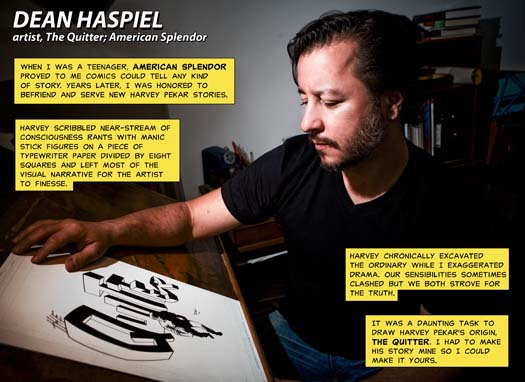
CulturePOP Photocomix was born out of Seth Kushner’s desire to fuse his love of photojournalism, personality profile, and comix into a wholly unique form. Through this prism, Kushner has profiled such diverse personalities as toy designer Super Sucklord, author Douglas Rushkoff, comedian/musician Reggie Watts, artist Cynthia Von Buhler and auto-bio comix pioneer, American Splendor’s Harvey Pekar, on the one-year anniversary of his death.
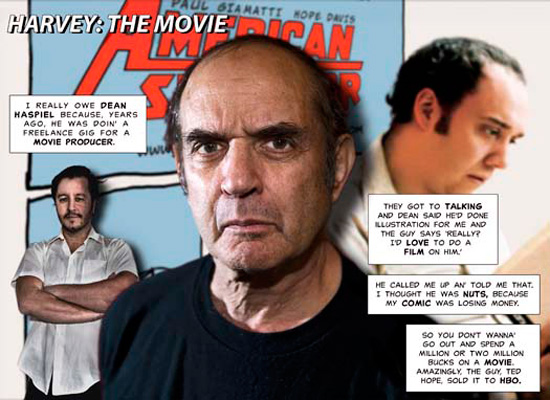
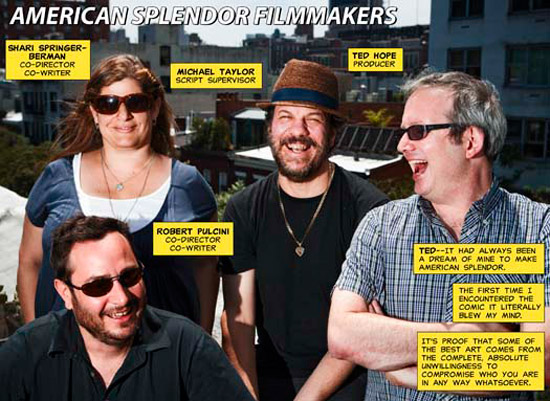
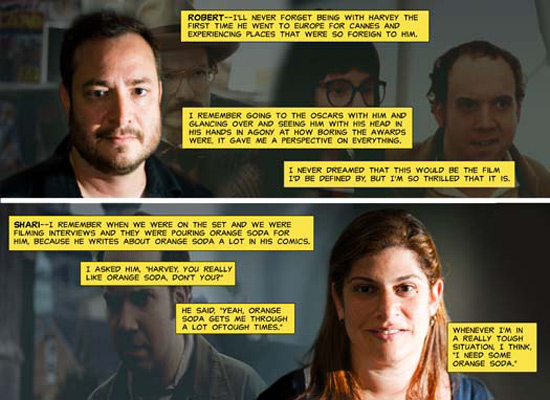
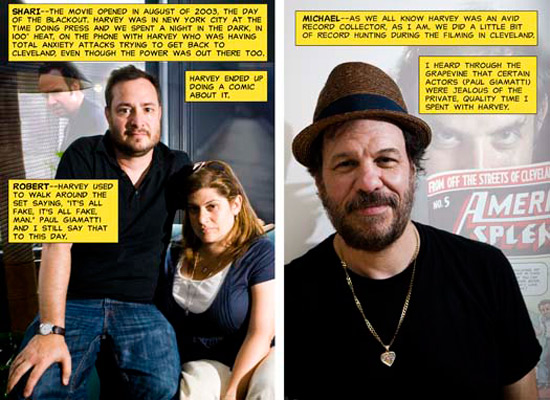
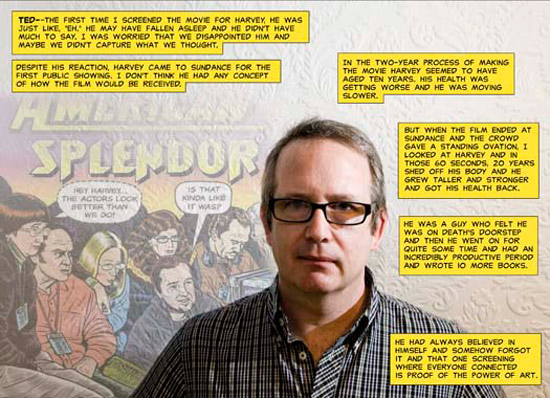
Read the whole thing right here.
Seth Kushner — shoots portraits for such publications The New York Times Magazine, Time, Newsweek, Businessweek, L’Uomo Vogue and others. Seth’s first book, The Brooklynites, was published by powerHouse Books in 2007. Currently, he’s working on his next book Leaping Tall Buildings: The Origins of American Comic Books, coming March 2011. www.SethKushner.com
“If there’s one thing the file-sharing wars have taught us, it’s that there’s more profit in figuring out how to let honest people do the right thing than there is in chasing down cheapskates who don’t want to pay up – especially when the anti-cheapskate measures make life miserable for the honest cits,” so says Cory Doctorow, and he’s come up with an interesting way to encourage fan merch of On Demand Objects (ODO), while making life simpler & better from those that inspire the action (generally the copyright holder).
Definitely read Cory’s whole article, as it has great implications for filmmakers looking to extend their universe beyond a single product (i.e. film) or wanting to encourage collaboration among the community, but in a nutshell, Doctrow lays it out:
what if there was a mark that indicated that the creator hadn’t endorsed a product, but was still splitting the take with the upstream licensor. For example, if you wanted to make your own 3D modelled action figures derived from one of my novels and offer them for sale, you wouldn’t need to get my permission – you could just add the ‘‘no endorsement’’ mark to the product and send me a fixed percentage of the gross. Ideally, this would be a high percentage without being punitive, say 25%.
Here’s how that could work: tens, hundreds or thousands of fans with interesting ideas for commercially adapting my works could create as many products as they could imagine and offer them for sale through i.Materialise or Shapeways. There’s no cost – apart from time – associated with this step. No one has to guess how many of these products the market will demand and produce and warehouse them in anticipation of demand. Each product bears the ‘‘no endorsement’’ mark, which tells you, the buyer, that I haven’t reviewed or approved of the product, and if it’s tasteless or stupid or ugly, it’s no reflection of my own ideas. This relieves me of the duty to bless or damn the enthusiastic creations of my fans.
But it also cuts me in for a piece of the action should a fan hit on a win. If your action figure hits the jackpot and generates lots of orders, I get paid, too. At any time, we have the option of renegotiating the deal: ‘‘You’re selling so many of these things, why don’t we knock my take back to ten percent and see if we can’t get more customers in the door?’’ Setting the initial royalty high creates an incentive to come to me for a better deal for really successful projects.
