Categories
Truly Free Film

Jennifer Lawrence Does Not Want To Be In Your Movie: Lessons Learned Casting Our Microbudget Feature

By Scott K. Foley and Josh Rosenberg

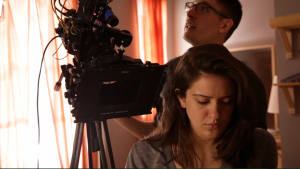
Maya and DP Joe Fitz

When we set out to cast our microbudget feature, Jessica, we were certain we’d be able to quickly find an up-and-coming actress to star. I mean we’d written a script about a complicated and conflicted character, the kind of breakout-caliber role that actors dream about, and one that with a bit of luck would propel their careers, all of our careers, to the next level. What we didn’t know was how, as first time and microbudget filmmakers, we’d be expending an enormous amount of time and energy trying to get past the gatekeepers and how some much appreciated tough-love advice from an unexpected source would finally allow us to move forward and start making our movie.

Categories
Truly Free Film

Ye Olde Complete Guide to Formats

by Andrew Einspruch

Filmmaker Andrew Einspruch recently attended the Australian International Documentary Conference and wrote a series of articles for the event, which he’s graciously allowed us to reprint here. These articles originally appeared in Screen Hub, the daily online newspaper for Australian film and television professionals.

You’d already know that formats are all over your TV screen. From Big Brotherto Who Wants to Be Millionaire to Go Back to Where You Came From, formats (shows with “a framework which contains several clearly described elements that are combined in a unique way”) are TV mainstays. What you might not know is that worldwide in 2009, formats generated production worth € 9.3 billion (that’s with a “b”), or $11.8 billion. And that amount would only have gone up since then.

Patty Geneste knows a thing or two about formats. Her company, Absolutely Independent, has won several international awards for the formats it represents, and she sits on the board of the Format Recognition and Protection Association (FRAPA). So she brought lots of expertise to her AIDC session on dealmaking.

The first formats were gameshows, like Wheel of Fortune and Jeopardy. Next came light entertainment, like You Bet or Honeymoon Quiz. Today, formats cover a wide range of styles, from factual entertainment to scripted or constructed reality, from observational documentary to comedy drama. Shows that are formats are often not obviously so. The drama Homeland, for example, was an Israeli format sold into the US.

Categories
These Are Those Things

“ADRIFT”: Video Love Poem To San Francisco (And Commitment And Uniqueness And Artistry)

Do you have enough beauty in your life?  Do you need something to make you feel that life is worth living?  That you are fortunate to be on this planet? That it is a gift to see and experience these things?  If so, you may need a prescription for beauty.

Have you learned to foster a deep appreciation for the strange and wonderful? Do you know how to have confidence in your least shared desires?  Can you feel that warm surge for the thing that others may instinctively turn away from?  If you are missing such pleasures, you need to develop a practice that celebrates difference a little more.  You need a course in Fog Appreciation 101.

Do you know what it is like to use your labor, intellect, passion, and creativity in service of something greater than yourself?  When you look at the things around you, do you see representations of your commitment or that of others?  Are you inspired by the displays of similar commitment in the work and accomplishments of others?  I believe that if you can, if you do, you too will do more with the gifts and opportunities before you.  Learn to look at the labor encased in the thing that you admire.

It is on these lines that I was inspired by Simon Christen’s short and gorgeous video “ADRIFT”.  Granted, I was well prepped for it.  I have been living in San Francisco for less than a year.  I am still awestruck by the action of fog.  And the play of fog with the rest that this land has to offer.  Part of the pleasure for me too, was in watching, considering the commitment that Simon must have had to make this movie for us.  Thank you Simon.

And before you watch it perhaps you should consider what these feelings I described above would be worth for you.  Think about a reverse crowdfunding campaign, where if you knew someone would deliver these feelings and thoughts to you what you would be willing to pay.  Think about if you knew someone would have to hike regularly in the cold and in the wet in the early morning hours and then afterwards sort through the results, painstakingly come to know them intimately, aligning them next to each other to such an extent that the beauty maybe started to diminish and the artist behind them might question whether all those days and hours were truly worth it, would they ever get to a point where someone would say “Yeah, that was worth a dollar of my time.”  How can we say loudly “Yes, Simon, thank you.”?  Luckily, Vimeo has a tip jar. Don’t forget it after you watch.


Adrift from Simon Christen on Vimeo.

Hat Tip to Ryan Heller for sending me the short!

Categories
Let's Make Better Films

One Week Left To Apply For A Fellowship In Paradise

Imagine one of the most beautiful places in the United States.  Give yourself a month there.  Imagine a private room designed by a great architect.  Add on a miles and miles of a private art park, kind of like Storm King in NY but with the work hidden and no one else to encounter in the woods.  Did I mention old growth forests?  Add that too.  Now sprinkle on a dozen artists of different disciplines.  Top it with a private chef. 

Would that be enough for you to apply for a screenwriting fellowship?

Categories
Truly Free Film

Diary of a Film Startup: Post # 31: Kinonation — Mistakes Made, Lessons Learned…

By Roger Jackson

Previously: Movie Live on VoD…Now What?

Ted Hope recently asked me to write about what we might have done differently at Kinonation with the benefit of a year’s hindsight. Mistakes made, lessons learned, what worked, what didn’t…

1. Big, Fat Assumptions

Most startups ventures are premised on one or more big, fat assumptions…which may or may not be accurate, even if you’re convinced they are. Kinonation is based on the assumptions that it’s really hard to get indie films widespread VoD distribution…and that there’s a huge backlog of films whose producers want help with this problem…and that the VoD outlets are actually interested in running indie films…and they have the audience to watch them.

Categories
Truly Free Film

Words Of Advice For The 80%: Getting To That SECOND Film

By Jennifer Phang

When Ted and I spoke about a possible post here, he mentioned that 80% of feature film directors never get to make a second feature.  Why is that?

One reason is that it’s difficult to sustain the momentum of a crew. You are creating a whole village around a project which has an indefinite, but definitely finite, lifetime. Morale starts high, because the act of creation is invigorating, and then people get exhausted, because it’s a gigantic process, and along the way the money runs out, because the village grows and every new villager brings new skills and also new needs. And somehow you have to sustain the discipline to find the beauty in every shot, but also the momentum to finish the film.

The first time is not exactly traumatizing, but it can feel catastrophic, especially if you set out with high ambitions. It’s possibly your one chance to

Categories
Truly Free Film

Making Money Under the Education Kanopy

by Andrew Einspruch

Filmmaker Andrew Einspruch recently attended the Australian International Documentary Conference and wrote a series of articles for the event, which he’s graciously allowed us to reprint here. These articles originally appeared in Screen Hub, the daily online newspaper for Australian film and television professionals.

The heretical statement came from Andrew Pike, MD of Ronin Films during a session called “Education Rights – Ensuring Profitability & Sustainability”. At the Australian International Documentary conference, dedicated primarily to making docos for television, Pike compared making TV doc to an extreme sport. “Like whitewater rafting, it is full of pitfalls. It is full of people shouting opinions at you about which direction you should go and how you should manage your affairs. It’s an area with a high adrenalin rush, and a lot of exhilaration. There’s high emotion when you get a pre-sale, and high emotion, despair, and doom when you get knocked back.”

By contrast, Pike called the education market the “unglamourous area of the film industry,” devoid of red carpets, billboards, bright lights, or posters with your name plastered all of them. “It is an area for worker bees,” he said. But worker bees can turn a profit.