Categories
Truly Free Film

Guest Post: Orly Ravid “Going to Market with Your Film, Cannes 2011”

Ah, it’s that time of year again. I just booked my travel at Cannes; of course I did it last minute. My love for the market is as great as my dislike, alas. The place is filled equally with hope as despair. The promise of wealth and discovery looms with every glass of Rose and Pernod — and I am not sure which causes my headaches more. That said, I am packing my bag, glad that once again I have a film playing in the official selection. I wish the first time I went I was armed with all the recommendations that regular contributor Orly Ravid has thought to offer us today.

TEN TIPS for FILMMAKERS
Going to Market or Seeking Distribution

Going to a festival / market such as Cannes is exciting. Wine is often cheaper than water. Almost anything you eat there tastes better than almost anything you’ll eat here, even though it is a tourist trap. Somehow, no matter how many carbs one eats, one usually still loses weight either because of the hustling and bustling or the fact that the French make their food lighter even when it’s rich and they don’t use preservatives when we do…. ahh France. But, I digress.

When searching for distribution at or in preparation for, a festival or market, be clear about your goal and the amount of responsibility you have to your investors. You should be conducting a lot of research before you ever hit the market floor to identify which companies will be a good fit for your film. Depending on your knowledge, experience, willingness to take responsibility and the type of film you have, it may be advantageous to sell your film on your own, or it may be better to use a sales agent. Much is entailed with selling a film in different territories and formats and if you do not have experience in doing so, you may be better off working with someone who does. I have some tips for you to follow regardless of how your film will be sold. The Film Collaborative can help filmmakers who have decided to handle their own sales by evaluating contracts and guiding them through the process without taking the filmmakers rights, but it does depend on the filmmaker’s willingness to actively solicit buyers in the first place. Attracting suitable buyers is a time consuming and costly process (travel, marketing, sales skills), so if you have no interest in doing this, it is better to delegate that work (and your rights) to a sales agent. Before signing on the dotted line with ANYONE, (sales agent or distributor) you will need:

1. REFERENCES: Get references, and then call or email the *other* filmmakers the company has worked with. I am only partly teasing. You should be able to find a list of current clients on their website and you can research contact details for those people. It’s great to contact the references actually given, but sometimes it gives a clearer picture to contact a few at random. You’ll be shocked by how useful this can be to either comfort you that you are doing the right deal or protect you from being stuck in a deal you should not have done. The Film Collaborative has set up a Distributor ReportCard (a sort of “Yelp of Indie Film Distribution”) to help in the research of this. Check out our Distripedia™ section on our website www.TheFilmCollaborative.org

2. CAP EXPENSES: Define and cap all recoupable expenses and evaluate those based on projections. Spending $30,000 – $50,000 – $75,000 – $250,000 ++ is not inherently bad or good. It depends on the upside and the reasoning. Be clear about what the expenses are for, how much is approved, and if you and 8, 10, or 12 other people are being charged back for the exact same bill. Let’s not let that happen. Are you paying for a party in Cannes? Maybe that is what is needed to attract buyers…just make sure that you are choosing to do so and that it makes sense. If the expenses are for distribution, have an idea about P&A budgets for different types of releases, the size of the release, the realistic projection of return and how long that return might take. The bigger the release (theatrical to many cities, large advertising spend, high cost publicists), the more expense is incurred and likely the longer it will take to recoup. And one should have a clear sense of the objectives and projections of the theatrical so one can properly analyze expenses.

3. RIGHTS vs RIGHT TO SELL RIGHTS: Distinguish between the right to represent the rights (example, traditional sales agency could choose to do vs taking all rights) and vs having rights to actually directly distribute (example a sales agency that takes all rights so that it can also then directly do digital distribution or a buyer who buys multi territories but then has other companies do the distribution in most of them, or a company that does not do its own theatrical or its own digital or its own DVD. Extra middlemen mean extra fees means less $$$ to you. You may want a company to have both and take care of it all for you and maybe it’s even the most advantageous deal because of relationships and best terms. Just know what the deal terms will be instead of realizing after the fact. This is especially critical when fees and expenses come into play. You may not want or need your sales agent to directly distribute to digital platforms if you can manage this yourself or they don’t end up even doing that in unsold territories but have your rights anyway, or maybe you do. And that brings me to another point about rights, don’t give any away that won’t be “exploited” as they say in the industry (that’s meant to be a nice thing). I.e. have rights revert back to you that are not properly handled and try to not give them away in the first place without knowing why it makes sense to. And I always like to carve out digital platforms a filmmaker can get onto that a sales agent or distributor does not want or choose to (in collaboration with the distributor or sales agent of course).

4. ACCOUNTING: Make sure you know when Accounting is due and when your corresponding payment is due. Try for QUARTERLY unless you don’t like money coming in at least 3 times a year since most will pay no sooner than 30 or 60 days after the end of the quarter. Semi-annual accounting is possibly acceptable later into a term if you have no choice.

5. AUDITING & ARBITRATION: Reasonable Auditing and Arbitration provisions are key so you can have a clear way of investigating. Know where the arbitration will be conducted. “Resolving a matter via arbitration may be less expensive and more expedient than having to sue the distributor, but an arbitration provision may also be less effective at encouraging the parties to compromise prior to invoking arbitration than the threat of a lawsuit,” says TFC’s legal counsel Cherie Song, an attorney at McGuireWoods LLP. Also, “a distributor should have an obligation to maintain records of all sales and rentals of the film, and give you the right to inspect such records at reasonable hours with prior notice,” she says. “If your audit finds an underpayment, the distributor should pay you the difference within 30 days of demand, and if the difference is more than 5%, the distributor should reimburse you for your auditing costs.”

6. TERMINATION: Also set parameters by which a deal can be terminated. Not suggesting this should be random and exploitive of the sales agents or distributor’s efforts, but should they be in breach or become insolvent, one needs a remedy if it’s not cured. “If the distributor fails to fulfill a material obligation (e.g., if the distributor fails to pay the MG or your share of “Gross Receipts”, fails to provide statements or fails to market or distribute the film within a certain time period following complete delivery) or files for bankruptcy, then you should have the right to terminate the agreement with notice, with the rights to the film in unsold territories immediately reverting to you,” Cherie recommends. “The distributor should also indemnify you for claims resulting from its breach of the agreement and violation of third party rights. Furthermore, the distributor’s payment and indemnity obligations should survive the expiration or earlier termination of the agreement.” And our capitalizing of “Gross Receipts” is on purpose. All terms that have any possible key meaning and affect your deal should be capitalized and DEFINED! Many thanks to Cherie for her impeccable services to our filmmakers overall.

7. MARKETING PLAN: In order to distinguish a knowledgeable and reputable distributor from one who is less so, ask for a detailed marketing plan. For filmmakers to be in the strongest negotiating positions on this, a marketing plan should have already been developed and implemented during production and a fan base already started. The distributor will simply be adding extra muscle to this plan, both in terms of financing and staff. If there is no previous plan, ask to see exact specifics on how the title will be handled in-house and the expenses associated with it before agreeing to a contract. This is of utmost importance as the success of your title depends on these efforts. Without a clear understanding of the strategy, you may find your title simply becomes part of a catalog passed along during markets or part of a library that is rarely exploited. The more effort a filmmaker makes in gathering an identifiable audience for their work, the more leverage he/she has because the film has provable potential.

8. BUILDING AN AUDIENCE YOURSELF: Intentionally putting a fine point on this topic! More and more distributors and sales agents are researching your title just as much as you are researching them. If you haven’t made any effort to build an audience, the perception is maybe there isn’t one. You should be looking at the sales agent/distributor relationship as a partnership not as a savior. This makes your film far more attractive to those companies because they can see the money making potential and their efforts will make the title a much stronger earner. Wouldn’t you want to have an edge up on getting a better deal or not even needing one if you had already built an audience around your film well in advance of your first premiere? I know I would. (And thanks to our social network marketing guru / strategist Sheri Candler who contributed to this blog and especially #7 & #8).

9. CARVE OUT SOME DIY: Whenever possible, carve out the ability to sell off your own site and also via your own social networking pages and via other key DIY platforms & solutions. We recently did a blog (April 2011) about these so feel free to check out that info via the TFC site.

10. SPLIT RIGHTS / BE AS DIRECT AS POSSIBLE: If there is one thing I cannot stand is big fees taken out for being in the middle of revenue and not doing much to justify the fee. If a distributor is direct to key retailers and key digital platforms and is doing all or most of the release directly great. But if a distributor is licensing your rights for a not-very-huge-fee and hiring someone else to do the theatrical (and recouping an extra fee expenses) and / or not direct with libraries and institutions (if relevant) and/or not direct with key retailers or digital platforms then why bother? Go direct. Be as direct as possible. Split rights as much as possible especially when there is little investment on the MG side and/or little theatrical P&A side that help justify the rights needed for recoupment.

In closing, I will again emphasize research, research, research. Don’t be lazy and then regret later. It may have been more difficult to do this as an average filmmaker previously, but it isn’t difficult now. Take responsibility for your work and the business of it. Ask around. Ask other filmmakers, other companies, Ask us. Ask at least 3 people any given question so you can get a sense of the real answer to the extent there is one.

Bon Chance!

— Orly Ravid

Orly Ravid has worked in film acquisitions / sales / direct distribution and festival programming for the last twelve years since moving to Los Angeles from home town Manhattan. In January 2010, Orly founded The Film Collaborative (TFC), the first non-profit devoted to film distribution of independent cinema. Orly runs TFC w/ her business partner, co-exec director Jeffrey Winter.

Categories
Truly Free Film

Guest Post: Hal Siegel “Virality And The Potential Of Social Films”

It is only through our communal efforts, and subsequent sharing of our processes, successes, and failures, that we will find a way for our creative work to find & build audiences, transform them into communities, and as a result build a new creative middle class that will able to support themselves through their creations, be they of widest, most diverse and ambitious forms, styles, and content. That’s the desire right?

I was thrilled to come across Hal Siegel’s “social film” HIM, HER, AND THEM. I immediately wrote to him and asked if he would share it’s inspiration with all of you. He agreed to guest post today. Here’s hoping that this is just one of many posts to come from Hal.

The idea of something “going viral” has shifted in our collective conscious from the realm of biology to that of marketing. But unless the subject concerns puppies and kittens, the idea of content specifically designed with virality in mind seems to conjur spooky, Orwellian images of mind control and manipulation. I think it is time to move beyond these preconceptions. Let’s not forget that, from the right perspective, people too can be seen as a viral system: not a plague, but life. And for that matter, so can a film.

First, for the purpose of context, a brief personal history: I ran a small interactive agency for about ten years. For a while it was interesting and profitable, and then for a time it wasn’t interesting but was still profitable, and then finally it wasn’t interesting or profitable. To borrow from the Chinese: double unhappiness.

During that last phase, mostly out of frustration, my business partner and I talked our way into doing some unremarkable commercial video work. And here’s the thing: literally, within five minutes of the first day on set, I was hooked. I loved it. Everything about it. (Full disclosure: getting up the nerve to do this was made a lot easier by the fact that a very good friend of ours was a successful and well-regarded Director of Photography). And so I thought to myself: Fuck. I chose the wrong career. I’m a thirty-eight year old creative director with a wife and daughter and there is no way I can start over again as a film director.

Or could I? Right around the same time, innovative interactive video projects like The Wilderness Downtown and Collapsus were starting to appear. Experimental directors like Radical Friend were doing really interesting, clever things. I looked at projects like these and thought: that is exactly the kind of stuff I wish we were doing. So we started working and brainstorming. We began by thinking about interactivity and Transmedia. But the real “aha” moment came for us when we started to talk about distribution. At some point one of us said something like: well, we could always release it on Facebook. And then we thought: well, what if we integrate it into Facebook?

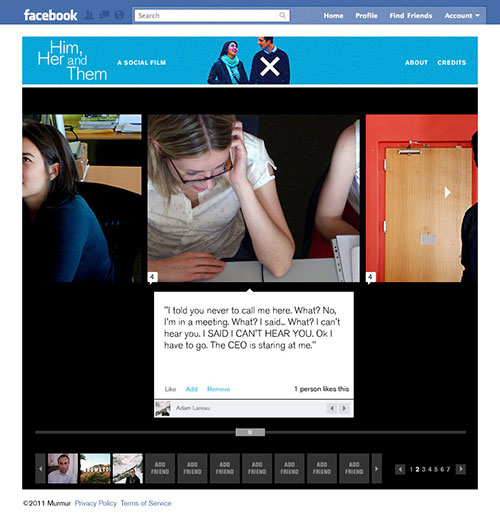
That was about a year ago. Him, Her and Them was released as a Facebook app in April. We refer to it as a “social film”, in that it is a combination of a traditional cinematic narrative blended with social media functionality. You can add friends (from your social network) and you and your friends can add to the story via simple text additions–much like the way that comments work. Him, Her and Them has a beginning, a middle and end, but viewers are able to make subtle changes to it along the way. You can watch the film here.

Then there’s the sharing. With a traditional video, you have one opportunity to share it—when you’re done. You watch it and, if you like it, you post it to Facebook or Twitter or your blog. Done. But now, with HH&T, every time you add to it is a point for sharing. With this, we’ve increased the potential virality exponentially. And this is just one type of interaction.

Since the release, we’ve come to think of HH&T as a “proto-social film” because it really just scratches the surface of what’s possible. Our thinking has naturally evolved since we began, and it’s fair to say that the next projects we have planned will bare little to no resemblance to Him, Her and Them. So what’s next for Murmur and social films? Naturally we are taking a hard look at social/casual games (Cityville, Farmville, etc) but also user-generated content sites and apps like Threadless and Polyvore. There is a lot here to consider. A few key insights:

  • Virality has to be built in. It’s no longer enough to base the notion of virality merely on the quality of the product. That may sound like heresy to some, but production costs for creating a pretty good looking film are cratering. There is simply too much out there of at least decent quality. Him, Her and Them had over five thousand viewers in two weeks and is growing regularly. Our marketing budget was zero dollars. Sure, some of it was due to novelty, but quite a bit was also based on the way it was designed. And here’s the thing: we didn’t make it nearly viral enough.
  • Social Loops:These two words are beginning to keep me up late into the night. I find myself lying in bed, staring at the ceiling thinking “how can we build in a social loop around that part of the story?” Social loops are the engine that power virality, social games and social media. If you are going to get serious about increasing the size of your audience via social media, then you need to have an understanding of social loops.
  • Gamification:SXSW was all abuzz about gamification. Game play is clearly going to be a major influence on all kinds of entertainment and is going to start popping up in all sorts of weird places. Here’s our take on it: Yes, we plan to draw on game-type mechanics, but that said, our goal is to not make it feel like a game. Also, here’s a thought that might be worthy of its own post: most movies are like games that you simply play in your head. I’m not just talking about sc-fi or mysteries. Your basic romance is a puzzle with two pieces: will they or won’t they? you have to watch to find out (and of course you have to actually care about the characters to want to “play” in the first place. It still comes back to story).
  • A software business model: If it’s not obvious by now, it should come as no surprise that we plan on embracing the “Freemium” model (as in a free “lite” version and paid “full” version) utilized by software and games. Then we will extend it via virtual goods and other “add ons”.
    Finally, For those of you readers who are sitting there shaking your head in consternation, I will say this: you are right to think that virality or social loops will not improve the quality of your film. Only a better story will do that. But what virality can do is significantly increase the size of your audience and, potentially, the money you earn. I believe that there is tremendous potential for social films, but that’s where we’re at. Potential. Will it be realized? Stay tuned.
  • Oh, and beware: like the transmedia movement, a social film is a complicated affair. It involves nothing less than all the traditional elements of filmmaking plus the production aspects of software development: user interface design, usability testing, programming, quality-assurance and more. Hey, I never promised you a rose garden.

    — Hal Siegel

    Hal Siegel is a partner in Murmur, a hybrid studio/technology company that creates and distributes social films. He wrote and directed Him, Her and Them.

    Categories
    Truly Free Film

    Guest Post: Ava DuVernay “What Color is Indie?”

    Back in January I heard of Ava DuVernay for the first time when the NYTimes ran a story on her new distro initiative. I thought “wow, there’s a good idea, that can be replicated in many forms.” It lifted my spirits, but then the assault of super-abundance of everything pulled my attention elsewhere. Recently, my attention got pulled back when a Twitter conversation turned it to the overtly white male dominance of the “indie scene”. Fortunately, I was put in touch with Ava, and she guest posts today with some of experiences in DIWO distribution.

    My name is Ava DuVernay and I just completed a 7-week theatrical release of my film I WILL FOLLOW in 20 major US cities, including NY and LA, without studio or corporate backing and no formal P&A. The release was accomplished through AFFRM, a black film distribution collective that I founded. Have you heard of us?

    
I may incorrectly assume that most of Ted’s readers have never heard of AFFRM, or I WILL FOLLOW, or the excellent black film orgs that make up the African-American Film Festival Releasing Movement — for which AFFRM stands.

    Why do I think that? Because we haven’t cracked that American indie establishment circle. You know, the Tribeca-Indiewire-IFP-FilmIndependent-SXSW-Lincoln Center of it all. The gate-keepers to the mainstream indie treasures. We haven’t had their attention. So we might’ve slipped by you.

    It’s weird. Some new group pulls off an $11,235 per screen full-run simultaneously in multiple cities with absolutely no formal P&A, no four-walling, no touring, no service deal on their first try, and enterprising filmmakers and film pros don’t want the skinny on how? Maybe you just hadn’t heard. We’ve had full features in NY Times, LA Times, CNN, NPR and USA Today, but not one inquiry from the many DIY, DIWO, new distribution panel programmers or experts? The circle is tight.

    With AFFRM, we sought to take the DIWO approach a step further, to give it infrastructure and branding. To align like-minded regional black film organizations and push them to go beyond their existing mission, to a renewed vision with national reach. It worked. Like, really worked. And we’re anxious to share what we learned, and to learn from others. But if you only get your news, views and film picks from the circle, you don’t know about us – and others like us.

    My point is… you’re missing stuff. Many lovely films, many talented filmmakers and maybe a new idea to add to the discussion on how to move film distribution forward without corporate permission. I’ve been astonished by how many black filmmakers and film pros have approached us in the last few weeks about how we did what we did. Several dozen. And further astonished by how many of my non-black counterparts have approached. Zero.

    Makes me think, what color is indie? I mean, what does it take to be of color and truly considered authentic American indie? To have done something seen as meaningful to the circle of the American independent film establishment, both artistically and as a business model. Like, if I don’t participate in what a good pal calls “white people festivals”… am I indie enough? Do you take my film as seriously because I chose to world premiere at Urbanworld in NY instead of submitting to Tribeca? If I don’t run my film through the labs or diversity initiatives of a recognized institution… do I not have that cool indie cred you need to see my movie with its beautiful black cast? I wonder.

    I understand wanting your indie film product of color vetted through the proper channels. I get it. But just be aware that that is what you’re doing. Be aware that your indie is handpicked by a select few. And be clear that your indie is very white boy in view. Not a bad thing. White boys like all kinds of cool stuff – other white boys, white girls and the occasional thing of color that speaks to their sensibilities as white boys. But be real, that’s limited.

    It limits you from hearing new marketing and distribution ideas, meeting filmmakers and experiencing films outside of this establishment construct, outside of the circle. You’re missing some good new stuff and ignoring success stories from many folks of color (See: I Will Follow or Mooz-Lum) or are by folks who are just downright colorful (See: Audrey Ewell’s Until The Light Takes Us and Bob Ray’s Total Badass). It’s not progressive. And it isn’t what I feel most people who love, support and live indie film really want. I don’t think its purposeful hateration. I think its just this lull of curation and prestige and, to be quite honest, laziness. Whatever it is… its affecting the whole business. And its far from positive.

    If these statements makes you proclaim that I’m trippin’ and “there IS no circle”– then I’m happy that I’m not talking to you. Really am. Thrilled, in fact. And I invite you to see my film about a grieving black woman shot in Topanga Canyon that Roger Ebert called “one of the best films he’s seen about the death of a loved one.” You’re just my kind of audience member.

    If on the other hand, these statements coax you to admit that you haven’t gone to a non-establishment fest or seen a film not featured in Filmmaker Magazine in years, then I invite you to step outside and take a look. Be like a couple of folks at Sundance Institute who’ve reached out to us to share and compare notes. Or the folks that head up RiverRun where I was invited to sit on the jury a few weeks back. Those RiverRun people take their mission of inclusion seriously, working to connect with the black community in Winston-Salem by leaping out of theoretical planning meetings and into bold action. They presented a special festival panel at the local historically black college this year, on which I was pleased to participate. I wondered if it was the first foray of a non-ethnic film festival at an HBCU? First I’m aware of. It was super impressive. And its what we all need to be thinking about.

    Bottom line: It would benefit us all to be conversing and connecting. It’s not too late to break the boundaries of what you think this thing called indie should be, should look like. For instance, I dig that Indiewire, after years of really poor connection with black independent cinema at large, has wooed the wonderful team at ShadowandAct.com to be part of its blog network. It’s a step in the right direction for iW amidst an ongoing, challenging lack of coverage of black fests and black and brown indies on the main site.
    
This post is not meant to be a ball buster but a spirited call-to-action. There are new ideas, new paths for distribution, new films and filmmakers you’re missing if you only look from inside. There are riches in the niches. Both monetary and cosmic. Heck, you love indie film! You care about its future! So why not step outside and look around? Its nice out.

    Here’s the opening weekend video of the thousands and thousands and thousands of people who came out to AFFRM’s inaugural release for I WILL FOLLOW in March. Quite a spectacle that you may not have seen or heard about. But now… you know.

    Thanks for the invite, Ted.

    — Ava DuVernay

    VIDEO: http://www.youtube.com/watch?v=GOiuV6uYvas

    Ava DuVernay is a filmmaker and film distributor from Los Angeles, California.  Her Twitter is @AVADVA. More on AFFRM at www.affrm.com. More on I WILL FOLLOW at www.iwillfollowfilm.com.

    Categories
    Truly Free Film

    Guest Post: Christopher Boghosian “Los Angeles Won’t Make Your Movie!”

    Last Friday, Rosen & Bennett offered up some first feature advice: go home. Today Christopher “I Am A Nobody Filmmaker” Boghosian comes to a very similar conclusion after spending some time knocking around Los Angeles. His last post generated quite a lot of buzz. Wonder if you fellow LA residents feel like wise?

    Moving to Los Angeles just might be the worst decision a filmmaker can make. Whereas the city is arguably the best place to break into the studio system, LA is quite adverse to independents like me.

    Life is tough in LA. Its high cost of living demands a well-paying job, while filmmaking requires flexibility, but the two rarely go together. Finding and keeping the “perfect” job becomes a job in itself. Even if you’re well-off, the congestion and state of atrophy in LA is sure to zap your creative energy. Everything takes longer; a couple errands can easily consume your entire day. And because everyone is in each other’s way, anger and resentment runs rampant in lines, stores, and, yes, especially traffic. Keeping the optimism and energy needed to make a film becomes an emotional challenge few conquer. In LA, the struggle to survive while creating quickly turns into the struggle to create while surviving.

    To make matters worse, aspiring filmmakers are nothing special in LA. In fact, we’re a nuisance. Did you know it’s a misdemeanor to film in LA without a pricey permit? Yup – you can end up in jail with shoplifters and prostitutes. Whereas the city bends over backwards for big budget movies, it seeks to foil and defeat micro-budget projects. People like me, trying to make a movie for virtually nothing are viewed as pariahs, beggars and wannabes. Sure, there may be that rare person who supports our “passion,” but most are tired and resentful of the inconvenience. Even mom-and-pop storeowners have become savvy, demanding hundreds, if not thousands of dollars for the use of their little store.

    Filmmakers might argue that LA is abundant in resources. That may be true, but resources cost money. What good is knowing a production sound mixer if you can’t afford her reduced rate of $250/day? And what good are all the actors if the talented ones don’t audition for your no-name, low-paying project?
    Sometimes I suspect moving to LA is one big diversion. It seems productive and necessary for one’s filmmaking career; however, it just might be another distraction from the blank screen, a costly game of solitaire. It’s easy to be fooled; the move feels productive: packing and driving; buying furniture and decorating; applying for jobs and interviewing. But in the end, you’re right back where you started from, a blank screen, except now you’ve added a whole slew of burdens and concerns distracting you even more.

    Without the support of my wife and family, there is no way I would now be completing my first feature film here in LA. I am incredibly blessed and I know it. On the other hand, LA is my hometown. I was born and raised here, thus, it supports me in ways it does not support my immigrant peers. I’ve got all kinds of family and neighbors willing to help me out. This is why I believe most aspiring filmmakers would be more productive back home where they presumably can focus less on survival and more on making films.

    Independent film productions in LA often entail law-breaking, angry neighbors, and police shutdowns, whereas I continually here stories about community support for productions elsewhere, such as free catering, police cooperation, even auto dealers lending cars out for free. This is precisely why I am eager to shoot my next film in my wife’s tiny hometown in Indiana.

    Making a film is incredibly difficult, so why compound it by moving to an inhospitable city with laws and a culture aimed at thwarting you? If only the thousands who migrate here every year would stay home and make the most with what they have! Ironically, top film festivals like Sundance actually prefer provincial films set in unknown towns and communities. Festival programmers want to be taken someplace new rather than see another crummy LA apartment.

    So, perhaps, while driving out to Los Angeles, many aspiring filmmakers are leaving behind their greatest asset: their hometown.
    -Christopher J. Boghosian

    Christopher J. Boghosian is an independent filmmaker and blogger born and raised in Los Angeles, California. You can visit his site at FollowMyFilm.com

    Categories
    Truly Free Film

    Guest Post: Jordan Passman “Value What You Use: The Film + Music Equation”

    Just because you can do something, does that mean that you should. Do short term needs always outweigh long term goals? Does obtaining services for less than they are worth make you a good producer?

    Last month Jordan Passman introduced us to his scoreAscore service, allowing filmmakers to connect with composers at prices they set. Today Jordan guest posts to expand on his vision to stop the marginalization of music in the film biz.

    We fight for film music, and here’s why:

    “We won’t be able to pay you but it’ll be great exposure for your work!”

    “This is an unpaid request.”

    “Ultra low budget, so no upfront fee”


    There are an overwhelming amount of posts with these phrases in them on craigslist and others, and we need to stand together against them so they don’t completely ruin music for film. Films have inspired some of the greatest music of all time (Psycho, Jurassic Park, UP, Pink Panther, Star Wars & Forrest Gump), and it is our duty to keep this moving forward!

    When you break down the filmmaking process, it’s easy to see why music gets so frequently marginalized. Music is a final thought. A composer is almost always the last one to join the creative team, and at that point filmmakers have already spent their budget on production, talent, editors, DPs etc. The filmmakers who are posting the above headlines on craigslist exemplify a major problem in this business. Often times, they already paid their DP, editor, actors, make-up artists…but now it’s time for music, and they have no money put aside for a composer, yet they expect someone to do the job at no cost. It’s like losing 500 dollars in blackjack, and then being upset over the two dollar charge for the valet who parked your car. The two dollar valet fee pays the overhead and the employees’ time, but it hurts to spend that money when you’re already in debt. I am confident that filmmakers still see the value in music for film, however, we need to remind them that it’s crucial to compensate composers for their hard work.

    Composers should not be a last thought, but rather a key aspect of a film, one that merits fair compensation. The composers I know put everything they have into every job they have. They always deliver their best, even when they know they are underpaid or even unappreciated. It takes hundreds of hours of focus and dedication to deliver a film score (writing, orchestrating, recording, producing, mixing, mastering, etc.), and yet it’s sometimes expected to be done to perfection, with little to no budget! We’re in a world where the perceived value of music is less and less, and people think it can be created instantly on a computer. But in fact it takes an incredible skill set to create a powerful score. How do we instill the value of music into this artform? The solution is to put the choice into the filmmakers hands.

    Because I am passionate about solving this problem, I created scoreAscore.com. I am a firm believer that “what you spend is what you get”, and my experience running scoreAscore has proved this theory. Like all other creative individuals, the best scores are produced by composers who feel valued and appreciated. Anyone who has worked with professional composers on a project with a luxurious budget knows what they do to enhance a film. I want to create a healthy and fair way for media producers to find music, and for composers to contribute to projects. scoreAscore allows filmmakers to name their price for their music. The mission of scoreAscore is to value composers’ work, so that all camps are happy. We can’t afford to lose the professional composers in this industry, and if we don’t pay them deservedly, we will lose the magic that music brings to films.

    — Jordan Passman

    Jordan Passman launched scoreAscore.com in May 2010. Born and raised in LA, music has always been a huge part of Jordan’ s life. In his early career, he worked in the entertainment industry throughout college (Creative Artists Agency, Warner Bros. Studios & Warner Bros. Records). After graduating from Pitzer College, Jordan joined the Film/TV Membership Department of ASCAP (American Society of Composers Authors and Publishers) in New York.

    Categories
    Bowl Of Noses

    Everything Belongs Together

    Let Lil Buck show you how to dance to Yo Yo Ma. Who says classical music’s not cool? The fool.

    Categories
    These Are Those Things

    Where’s The AllMashUp AllTheTime Station?

    And beyond this great clip (and The Grey Album, GirlTalk, & BiggieHendrix) what else plays on it?