
Categories
Truly Free Film

Guest Post: Orly Ravid “Stop Waiting for Godot & Distribute Your Movie Now Dang Darn It!”

Orly Ravid had some good advice for us all before Cannes. Now that another festival is over, she’s got some more critical advice for all with a film made, in process, or contemplating existence.

Orly looks at what gives films “value” to distributors, but points out that those are not the only factors, and with a little effort and willingness to take it into your own hands, there’s good business to be had. There’s one key rule though: Don’t Wait For Godot. Film is a perishable good.

WAITING FOR GODOT – “To wait endlessly, and in futility, for something to happen.”

In future posts, we intend to track the progress and releases of the films that did deals at Sundance. And we also will track deals and respective progress related to other fests such as Tribeca and Cannes (which seemed to be largely a SundanceSelects play with an occasional TWC and Magnolia deal and a few others coming.). But for now, I want to address a phenomenon that I keep seeing and strongly feel needs to change.

Filmmakers are approaching us with films that had their festival run a year or even two years ago, OR, a film that did not have the benefit of an A-list festival selection, or maybe not even a B-list festival run, or is even more than two years old. I guess they assume that deals are still out there for their films and they are holding off on moving into the market until those deals are struck.

Film sales happen (when they happen) more often than not, for these reasons (I am speaking to filmmakers in America and trying to sell films in and/or from America):

1. FESTIVALS & AWARDS& REVIEWS: The film has the good fortune of being an official selection of a prestigious name film festival (and attended by or at least tracked by industry). By virtue of being an official selection, the festival brand helps the film’s brand and perceived value of that film to potential buyers. Also, publicity that actually occurs as a result of being part of the festival helps the film get noticed and attain perceived value to potential buyers. Winning prizes helps (especially Audience Awards) and getting great reviews help in attracting potential buyers.

2. The value (actual value of a deal that can be done) starts to go down after a festival premiere. Meaning, films that don’t sell at festivals or do not start negotiations at or close to the festival’s start or end date, go down in price. The perception in the market is the length of time between a festival premiere and settling on a distribution deal indicates the amount of value the film has. If there is a long passage of time, the price goes down accordingly and the likelihood of getting any deal fades. of course this depends to a greater or lesser degree on who is selling and who wants to buy and what their motivation is. But usually, prices go down in direct proportion with the passage of time.

3. CAST: The film has cast that increases the perceived value. And if #2 is accompanied by #1, all the better. This is not a cast of unknowns or a cast of former notable talent.

4. GENRE / DEMOGRAPHIC APPEAL / NICHES: Genre appeal, including horror, sci fi, western films often sell better than dramas; docs sell better than mockumentaries, often not always. Hot topic or big concept / trend topic documentaries or documentaries involving key niches or names often sell than more obscure or more personal documentaries, of course there are always rare exceptions. Best not to bank on your film being one of those. Films appealing to specific large enough demographics seem more “valuable” than those that don’t seem to have any specific appeal. Broad comedies can sell but highly depend on notable cast and when they don’t have the cast, it’s almost always the case that they need a big festival to create the buzz that gives them the commercial push. Foreign sales are not attractive for American-centric stories unless they are studio films, genre films, and/or have the cast or had/will have a big l theatrical release.

5. THEATRICAL: A small US theatrical can help usually only if the reviews really were strong and the film has some commercial appeal or at least niche appeal (and there are distributors catering to that niche if it’s not more broadly commercial). Theatrical in the US can’t hurt foreign sales but a tiny US theatrical can also have no impact on foreign sales whatsoever if the film is perceived as too American and does not feel either commercial enough for other territories to compete with all the world cinema or does not fit into niches for which there are buyers (if it’s not broadly commercial enough). Or the film can fit in to the niche but the niche is also glutted so competition is stiff. For Broadcast sales, sometimes it is simply a matter of programming and timing luck; the film fits what the stations are looking for.

We all know there’s no guarantee of a sale and sometimes even when a sale occurs, it’s not necessarily a great one. Even at the top A-list fests, many films do not “sell” so even for those filmmakers a strategy of building community around your film WAY AHEAD of your first public exhibition / premiere is wise, because this way, even if you are afraid of or counseled not to start any distribution in tandem with that premiere or necessarily soon following it, and even if you think you have a shot at the big deal, or a deal and that is what you want above all things.. even then, all that community building will do is increase the perceived value of your film. And guess what? If that deal never comes, or if the offers suck (which you may be more scrutinizing of and careful about when you do the math based on your acquired ability to distribute directly to the fans), you will always have that back up plan.

Many filmmakers come to us with thousands of even tens of thousands of Facebook and Twitter fans, lots of traffic to their site, an email list started and even good reviews of their film if it played smaller fests or if their genre was reviewed by niche film sites and this has all happened months ago or even a year ago or even two, and they are waiting for a DEAL, I have to say, DON’T WAIT. * You already have a deal*, direct to the fans of the film, the ones you have been connecting with and getting the attention of for all this time. Let them see it/buy it and stop waiting! They’ve been waiting and if you make them wait too long, they will either wander off in frustration or they may feel no other alternative but to view the film via P2P networks for free or get a DVD via E-bay that a journalist or programming staffer is selling for extra lunch money.

In short, and yes this blog is short compared to the usual (whew), don’t wait for Godot. There is nothing this marketplace is signaling that merits the wait. Broadcast sales are a different matter, you have a doc, or Latino-interest film, or gay film, or genre film, or even film with some cast.. a TV deal can MAYBE be done but still, there’s all the rest YOU should be doing sooner than later, or working with people who can help you do it if you don’t know how. This includes DVD and Digital off your site, it includes all the key digital platforms and it even includes hybrid theatrical / events and other public performance of the film (educational and/or commercial). And if your films has legs, you can carve out deals and DIY and work it all out. But if you just sit on your film and wait you are risking losing everything and I have to ask you, based on what? What information are you working with? Part of your distribution plan should include how long will wait before you start distribution? What is your path to sales? Plan A, B and C and how can you plan for all of those? It is no longer enough to hope for distribution and sit and wait.

Filmmakers, don’t hate the messenger… I say this with love and as someone who embraces deal making as much as I do DIY. ☺ You must have a plan of action early in your process.

Here’s an example of a filmmaker who we think did it right, and he worked with Peter Broderick:

http://www.peterbroderick.com/distributionbulletins/files/47cea5ca884d84a0e1ed01f23ef06d3d-16.html

And we’ll have other examples and even more details in our forthcoming digital case study book entitled SELLING YOUR MOVIE WITHOUT SELLING YOUR SOUL: Case Studies in Hybrid, DIY, P2P Independent Film Distribution (co-authored by The Film Collaborative, Jon Reiss, and Sheri Candler). Until then, stop waiting and get moving toward bringing your film to its audience.

— Orly Ravid

Orly Ravid has worked in film acquisitions / sales / direct distribution and festival programming for the last twelve years since moving to Los Angeles from home town Manhattan. In January 2010, Orly founded The Film Collaborative (TFC), the first non-profit devoted to film distribution of independent cinema. Orly runs TFC w/ her business partner, co-exec director Jeffrey Winter.
Categories
Truly Free Film

itzon – a new film platform. It’s film, but different.

I got a press release last week announcing a new platform for indie film that I thought you all would like to know about, and it’s FREE. The press release is below. Let me know what you think about this new platform for indie film.

www.itzon.tv brings a huge variety of independent film to a global audience. You won’t see these fantastic films in your local multiplex cinema, they are the best of up and coming indie filmmaking talent streamed straight to your computer or Internet-ready TV. Film lovers all over the world can dive straight into itzon.tv to see what’s playing now on the linear stream, browse the programme guide and magazine, use the Video on Demand (VoD) service and vote on the films they love.

And the best bit? It’s FREE!

itzon is changing the face of independent film online by converging TV, Internet video and film festival with the latest in cloud and streaming technologies. The online platform provides film lovers with a huge range of independent films, documentaries and animations from around the world all scheduled into a linear stream. Providing a full-screen, high-definition ‘TV’ experience, available through an Internet browser or Internet-ready TV. The itzon team has listened to film lovers and done away with the need to sign up or log-in to watch the films they show, just go to www.itzon.tv and watch straightaway.

In addition to the free-to-view linear stream, itzon offers viewers:

Access to amazing films that won’t come to your local cinema.

Ease of use. There’s no need to download any special software to watch itzon, in fact you don’t even need to open an account. Viewers can just arrive and start watching great films straightaway.

Films that are categorised by type and genre with introductions that make it easy for viewers to decide what they’d like to watch without searching through an endless library of content.

Next-to-no buffering or stalling when you watch films on itzon (they have clever auto adaptive bandwidth detection!).

itzonDemand, a 30-day VoD catch-up service. Viewers can either watch films from the library for free with advert breaks, or purchase credit and watch the films advert-free.

Credit viewing as opposed to paying for a film upfront. Credit is used per minute which means viewers have the freedom to watch what they want, when they want, without having to pay upfront for a film to watch in a certain timeframe. If a viewer decides after a few minutes that the film is not for them, it will cost less than a penny/cent.

The chance to vote on the films they love to create winners in the monthly itzon film festival.

itzon is for people who love to be at the start of something new. Whether that means itzon itself, a great new series, a hot new director or discovering and promoting a film that everybody should see. itzon is for the independent film fanatic, the mainstream film and TV lovers and the tech-savvy early adopters who are simply looking for something a little bit different.
Currently in Beta testing, itzon is preparing to launch 18th May. It’s film, but it’s different; it’s itzon.

www.itzon.tv | facebook.com/itzon.tv | twitter.com/itzontv

Categories
Bowl Of Noses

2011: What An Amazing Year!

This year we’re going to experience four unusual dates: 1/1/11, 1/11/11, 11/1/11, 11/11/11.

On top of that, this year, July has 5 Fridays, 5 Saturdays and 5 Sundays. This happens once every 823 years.

And here’s a neat trick that will work for everyone: Take the last two digits of the year in which you were born – now add the age you will be this year. The results will be 111 for everyone in whole world if you’re born in the “1900’s”. If you were born in the “2000’s” then the number is only 11, i.e. 2000 + 11 years old.

Categories
Truly Free Film

Guest Post by Jennifer Fox: “Change Or Die: How 22 Years On One Film Lead To Desperate Measures

I have been producing for about 25 years now. I have routines, methods, and even rituals that help me get done what I have to get done. But if there is one thing that is constant in the film/media biz it is change. If we don’t remain eternal students, we don’t evolve and grow. Both our art and our business requires that we sometimes abandon all we have learned and take new approaches. We have to learn new tricks and embrace them with the love of a true amateur.

Not surprisingly, I am inspired by tales of filmmakers doing just that. It would be hard to find a story that captures this necessity more than Jennifer Fox’s 22 year ordeal with her latest film. Thankfully it brought Jennifer both all the way through and too a point that we can all now join in and share in both the process and success. We can learn from her guest post today.

As a 30+ year documentary veteran, there is one thing I’ve learned, it’s “change or die.” And while I am spewing out truisms that I’ve collected, I’ll share another one, “survival is winning.” I love making films, I certainly don’t expect to get rich, but what I do hope for is to be able to wake up each morning and to do what I am so privileged to do: work on a film and every few years, make a new one. So far I’ve succeeded. But this current film threatened to sink my boat more than once.

I must say I always knew MY REINCARNATION was a difficult project. I walked away from it many times, saying it was impossible. But something always drew me back and after 22 years, we had a fantastic story that we were launching in the world. It seemed that my worries were for naught. The film had several European television stations onboard as co-production partners (more on this in my next post), had been sold to PBS’s premiere series POV, and was invited to top festivals around world. So, at the end of last year when I discovered that one of my European co-producers, through no fault of their own, had failed to raised their promised $100,000 towards the budget, the wind went out of my sails. As the main Producer, I was responsible. In fact I had already technically “spent” that money finishing the film, I just hadn’t paid the bills. My brain went into an exhausted tailspin.

(For those of you who may have fantasies about the money you make once a film is finished, I hope I don’t ruin your day. My experience is that the majority of funds have to be raised before the film is finished. There are very few films that make large sums of money in distribution. To give you one example: a country might pay $50,000 or higher to get involved in a television co-production, but once the film is finished, that same territory will only offer a fraction of that to buy the film outright. Meanwhile, all European film subsidies and US foundation grants are for development, production and post. No one gives money backwards.)

So there I was on New Years Eve 2011 with a big problem: How could I raise funds for a film that was technically completed?

Making MY REINCARNATION I had already been forced out of my fundraising comfort zone. In the past, my films were funded with television pre-sales and foundation and government grants; I didn’t “believe” in documentary investors because I thought it was too hard to pay them back. Moreover, I had never figured out how to approach private donors. This time, trying to raise funds for a spiritual subject, I faced a whole new set of challenges. It took 12 years before the first trickle of funding came in and 18 years before any substantial monies. Throughout the production of the film, I was forced to think out of the box: I privately approached and successfully brought on several private donors in exchange for producing credits; I ran a lottery and auctioned off most of my valued personal possessions; I pre-sold DVDs; and then I took my first ”investment/loan” through a deal with IMPACT PARTNERS.

This year I faced a whole new problem. With the film already playing at festivals, I racked my brain, what to do? Ideally I would find one large patron to complete the production costs, but I had exhausted my contacts. When I delicately returned to the people who had previously donated monies to tell them my sad tale (which is what all the books tell you to do), everyone politely declined to pony up additional funds. I was running out of options.

There was only one straw left. I knew I had listen to my own mantra. (You know that one about “change/die”). Early last year, I was introduced to crowd funding when my singer/song writer friend, Ana Egge, emailed me to ask if I would donate to her KICKSTARTER campaign to record her new album. ‘Who could turn down such a talent like Ana?’ I said to myself. So, I gave her a small donation and really enjoyed the updates and the feeling of being part of her creation. I even gave her a second contribution mid-way through the campaign. I saw the democratic power of this new arts patronage. I was intrigued. ‘But it’s not for me…’ I thought.

When it came to my own project, the idea of going public with my financial problems and holding out a hand to the world terrified me. To me, asking for money is something private to do behind closed doors one on one. I was embarrassed to tell people I had this funding challenge; what would the community think of me?

But desperation is a powerful motivator. I didn’t know if I could do a crowd funding campaign. However, one thing I knew for sure, I couldn’t do it alone. I was exhausted from the last 22 years of pushing the ball up hill on this film. Honestly, at my age the idea of a “web anything” can be a bit daunting. Moreover, I was already committed to a heavy festival tour with MY REINCARNATION as part of its outreach and distribution. How could I be on the road and running a campaign that would surely take so much work?

So I decided to look for help. I reached out to another girlfriend and filmmaker, Katherine Nullify, who had done a successful Kickstarter campaign for her first feature UPSTATE last year. She brought in another filmmaker friend, Lisa Duva, currently making her first feature CAT SCRATCH FEVER. We all worked together several years ago on the web 2.0 theatrical outreach for my previous film FLYING: CONFESSIONS OF A FREE WOMAN. These were women who could do anything and quite honestly I needed their juice. I wanted to enroll them to help me out.

My idea was to do a crowd funding campaign, but also to look for new larger donors to offer producing credits. I had the crazy idea that we could re-credit MY REINCARNATION in the territories that we hadn’t delivered the film yet – primarily the USA. I pitched the idea to Katherine and Lisa and they thought it would fly. Since I was broke, I offered them a percentage of the funds we would raise as payment. Thank god they accepted.

The third person of the team was already in place. Luckily for me, for the last year I had been working with a young, self avowed, web geek, Stefanie Diaz who had built our MY REINCARNATION web site and could do anything web. She loved the idea of a Kickstarter campaign – it was right up her alley.

The team was ready to go. The biggest question left was how much to aim for? We knew that most campaigns only try to raise between $5,000 – $15,000. But that would be a drop in the bucket. There was no way we could target the $100,000 we really needed, because it seemed impossible. So with knees shaking we launched our 90-day MY REINCARNATION Kickstarter campaign with a goal of $50,000.

I have never been so nervous in my life. 46 days and endless sleepless nights later, we hit $50,000. So with 44 days left we decided to keep going and try to make it to $100,000. How we got this far and what we came up with during those nights will be in my next blog post…. Meanwhile, with only 9 days left, I better get back to the web to write some Kickstarter thank you notes and beat the drum further…

— Jennifer Fox

Jennifer Fox is an internationally acclaimed, award-winning Producer, Director, Camerawoman. She is known for her groundbreaking work on both documentary features and series, including BEIRUT: THE LAST HOME MOVIE, AN AMERICAN LOVE STORY, FLYING CONFESSIONS OF A FREE WOMAN, and now MY REINCARNATION. She is the subject of three films on filmmaking, TO HECK WITH HOLLYWOOD!, CINEMA VERTE DEFINING THE MOMENT and CAPTURING REALITY: THE ART OF DOCUMENTARY She has Executive Produced scores of films and teaches and consults on directing and producing internationally.

Categories
Truly Free Film

Guest Post by Ross Howden: “How Do You Sell A Film That’s Being Given Away?”

The most important thing for filmmakers is to have an audience. Survival (aka Economic Returns) probably falls next on the list. Using the available tools to distribute and aggregate, are these two pursuits compatible?

I just got back from a very successful Cannes (hence, my inability to post for the last couple days — my apologies!). Among my pleasures there was hosting a Producers Roundtable. I was fortunate enough to have a great group to discuss the state of film with, and among them was producer Ross Howden, who is doing something truly bold with his latest film, The Tunnel. And it is working well. I am excited that he is now sharing his experience with the rest of us. Read on!

A few days before leaving Australia for Cannes, I agreed to sell Australia’s first crowd funded feature film: The Tunnel (www.thetunnelmovie.net). In another first, the film is legally being given away on BitTorrent the week of the Festival.
The Tunnel is a compelling thriller/horror about a female reporter who takes a crew down to the deserted tunnel system beneath Sydney to investigate why homeless people are disappearing. My business, ScreenLaunch (www.screenlaunch.com) is an Australian sales/distribution/production company that specialises in low budget features and innovative distribution models. This particular model was very innovative, even by our standards.

On the plane over I was asked “So how do you sell a film that is being given away?” It’s a good question – one I’m in the process of answering.

A friend once told me the secret to selling is to first find out what the buyers want. We already knew people wanted to see the film – the audience had paid for its production. Co-producers/writers Enzo Tedeschi and Julian Harvey developed the “135K Project” model, raising the film’s budget of $135,000 by selling each frame for $1. This acted as a great way to finance the film and gave a chance of profit share for less than the price of a lottery ticket – with greater odds of success.

So the audience wanted the film. And logic dictates that’s what buyers would be looking for – a film that has an audience. But there is an inherent risk in this model – won’t people just download the torrent version? In Australia, the traditional distribution channels took a different view. Transmission/Paramount bought the DVD, and Showtime bought the Television rights. The special extra footage on the DVD and the ease of a TV on demand purchase was valuable to them despite the fact it was being given away.

Armed with this good pedigree of attached local distributors, we hit the Cannes sales booths and a round-robin of meetings.

The first lesson we learned was that the film is not being “given away.” We found the best way to explain things was that all rights are available but only ‘non-exclusive’ internet rights are available. Part of the deal with the crowd financing model is that those inclined can download the film legally for free. The producers were clear that this was a promise to their investors that they were not going to break. And they haven’t. It is released on Thursday, 19th May.

But it seems the Cannes market is not so forgiving of alternative online distribution. One of our salespeople got this crude response from a Cannes sales agent: “buying a film that has been released on BitTorrent is like going to a brothel and paying for a hooker that is giving services out for free.” Oddly, we’ve found that many other sales agents particularly from companies promoting a multiplatform interest didn’t actually know what BitTorrent was. Others acted if we had sworn at them and went looking for the skull and cross bones above our heads.

The response was curious, if not a little disappointing in a market that prides itself for the breadth of its thinking. We all know that the models are changing; surely there would be greater interest in at least exploring the options around new distribution models?

We certainly don’t support piracy or want to get involved in “windows wars.” We just want people to see our film. And, we’re keen to start moving closer to a distribution model that embraces new audience habits and choices – before those habits become so overwhelming that it’s a game of catch up with the crowd.

Many buyers liked that the film was finished yet they didn’t have time to watch it. Some wanted DVD screeners to view later (or toss in the bin when reducing their luggage weight.) The producers didn’t want us to hand out screeners of the film, which some buyers found ironic given they could download it on Thursday. (Assuming they knew how!)

We concluded some buyers might think we have something to hide – or that the movie had problems. We knew the film was great, so we decided to screen the film in a theatre. And now we are busy handing out invites to buyers for a film that we believe can easily be as big as District 9 and Blair Witch (perhaps better as something actually happens!)

Tuesday night, 17th May at 8pm, The Tunnel, the first film legally released BitTorrent film associated with a major studio screens for sales in the Palais at Cannes. I already have post-screening meetings booked to discuss a sale, so the minds may be opening. Is this a small step towards the distribution model of the future? We will know on Wednesday.

How do you sell a film that is being given away? My answer? Make sure it’s a good one, and stay open to the wisdom of the crowd.

Download the film now at: http://vodo.net/assets/torrents/The.Tunnel.2011.720p.x264-VODO.torrent

Contextual Links to sites:
http://www.bittorrent.com
http://vodo.net/thetunnel

— Ross Howden

Dr Ross Howden is founder and Director of ScreenLaunch – a sales, distribution and marketing company for innovative digital screen content. Prior to establishing ScreenLaunch in 2010, Ross spent fifteen years in the entertainment industry as a film producer, sales representative and entertainment technologist.

BREAKING NEWS!:
The Tunnel just got a month of theatrical screenings in Sydney at Hoyts the main theatrical chain — a rarity for Australian independents. The BitTorrent release also got a great article in Cannes Market magazine: http://www.lefilmfrancais.com/cannesmarketnews/cmn7/index.html

Categories
Truly Free Film

Guest Post by Jon Fougner: Cinema Profitability Part 5

This is Part 5 (and the final part) of Jon Fougner’s guest series on Cinema Profitablility – today he concludes the discussion of marketing as well as margins.

Marketing Continued: 


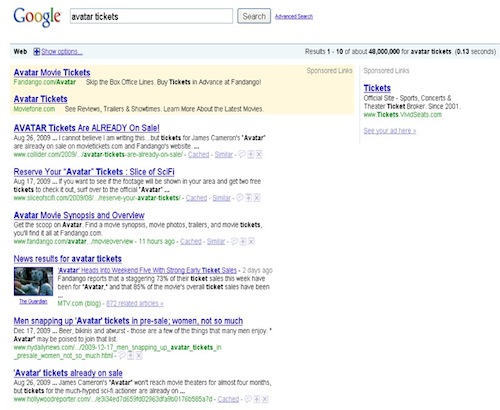
Once the site is in good shape, let’s get people to it. Today, a user may be unlikely to find the website in the first place, since none of the Big 3 has successfully SEO’ed its site for current releases (e.g, searching for “Wolfman showtimes” on Google). One side benefit of the affiliate program described above will be improved search rankings for this common and valuable query type, since affiliates will be linking to the site. Besides common sense, the reason for optimism that each of the Big 3 should be able to get above-the-fold on Page 1 of search results is that the bar has been set low; here’s the above-the-fold part of the Google SERP for “avatar tickets” from a San Francisco area IP address on 1/17/2010:

In the organic results above, Movietickets.com and the Big 3 are MIA, and Fandango is getting beaten by 2 less relevant sites. In addition to such “universal organic” SEO, the Big 3’s sites should optimize for the increasing array of data type-specific search results modules, most notably, showtimes and local.

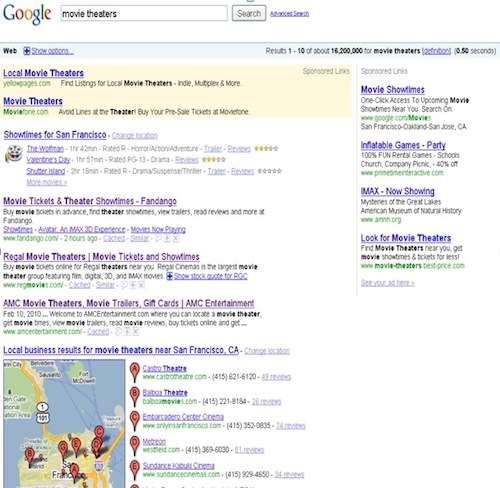
Google’s showtimes module exemplifies the importance of offering publishers an appealing, open affiliate program; Google hyperlinks Fandango showtimes, but not Movietickets.com. When a consumer is looking at movie showtimes, only some of which are hyperlinked to a POS, I suspect that he often believes that the non-hyperlinked times are not available for sale online anywhere6. Therefore, when he values pre-ordering (i.e., when he anticipates a sell-out), non-hyperlinked theaters will suffer. I anticipate that Google’s showtimes module will gain adoption, as a clean alternative to the cluttered UIs of the online brokers. Therefore, with respect to the Big 3, barring a private affiliate deal between Google and Movietickets.com, I believe that AMC’s Loews will lose pre-order market share.


The Big 3’s core customers are Facebook users. For any of the Big 3, creating a Facebook Page for each theater offers a free re-marketing channel for both brand and direct response. Even if it already has a “master” Page run by corporate, it’s worth trying localized Pages as well, since the share of user attention that (say) Regal could command is not fixed: users can fan both a national Page and a local Page. These could be managed centrally, via a 3rd party Page management dashboard, or locally by the theater manager (with assets and guidance from HQ). Giving many local teams a chance to shine in friendly competition with one another will engage employees’ creativity and help best practices bubble to the top. Two easy ways customers can connect to a Page for (say) Alamo Drafthouse Cinema are:
• visit facebook.com/alamodrafthouse, or
• text “like alamodrafthouse” to 32665 (“FBOOK”), Facebook’s U.S. short code.

As the Harvard Business Review pointed out in an article demonstrating the loyalty value of Facebook Pages, one should avoid “if you build it, they will come” thinking; most of your customers aren’t yet your fans on Facebook. It’s key for a given cinema to present the opportunity to connect when the consumer is enjoying its products. For instance, these two methods to connect could be publicized on:
• marquees,
• ticket stubs,
• receipts,
• concession packaging,
• and pre-trailer ads.
What’s more, when these consumers connect with the Page, their friends will learn about it and have the opportunity to connect as well. Turning these fans into repeat customers hinges on direct response best practices. The linchpin, of course, is experimentation. Facebook shares advice and updates regarding Facebook Pages, Facebook Ads, and brand marketing.


Once a Facebook strategy is humming along, it may be worth trial-and-error forays into other leading social media platforms, most notably, Yelp, YouTube, and Twitter. The proliferation of UGC (including negative reviews) across these and other sites is spurring a reputation management industry serving frustrated local business owners; Marchex is emerging as an early leader. Besides outbound marketing, these tools can help identify which locations and employees are undermining the brand promise of customer service.


Margins


Most of the commonly suggested concessions ideas forget that the food gross margin is already heroic. Even alcohol is not a slam-dunk, since its gross profit per sale won’t be much more than soda; I believe that the main benefit would be to increase the overall beverage sell-through rate (albeit at increased costs7).


I believe that the most effective strategy to improve the ticketing gross margin is to demonstrate to the studios that one has profitable alternatives to their products, as described above. Perhaps counter-intuitively, a given Big 3 player would want his 2 peers –against whom he bids for films — also to discover these profitable alternatives, so that their demand for studio product is similarly attenuated.


AMC has decided to invest in large theaters in highly trafficked neighborhoods of dense population centers. I believe that its industry-leading average ticket price, box office per screen, and revenue per theater are a result of this decision. (Increasingly, in the future, the fraction of screens that are 3D and IMAX will influence these KPIs more than they did pre-Avatar.) I believe that cinemas tend to be anchor tenants, bringing customers to nearby restaurants and shops. They should try to internalize those positive externalities in the form of subsidies from their landlords and/or local governments.


What’s Next


I continue to believe that digital and 3D are the most important near-term innovations for the Big 3. Avatar’s $2.6bn worldwide take will accelerate DCIP’s roll-out. Next highest on the strategic priority list, I’d:
• Unfetter (contractually and game theoretically) from restrictive relationships with content vendors, ticket brokers, and their own consortia (DCIP and National Cinemedia)
• With that increased runway, relentlessly experiment, like a technology company
• Invest at least $10mm annually in Internet marketing, not including paid media

If they can move fast, they might just keep seeing us at the movies.


Footnotes 


6 Since these links are not labeled as sponsored but are, in effect, sponsored by Google itself, I would not be surprised to see Google, in the interest of organizing the world’s information and making it universally accessible and useful, hyperlink even showtimes that do not offer affiliate commissions.


7 These costs may be high. They include explicit cash costs (alcohol licenses, janitorial, insurance, etc.) as well as implicit costs of undermining the customer experience for those distracted by their fellow customers. That latter risk will be particularly acute if the service model is as casual as at baseball parks.

— Jon Fougner

Jon leads local product marketing and monetization at Facebook, working with the advertising engineers and product managers to build products for local businesses, ranging from restaurants to movie theaters.
