Categories
Truly Free Film

Christopher J. Boghosian on “Why I Made 7 Films in 7 Weeks”

I believe that one of the most important things a filmmaker can do to elevate their career and increase their chances of survival is to be prolific. Work begets more work. It once was that the economics of filmmaking required someone to hire you to do this, but that no longer is the case. The price point of creation is at an all time floor. So what is standing in your way? Good ideas? Please! There is a wealth of material that needs you today.

I was very inspired to learn of Christopher “I Am A Nobody Filmmaker” J. Boghosian’s mission to make seven films in seven weeks. Christopher is clearly a brave, open, and generous filmmaker, but this was a challenge I suspect few are willing to undertake. I am hoping that Christopher’s efforts will hope change that.

Why I Made 7 Films in 7 Weeks

The most frustrating aspect of narrative filmmaking is the infrequency in which one actually makes films. The conventional approach is complex and expensive, resulting in inactivity and atrophy. As a result, filmmakers often find themselves developing a film rather than making a film. So how does a filmmaker improve her craft? How does she refine her voice and style? More importantly, how does she experience the mere joy of making films more frequently?

I have always envied the feasibility with which a painter can pick up a brush and paint; thus, I wondered, can a filmmaker similarly pick up his “brush” and paint? The answer is yes and the key lies in embracing limitation. By creating within one’s limited resources, a filmmaker eliminates nearly all production logistics that can snag even the most industrious types; I call it thinking outside the box, inside the box, which is exactly what I did this summer with 7 Films, 7 Weeks.

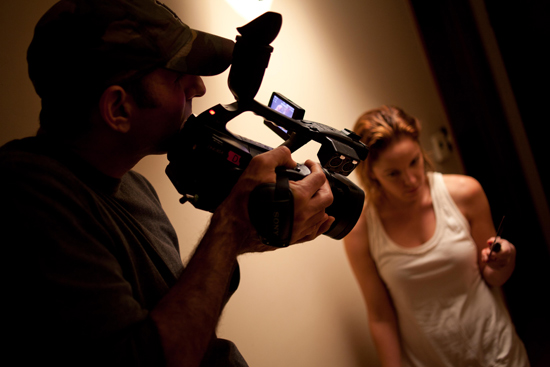
While my first feature film was in post-production, I was eager to cultivate my craft and voice as a filmmaker. Sitting around and waiting on others was not making me a better director, nor was it fun, so I set out to make one film per week for seven consecutive weeks. And to protect myself from production logistics, I limited myself to actors I had previously worked with and locations I had solid connections to. The result was a logistically stress free seven weeks, leading to the successful completion of all seven films.

As you can imagine, I am now a much more skilled and confident filmmaker. I worked with professional actors, conceptualized and wrote diverse scripts, and edited numerous scenes. By the third week, I stopped doubting myself and trusted more and more in my abilities and talent while having fun making films.

On the flip side, “cultivating my voice” as a filmmaker was much more difficult than I imagined. Though I made an earnest effort to create authentically, from a personal point-of-view, I struggled immensely and experienced much anxiety. Even now, after seven films, I remain unclear regarding my personal relationship with film, i.e., the way in which I am to uniquely engage in the art. Simply put: I want to discover what “a film by Christopher J. Boghosian” really is.

Rather than discourage me, this hard lesson has given me a greater respect for the art of making films and a deeper appreciation for the patience needed to do so. Because of my 7 Film project, I now realize that one’s voice is not quickly contrived, rather, it is an ongoing conversation steeped in sincerity and exploration.

I encourage all creative types to undertake such a project. Maybe 7 films in 7 weeks is impractical for you, so how about 7 films in 7 months or 4 films in 4 weekends? The key is to embrace limitation and stick to it – think outside the box, inside the box. And, of course, it helps to announce the project to the world, as I did, because a little bit of accountability can go a long way!

You can watch all 7 films on FollowMyFilm.com

Accruing way too much debt as a law student, Christopher realized it was now or never, so he packed his bags and returned to his hometown, Los Angeles, to make movies. Since then, he has fathered multiple short films, a feature and a super-cute baby boy! You can see what else he’s up to at FollowMyFilm.com

Categories
Truly Free Film

Blake Whitman on “How To Find Music To Use Legally In Videos (Announcing Vimeo’s New Music Store)”

The world keeps getting better and better — at least in terms how we can create better work and get it seen. Today, has brought some more good news.

Blake Whitman, Vimeo’s VP of Creative Development, announces Vimeo’s New Music Store:

In addition to being Vimeo’s VP of Creative Development, I also make videos. Something that I’ve been struggling with for a while now, is how to find music that I can legally use in my videos. I search and search and search every music related site on the net and it ends up taking WAY too much of my time. And even when I find that needle in the haystack, figuring out how to actually use the song (legally that is) is a whole other story. Do I contact the musician? The label? Do I need an attorney and who’s going to pay for that?!

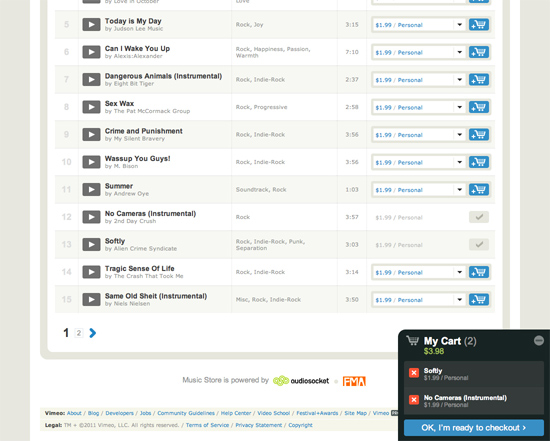
So we had an idea. Wouldn’t it be great to create a place on Vimeo to easily discover, license and download music? Well, the obvious answer is OF COURSE, but we wanted to make sure it would be easy and intuitive to use. So we decided to create Music Store, a music library powered by two great curated music providers, Audiosocket and the Free Music Archive. The library allows anyone to search tracks by lots of different criteria and provides license agreements right there on the site. You can purchase and/or download music easily and then throw it in an editor and start editing!

Check the key features:

     • Over 45,000 songs

     •Three types of licenses: 1) Creative Commons licenses which are free (yes free), 2) Personal use, Non-commercial, web-use licenses for the casual user which are $1.99 per track; and 3) Commercial, web-use licenses for professional users which are $98 per track.

     •Searchable by over 100 features like tempo, mood, theme, genre and instrumentation

Vimeo’s mission is to inspire and empower video creators. Vimeo Music Store is just another step in our effort to help people make better videos! Check it out here:

Categories
Truly Free Film

Brian Godshall on “8 Developments in The World of Music”

Music is a big deal for every filmmaker. But every Producer also knows that come music clearance time, money is running out, nerves have been scraped raw, and it is a hell of a lot of work and time to get the clearances in place. And usually you can not get paid until you complete delivery, and that includes delivery of the music licenses.

Those dedicated, music-loving souls whom do the clearances are one of the many unsung heroes of the film biz. I have had the pleasure of working with Brian Godshall on several of my films, and he is one of the really great ones. Today, he extends his generosity to share some of the latest developments of where the film and music world meet.

You know how important music can be to your projects. So we know you want to know all the new developments in the music business that may prove advantageous for an upcoming media you are producing. You may already be aware of some of these and some may be new to you. After you’ve taken a look at this list, if you have any questions, please feel free to contact me.

1. As of 6/10 Rumblefish makes available some music of theirs for free/cheap to video makers for you tube productions; www.friendlymusic.com; You can pick from 400,000 songs for $1.99 per video – they developed an app to make it easy and cheap to use music on websites, etc. rumblefish.com;

2. Per music blog/website Digital Music News— 4/29/11 — music focused Facebook deal – businesses can now reward visiting customers with free Mp3s – thanks to Facebook check-in incentive system created by Neurotic Media; neuroticmedia.com;

3. Mix Match Music allows music fans to make their own mixes of master recordings that are available through this site. Perhaps this may be a valuable tool to promote the music in your next project. mixmatchmusic.com;

4. Branding – some of the major record labels are joining up with an entity which has something to promote, such as a film, and a “sponsor” through a branding effort. The sponsor will then pay for the music download when a fan of the project goes onto the site and wants to download new music. target=”_blank”>hipdigitalmedia.com;

5. Per Digital Music News 8/25/11ReverbNation – has just launched “promote it” a Facebook-based ad platform that offer customized targeting, landing pages, and far deeper interactivity reports. ReverbNation is one of several companies to use the updated Facebook ad platform. Perhaps this can be used in your next music based project. reverbnation.com;

6. Shazam – It all started in 2002 – even before the advent of smartphones – Shazam launched a simple service designed to connect people in the UK with music they heard but didn’t know. Since then, Shazam has come of age and moved beyond music discovery and has now evolved into one of the world’s most recognized mobile consumer brands. The launch pad to our success has been our core music recognition technology that enables anyone with a mobile phone to identify music that is playing – even under noisy conditions – wherever they are, simply by Shazaming it. The clip is run through our database of more than 10 million tracks (extending back to the ’50s) to find an exact fingerprint match. shazam.com;

7. Just for fun you may want to check out THE BEATLES who granted use of their music to the site whymusicmatters.com; Their 2 minute video promotes the legal use of music. There are also short films with music from, among others, Louis Armstrong, The Jam, Kate Bush and Sigur Ros.

8. The President of NMPA Calls for Blanket Licensing of Mechanical and Sync Rights – The article below basically talks about how the Harry Fox Agency/NMPA are in discussions with the record labels and digital companies to revise legislation pertaining to some of the synch (film, TV and other visual media) uses of music. It may result in faster and more economical fees being charged to the producers of such audio-visual media. This was reported on various websites such as Billboard and indie-music.com.

June 16, 2011 By Ed Christman (@edchristman), New York
At the National Music Publishers Association’s annual meeting yesterday (June 15), president and CEO David Israelite urged members that now is the time to create U.S. blanket-licensing solutions for digital music service providers seeking mechanical and synchronization rights.

He said that music publishers are facing “three big challenges:” they have to continue to fight copyright theft and infringement; they have to help legal digital sites to prosper; and they have to make sure that publishers get their fair share of that prosperity.

But he said that prosperity could remain elusive if the industry continues to license the way it has been. “If you look at the challenges of the industry,” the way we license doesn’t work: it is broken.”

As a solution, Israelite said that now is the time to revisit the SIRA Act (Section 115 Reform Act) of 2006, which never made its way successfully through Congress to become the law of the land.

He urged that legislation be crafted that would create designated agents to act on behalf of all music publishers for synch and mechanical rights. He said that it didn’t have to be one agent, it could be a small number similar to the set-up of ASCAP, SESAC and BMI. As long as they agents were competitive and publishers had the right to align with any one of the appointed agents they so chose, and could switch if they wanted to, that would fill the void.

Otherwise, he warned, the music industry would lose out on creative business models, which might never launch because of the complicated licensing situation. Moreover, Israelite noted that the reform would only be in circumstances where the user requires blanket licenses. Publishers could still cut individual deals in situations that make sense.

He cited the Youtube litigation as a situation warranting some kind of mass synchronization vehicle. In that litigation, music publishers and other entertainment rights holders including Viacom are seeking to overturn a court decision in favor of the website. That decision said that when user-generated video’s containing copyrighted materials are uploaded to Youtube by users other than the rights owners, the site is protected by the fair-use provision provided by the safe harbor element of the Digital Millennium’s Copyright Act.

But what if Youtube conceded and wanted to be properly licensed? “We wouldn’t be able” to provide them with an easy solution for mass synchronization licensing, he said. That’s why its time to revisit the SIRA Act.

He made the point that in revisiting the SIRA Act, other music publishing issues might also be resolved. For example, music publishers don’t think it is fair that they get only 9 cents from a $1.29 list-priced downloaded song while the master rights owners get 81 cents.

Later, Israelite told Billboard that the NMPA was working with record labels and digital companies on how to draft such legislation. “We are far along in concept, but there is nothing on paper yet,” he said. The industry won’t even reach out to Congress until everything is negotiated and ready to go. “This shouldn’t be controversial [legislation],” he said. “We will all come together to support it.”

Earlier, U.S. Immigration and Customs Enforcement (ICE) Director John Morton opened the meeting with a keynote address that began with the admission: “I am here because I feel your industry is under assault from IP thieves and counterfeiters,'” Morton said. “We haven’t done enough about it.” But that has changed with the current Obama administration he said.

Among the steps the administration has taken is the creation of an IP Center in Arlington Va., which includes not only ICE staffers but personnel from Interpol and other agencies from countries like Canada and Mexico.

In one of its more controversial actions, ICE has been targeting infringing websites and seizing the assets.

As a result he said a lot of other sites came down just because they thought we were going to go after them. When ICE started putting seizure banners on sites, it had an unanticipated reaction. Even more people went to visit the sites to see the seizure banners. What ICE started doing was putting up educational messages about copyright infringement.

Ken Feinberg, the managing partner of Feinberg Rozen lawfirm, gave the other keynote address. He was appointed the special master of the administration of payout from the pending-and-unmatched funds. So far, $161 million has been paid out, to over 1,200 music publishers, he reported to NMPA members.

He called the pending-and unmatched settlement that he administered unusual because very rarely is he presented with a negotiated solution on the front-end.

There was one big problem, he conceded. That occurred when he realized there were over 2,350 songs with “conflicts”, where ownership claims in each of those songs added up to more than 100% ownership. But today, through privately held negotiations, that has been reduced to 52 conflicts, which he labeled a tremendous achievement.

Finally, beyond the settlement, Feinberg noted that while there are thousands of trade associations in Washington very few have more input than the NMPA.

Brian Godshall has handled music clearances and/or licensing for over 15 years for many dozens of independent films including the more recent movies PLEASE GIVE and JACK GOES BOATING as well as past films such as TOWELHEAD, BORN INTO BROTHELS, GARDEN STATE, GUNNIN’ FOR THAT #1 SPOT, KINSEY, THE NAMESAKE, SONGCATCHER and many others. He looks forward to new ideas and changes in the independent film industry. Email: info@bgoodshallclearmusic.com Web: bgodshallcleamusic.com;

Ted adds: “By the way, I don’t usually give out this sort of blanket endorsements, but: HIRE THIS GUY. You won’t be sorry. He’s worth his weight (and rate) in gold.


Categories
Truly Free Film

Make A Movie & Get Paid To Go To Sundance

Easy peazy. Simple doing. Just make a short film, submit, win. What could be better?

I heard about this contest where Talenthouse is working with Bombay Sapphire and Playboy, long a patron of film, to bring aspiring filmmakers an opportunity not to be missed.

One winner will travel to Sundance Film Festival to watch the premiere of their short film at a Playboy/Bombay Sapphire event. Travel and three nights’ accommodation and $500 for expenses will be provided. The winner will also receive a 30-60 minute mentoring session with key industry insiders in person or via Skype (timing based on each mentor’s production schedule and availability).

The selected short film will also be featured on Playboy.com and BombaySapphire.com and the winner will receive $3,500.

http://www.talenthouse.com/playboy-bombay-sapphire-your-short-film-featured-at-sundance

This competition is only for US residence and 21 + participants. Please take the time to read over the rules and if you have any other questions do not hesitate to email them.

Here are all the dates:

Submission Deadline: October 24, 2011
Voting Starts: November 1, 2011
Voting Ends: November 7, 2011
Semi-Finalists Announcement: November 15, 2011

Final round of voting dates
Voting Starts: November 16, 2011
Voting Ends: November 30, 2011
Winner Announcement: December 7, 2011

All the submissions remain property of the filmmakers. All T&C’s are found on
http://pages.talenthouse.com/xdl_files/ifs-official-rules.pdf

At the moment, I only know that one winner’s film will be screened.

The Talenthouse technology engine allows for voting to take place to boil it down to a set number of finalists, then here is the info
Playboy and Bombay Sapphire together with a panel of industry insider judges will choose 5 submissions, which together with the 5 highest voted submissions will be named semi-finalists. All 10 semi-finalists will be automatically submitted for the final round of voting where Playboy and Bombay Sapphire together with the panel of judges will select the ultimate winner, with special consideration for the top voted entries.

Categories
Truly Free Film

Koo On “Your Audience is Worth More Than $”

Film may be 110 years old, the Film Industry a century, Amer-Indie, as a semi-organized infrastructure and process, 30 years, but as a creative community we are only a few years, at best, in. Sure the guilds have been here longer, but as an open & transparent, group, activity sharing information and aspirations, it’s taken the rise of blogging culture to bring us together.

As much as we are coming together on a general basis, indie film communities come together now around specific voices. Nonetheless, other than Kevin Smith there are very few folks who have truly built and served their audiences to such an extent that that audience is in fact a community that can be depended on to support a film to the extent necessary to move it through production and release. Or rather, until recently. Crowdfunding, more than just a money raising tool, allows us to measure how communities can truly make movies happen. Koo, who has built the much loved and very useful blog No Film School, now is making a film, and as he shares below, he couldn’t have gotten so far with the support from the community he has so loyally served.

My crowdfunding campaign to make a youth basketball feature film Man-child has made it most of the way to raising its $115,000 goal (!). I’ve been working tirelessly since launching the campaign on August 16th, and you can bet I won’t be sleeping much until it ends September 23rd (this Friday). I don’t know if we’re going to make it all the way, but in coming this far, I’ve learned a lot — and that’s what I’m here to share. This post is also the story of how as a community we got 11-time NBA champion coach Phil Jackson — arguably the greatest living basketball coach, and someone I’ve never met in person — to back my Kickstarter film.

You have at least two audiences

I run the indie filmmaking website NoFilmSchool, and the site’s readers comprise my primary audience for the campaign. But even if you don’t run a website, you still have a primary audience — your friends, your family, your high school and/or college, and any other networks that you might belong to. This is your obvious first stop in a crowdfunding campaign.

Whatever kind of movie you’re making, your film has a topic. That topic has an audience. In the case of Man-child the topic is basketball, and so in addition to my web site’s followers, there exists another community that is potentially interested in my film: basketball fans. This is your second stop: people who are interested in your topic. But I think when you go after the second audience is important, because there’s a difference between the people who know you personally and the people who don’t. The former are willing to lend a hand because it’s you. The second group needs a bit more convincing.

Credibility first

People have mentioned in the past a notorious dead time in the middle of a crowdfunding campaign. Without the excitement of the launch or the urgency of a deadline, crowdfunding campaigns begin to resemble a 2-liter of RC Cola with the cap off (they go flat). This is a great time to try to reach out to a new audience, because if you did your job in the first half of the campaign (and didn’t annoy your followers on Twitter) — you’ll have more credibility than you did when the ticker read “$0 pledged.” Once the campaign was able to demonstrate social proof thanks a number of backers on board — but only then — did I try to reach out to the second audience.

Audiences are like venn diagrams

There isn’t a lot of overlap between my following of independent filmmakers and the basketball community at large. They’re like venn diagrams: two circles that overlap but for the most part exist separately. If your friends and family are in the smaller circle, the point is to reach the people in the larger circle who have no idea who you are. This is how your audience is valuable in a way that has nothing to do with what’s in their wallet.

Internet is plentiful, money is not

I launched NoFilmSchool by living out of a suitcase for 10 months. I know what it’s like to be short on funds. But during those 11 months when money was nonexistent, what did I have plenty of? Internet. Wi-Fi on a friend’s couch. A free connection at Starbucks. 3G. Even people on the other side of the planet who might not ever have a chance to see your indie film in the theater have a ‘net connection (and many countries are way ahead of the U.S. when it comes to broadband speeds). So when running a fundraising campaign, think of your fans friends and followers as more than financial contributors. They’re your allies in morphing the two circles of a venn diagram into one.

Strength in numbers

In the case of Man-child, as soon as we hit the halfway mark of the campaign (time-wise; we were not yet to 50% funded), I wrote a post asking for help from NoFilmSchool readers. Not financial help, but social media help. Along with an instructional video, I included links to lists of NBA players, media members, and bloggers on Twitter. Dozens of us began reaching out on Twitter collectively, asking ball players and journalists to check out or at least retweet the Man-child Kickstarter campaign. Personally, I was totally ineffective. Promoting your own campaign/product/service seems more like spam than someone asking on behalf of a friend, and there is strength in numbers: public figures have tens if not hundreds of thousands of followers on Twitter, and getting their attention is a crapshoot. They get mentioned so often that you need luck on your side to be in the right place at the right time; the more of you there are, the better your odds.

One success story is worth the effort

Despite my own lack of success, thanks to the efforts of others, several NBA players — including two-time all-star Stephon Marbury — retweeted the Man-child campaign. More importantly, Executive VP of the Los Angeles Lakers Jeanie Buss watched my pitch video and became a backer — along with legendary NBA coach Phil Jackson. I saw a jump in the campaign’s progress and didn’t know where it came from, so I went to look at the backer list, and there was Jeanie Buss. I hadn’t reached her, but someone else had. I thanked her on Twitter and we started direct messaging. She told me Phil had matched her pledge. My head exploded.

Your campaign is like a film

Films are better when they have an arc; the same goes for a crowdfunding campaign. In the past, I’d seen crowdfunders issue a press release at the outset of their campaign, but I didn’t feel launching a campaign was enough of a story by itself to get picked up by anyone. 10,000 people have run Kickstarter campaigns, after all — and that’s just the successful ones. More than double that number have launched campaigns. But I did think this social media success story — and the name recognition of having Phil and Jeanie on board — was a story. So I wrote a press release designed to get the campaign in the hands of the basketball world.

The jury’s still out

As I write this, the jury’s still out as to whether this press release has successfully brought in more of the basketball world. As a one man band running this campaign all on my own, it took me longer to get the press release out than I would’ve liked — even working around the clock — and I haven’t given media outlets much time to write up a story before this Friday’s deadline.

When it comes down to it, though, whether or not the Man-child campaign is picked up by a large sports web site, the social media outreach effort was a success — the story told in that press release has become an integral part of not only the story of the campaign, but the story of the film. And Phil Jackson, are you kidding me?!?

Your audience is worth more than $$$

More people have internet access than have credit cards. In the past month I’ve gotten a lot of messages from people who don’t own a credit card but want to help the campaign somehow. These aren’t messages they’re sending via snail mail or smoke signals — they’re through Kickstarter, they’re over Twitter, they’re via email. They’re online and they want to help. My personal friends (who aren’t very active on Twitter) logged on and had fun seeing if they could get a big name to retweet it. Give your audience something to do other than cut checks!

The “dead” midpoint of a campaign is a great time to start asking for help to reach a second audience. In fact, if my own experiences are any lesson, I would go out with this initiative prior to the midpoint, because you want to give yourself enough time before your campaign ends for your collective efforts to have an impact.

Speaking of which — my campaign for Man-child ends this Friday, September 23rd, at 11:59pm Eastern. If we don’t make it, I will certainly have learned a lot in the process, but I’d love to learn a lot more by actually making the movie! So if you feel like getting some great rewards in exchange for your support, check out my campaign — a download of the full film is just $10, a DVD is $24, plus you’ll be sent the unique frames of the film that you made possible (details in my pitch video below). Best of luck with your own crowdfunding campaign, keep that second audience in mind, and thanks for reading!

Categories
Truly Free Film

Interdependent Film

It is not independent film. We are all connected.

Categories
Bowl Of Noses

A Whole Bunch Of Truly Cool Temporary Tattoos

Let’s face it: must stick-on tattoos are so yesterday. You can get out the past and jump deep into the now with this great collection of designer temporary tattoos.