Categories
Truly Free Film

Jennie Livingston on her Documentary “Earth Camp One” Part 1

PART 1. PHILOSOPHY. INTRODUCING MY FILM CURRENTLY ON KICKSTARTER, ALONG WITH SOME THOUGHTS ON SPEAKING IN THE FIRST PERSON
 
Earth Camp One is a work of creative nonfiction about how I lost four family members in five years. The film is also about a hippie summer camp in the 70s in Northern California, the connection between those two things being that when you’re young, you want to break away from your family, find different cultural markers. What happens when they leave you? The film also has animation about different conceptions of the afterlife. Earth Camp One  is about my experience of grief and loss and about a broader understanding, or exploration, of how our society’s denial of mortality leads to everything from people feeling isolated and alienated when they’re going through something which is THE universal human experience. To national policies (wars) that, in not just my opinion, are predicated on a core belief that  no soldiers and no civilians can die because, actually no one dies. 

Right now I’m nearing the end (Friday night at 8!)  of a Kickstarter campaign to raise money to get to a rough cut on the film. I’ve applied for a billion grants where people I don’t know go into a room and look at my project and come out and tell me “yes” or “no,” (usually no, and by email) so it’s incredible to build a web page, put a video on it and have 400+  people say “yes!” by backing the project. It’s pretty mind-blowing, that “yes.” All the endless reservations, differences in taste, politics, and sensibility that kept various granting organizations or corporations from supporting my project are absent. Of course they may be hundreds of people viewing my video and reading my text who loathe it, but fortunately Kickstarter and Indiegogo have no guestbook for people who looked and left. Whomever might’ve rejected my project and moved on, I’m blissfully unaware, checking my email and racking up the next 15 backers who write me messages about how much they love the excerpt, and the idea of the film, and can’t wait to see it!

 
There are a lot of precedents for the kind of first-person documentary I’m making: just about anything by Ross McElwee, Agnes Varda’s The Gleaners and I, Thomas Allen Harris’s That’s My Face, Ari Folman’s Waltz with Bashir, and films by Alan Berliner, Jem Cohen, Doug Block, Su Friedrich, and others. I am not inventing a genre, just finding an authentic voice and structure within it. But finding money to make it is another story. Earth Camp One has been turned down by just about every place you could go to for documentary funding, but it’s GOTTEN funding from The Guggenheim Foundation, Netflix, Chicken & Egg, The French American Charitable Trust, and like most nonfiction projects that aren’t works for hire, it’s produce-as-you-go. This one is tricky because there really is some kind of aversion, amongst funders, to work in the first person. I’m not fond of the term “personal doc” as it implies you’re telling the story as therapy or for a small group of friends. No one called Joan Didion’s The Year of Magical Thinking or Dave Eggers’s A Heartbreaking Work of Staggering Genius “personal books.” Films in the first person can be self-indulgent, but so can the majority of Hollywood blockbusters. What could be more self-indulgent than the studio exec, whose main purpose in life is to keep his job, so  that he green-lights a series of movies whose primary quality is that it looks like every film that came before them?  
 
I think at least some of the discomfort that people have with films in the first person goes back to a time when men controlled printing presses and universities, and women were barred from running presses or getting an education. Women had one form of writing: the letter. Their language was personal, it was domestic, and they took their “I-statements” very seriously because the personal realm was their realm . They might dare to think about literature or politics or industry, but they didn’t speak about them: they were allowed to reflect on one thing and one thing only: their own experience. 
 

I can’t help but think that the extent to which first person speech, in film, is considered too personal, or not appropriate to fund goes back to the sense that someone speaking in the first person speaks with a small voice, with a domestic voice, as opposed to with the authority of the state, the church, the university. Whether the filmmaker is Alan Berliner or Agnes Varda, there’s still a sense that if you are talking about yourself, it must be personal, and if it’s personal, it can’t be universal. Or, as a woman in the audience at a recent screening of Tiffany Shlain’s Connected, one of my favorite films of 2011, said, when I pressed her to tell me what she thought, “I think films like this one are self-indulgent because documentaries should be about something important, and if you’re talking about yourself, it means you think you’re important.” I appreciated this woman’s candor, but I think her views are not only unconsciously sexist, I think there’s an unfortunate sense that what’s important must be outside ourselves! And I would argue that what’s universal is not always what’s rubber-stamped by experts or confirmed by mass appeal,  but is always a good story well-told: and that Joan Didion is no less universal than Toni Morrison: and that Tiffany Shlain is no less universal than Steven Spielberg: the difference is the form, not the authority of the speaker nor the weight of the story.
 
 
Jennie Livingston works in both fiction and nonfiction. Her films include Paris is Burning, Who’s the Top? and Through the Ice. She lives in Brooklyn, NY. This summer she directed a video for Elton John’s Las Vegas stage show, a series of portraits of New Yorkers to accompany the song “Mona Lisas and Mad Hatters.”


Categories
Truly Free Film

Jennie Livingston on her Documentary “Earth Camp One” Part 2

PART 2: COMEDY IN WHICH MY KICKSTARTER CAMPAIGN INSPIRES ME TO SEEK AN ENDORSEMENT FROM WERNER HERZOG
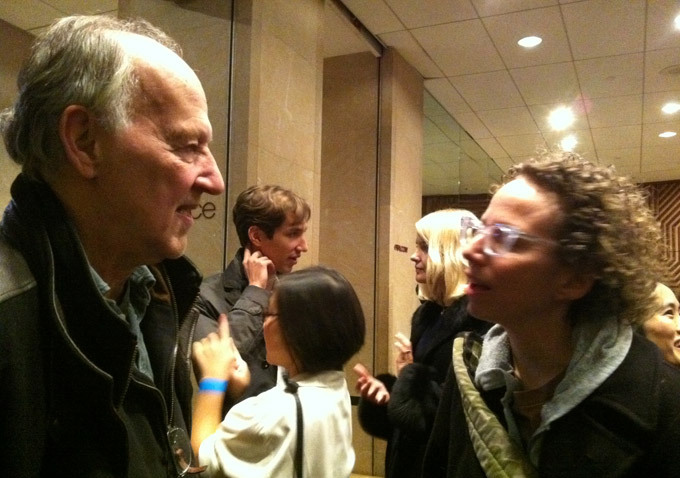
So, speaking of filmmakers who combine first person speech with observations of the world, I was (and still am as I write this) deep into my Kickstarter campaign for Earth Camp one, and thought I’d go to the opening of  DocNYC  last Tuesday night not only to see the new Werner Herzog film Into the Abyss but to ask Herzog if he would endorse my film Earth Camp One’s Kickstarter campaign.    

 
What, are you nuts? you’re asking. Well maybe in general, yes, but not in this case: when I was 22 I wrote Werner Herzog saying I wanted to make films and I wanted to work for him, and he answered my letter. 
 
He wrote: so you want to be a filmmaker? Have you robbed a bank? Can you hold the attention of a group of 2 year olds? Have you climbed a mountain? A whole series of riddle-of-the Sphinx-like questions written out by hand on blue onionskin air mail paper.  I wrote back (using a typewriter: this was two years before I got my first Mac Classic with a grant from the New York State Council on the Arts!), sending him some of my "street" photographs and telling him about  the film idea that would eventually become Paris is Burning. He wrote back: I’m coming to New York, let’s have dinner! And we did! He took me to Hop Kee in Chinatown and told me to make my film, to steal a camera if need be. And we've crossed paths and gotten together a couple of times since.
 
I thought  last Tuesday, he might, in the spirit of that dinner long ago, say something into my friend the filmmaker Hima B's camera, something I could post right here, like “give money to Jennie’s film now” or “I’m Werner Herzog and I endorse this Kickstarter campaign.”
 
So Hima and I go into the Skirball Center and the first person we see is Werner.  I also see the crowd and realize this is a pretty big premiere. The wrong time to ask for anything. We say hello. Then everyone goes into the theater. Forget the endorsement, enjoy the film.
 
Well I did enjoy the film. The subject, death row in Texas, was compelling enough. There was an amazing interview with a retired executioner and a surprise ending having to do with smuggling some very unusual contraband OUT of a prison.  It was, for Werner Herzog, an uncharacteristically emotional film. At the film’s center wa s father-son relationship, not something you see much of in Herzog!
 
At the reception afterwards, the Poland Springs was flowing and I was feeling very free. I thought, what the heck?  I met Werner's daughter, a photographer who had a gracious and bemused air towards the people pressing in to talk to a man who'd earned cult status for 40 years and 60 films. I told Werner about this campaign and about Kickstarter, how and why crowd-sourcing works. He said, “I barely look at the Internet.  I don’t even have a phone.” He said that  raising money that way is asking for a handout and I shouldn’t do it.  “Well, how should I raise the money to edit my film?” I asked? “You should be a bouncer in a sex club!” he told me. ( If you think I’m making this up to be colorful, go here, 4 paragraphs down.) 
 
Bouncer in a sex club? I flexed my muscles in a bouncerly way. FYI I’m 5’5” and 120 pounds. “Werner, you think they’d hire me?” He saw my point. “You should work in a brothel!” (I hoped he meant as a decorator or pornographer.) He advised “you should work out in the real world, earn money, and make your film for $10,000. You should be self-reliant!”
 
Now I don’t disagree that it’s honorable to earn money with the sweat of your brow and put that money back into your art. But the film we saw at DocNYC was funded by The Discovery Channel. No doubt Herzog was paid, the editor was paid, the producers were paid, the composer and the musicians were paid. The budget was not $10K.
 
Am I begrudging a filmmaker whose work I hugely admire the status he's earned? Certainly not. Look, there are a lot of ways to flex muscles. It’s like the difference between third and first person. By supporting my film my backers on Kickstarter are acknowledging we can’t depend only on corporations or on artists’ savings to get good culture made. And from my point of view, their pledging is a great reason to wake up in the morning and feel I’ve got a shot at finishing a film I’ve been working on, on and off, for 10 years.  And I know that even if a veteran filmmaker like Werner Herzog hasn’t heard of Kickstarter yet, I choose to believe that, in the deeper recesses of his own heart, he would endorse any filmmaker who's doing what it takes to make a film.  I might feel shameful for a filmmaker of Herzog’s generation to write everyone he knows and ask for $10 or $1000 to get in the editing room, and although I didn’t grow up on the Internet (I grew up on the telephone!)  I’m glad I’m flexible enough to do what needs to be done to make a film, and if crowd-sourcing is one tool in the toolbag right now, I’m happy to use it. Plus, there’s something amazing about the people for whom you intend the film giving it props before it’s even done. It’s very satisfying. It’s radical and democratic and actually makes you realize that you are making your work for people. Actual people. 
 
A final word on Herzog. Into the Abyss contains a remarkable portrait of a woman whose brother and mother were murdered. Then a few other family members died and she didn't leave the house for four years. Got rid of her phone, afraid of the news that could come with each ring. I told Werner that my film was about that kind of loss in my own life [though fortunately not that kind of depression]  and he said “well make the film, but get it over with!”   I completely agree. 
 
As of writing this I have 2 days left in the Kickstarter campaign. It ends Friday night and 8 and I hope it works, so I don’t have to work as a bouncer in a sex club.

Jennie Livingston works in both fiction and nonfiction. Her films include Paris is Burning, Who's the Top? and Through the Ice. She lives in Brooklyn, NY. This summer she directed a video for Elton John's Las Vegas stage show, a series of portraits of New Yorkers to accompany the song "Mona Lisas and Mad Hatters."


Categories
Truly Free Film

Come Hear Todd Solondz Discuss His Process This Sunday!

Sunday, November 6th at 4pm NYC

Todd Solondz will talk with playwright Thomas Bradshaw (the upcoming Burning at The New Group) about how to write about subjects that others won’t touch. As a writer and director, Todd Solondz is known for unflinching, darkly funny storytelling and graphic depictions of behaviors that somehow reveal the humanity beneath. Fellow New Jersey native Thomas Bradshaw, whose plays are similarly daring explorations, will discuss with Solondz his strategies for delving into the things no one wants to talk about.

To reserve your seats, please email seats@thenewgroup.org. Space is limited, so reservations are a must.

What is Dark Nights at The New Group?

Dark Nights at The New Group offers unique programming and enlightened conversation to complement and coincide with our company’s mainstage productions. In four to six events each season, Dark Nights seeks to create a forum for public conversation and dialogue between artists and audience, thereby enhancing the cultural landscape. Past events have featured luminaries such as F. Murray Abraham, Stephen Adly Guirgis, Eric Bogosian, Zoe Caldwell, David Henry Hwang, Tony Kushner, Martha Plimpton, Hal Prince and Wallace Shawn. Topics have ranged from gay adoption (in an event hosted by Rosie O’Donnell alongside our musical The Kid) to an evening highlighting Sam Shepard’s work (led by Ethan Hawke with music by the composers from A Lie of the Mind), to a panel on documentary theatre (featuring Marc Wolf performing Another American, his OBIE-winning play first produced at The New Group).

Todd Solondz has directed Welcome to the Dollhouse, Happiness, Palindromes , Storytelling, Life During Wartime, and the upcoming Dark Horse.

Thomas Bradshaw: recent plays include Mary (The Goodman Theater); The Bereaved (Partial Comfort Productions, and subsequently produced at The State Theater of Bielefeld in Germany); Southern Promises (P.S. 122); Dawn (The Flea Theater); Job (The Wilma). He is the recipient of a 2009 Guggenheim Fellowship, the 2010 Prince Charitable Trust Prize, and a 2011 New Voices New York Fellowship from the Lark Play Development Center. Prophet, Strom Thurmond Is Not A Racist, Cleansed, Purity, Dawn, and Southern Promises are all published by Samuel French, Inc. A German translation of Dawn was presented at Theater Bielefeld and the National Theatre of Mannheim in Germany. Bradshaw is an Assistant Professor in the MFA program at Northwestern University. He has been featured as one of Time Out New York’s ten playwrights to watch and Best Provocative Playwright by The Village Voice. He was the Playwright in Residence at The Soho Theatre in London.

Categories
Truly Free Film

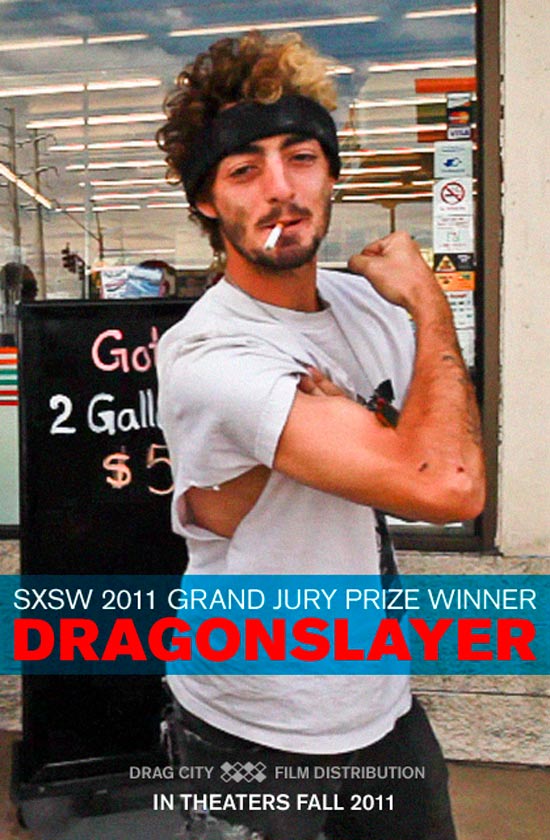
Go See Tristan Patterson’s “Dragonslayer”

What are you doing this weekend? If you had any friends that came to Tuesday night’s HopeForFilm Screening at Goldcrest of Tristan Patterson’s SxSW Audience Award winning film DRAGONSLAYER, I am sure that’s what you’ll now be going to see, because the word was “that good”! When I put on a screening, I also write a letter letting my list know why I care about the film. This is that letter for Dragonslayer.

Dear Film Fans,

It’s hard to find much good with the speculative & irresponsible practices of our financial sector, but the devastation they’ve delivered is the quiet but extremely resonant backdrop for Tristan Patterson’s fascinating character study of a skater named Skeetch. A doc delivered with tremendous affection towards what might have been mistaken for human wasteland, Tristan finds the beauty in his focus akin to the glory Skeetch and his tribe find in the tracts of abandoned homes and pools that become both their playlands and sketchpads. Artists abound on all sides of the camera, painting on an incredibly intimate scale. This is documentary as portraiture, as true to its form as it is to its content.

Film, like life, could/should be ours to invent, but the outside pressures frequently push us in over-worn directions; Tristan and Skeetch resist those forces to forge a work and a character unique but emblematic of our times. Skeeth has a skating style of his own, launched with abandon, punctuated with enthusiasm, and dismissing injury or error as a long ago accepted given. His ramshackle heart is mined by Patterson as a golden ray in a world dominated by artifice and posture — and through that, I defy you to not end up wishing our film diet could be populated by other reciprocal minstrels and artists with the restraint, discipline, observation, and heart of Patterson. This may be his first film, but you know there’s more to come.

DRAGONSLAYER is a handmade antidote to the corporate embrace of skateboard culture. It is ode to individuality and a ballad to hard times. It is of no surprise that SXSW’s audience rallied around it, awarding it well-deserved honor, prestige, and cred, and we are delighted to welcome it into our home as well. DRAGONSLAYER may be close to number seventy in the long line of cinematic pleasures, Christine Vachon and her merry band of collaborators have delivered to this world — a remarkable act of commitment and fortitude in this enterprise that sometimes seems hellbent on driving out the last ounce of resistance to a corporate world of false dreams, promises, and opportunity. It seems remarkable that this is the first film of hers we’ve shown, but what could be a better way to start?

Hope to see you there,

Ted

Categories
Truly Free Film

FREE! Everything you didn’t know you need to know about making an independent film

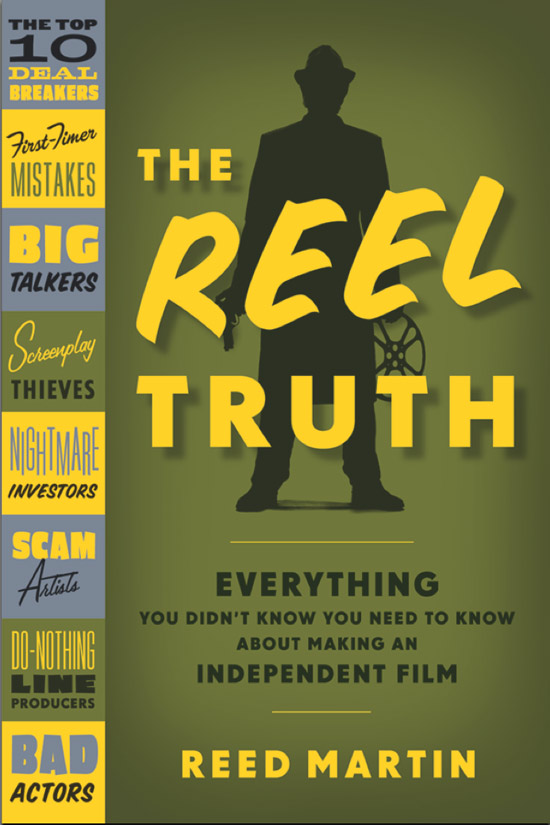
Reed Martin has kindly provided us with the opening chapter to his book The Reel Truth for free online. Subtitled “Everything you didn’t know you need to know about making an independent film,” it’s a great resource for anybody involved in independent film. Read and enjoy.

Do you dream of someday making an independent film? Can you picture your low-budget masterpiece debuting at Sundance next year? Can you see the poster for your indie feature under the lights of New York’s Angelika Theater or L.A.’s Laemmle’s Sunset 5? There has never been a better time to dream and achieve each of these goals if you know what to do and what pitfalls to look out for.

Today anyone hoping to make a terrific-looking narrative feature or full-length documentary can shoot in filmlike 24p digital video, assemble everything on a decent laptop using intuitive and affordable editing software, put a trailer up on YouTube and Facebook, and distribute the finished product on professionally replicated DVDs for only a dollar per disc. There are more avenues for getting independently financed shorts and feature films seen than ever before, allowing aspiring filmmakers who may or may not have gone to leading film schools to showcase their talents.

Developments that promised to revolutionize film production and democratize the industry have arrived, and all the tools anyone would ever need are available, affordable, and within reach. The technology needed to make independent films will only get cheaper and better, and the reasons to go through traditional middlemen will increasingly fall away, allowing filmmakers to self-publish and be totally independent from anywhere. In this environment, all that is needed is a passion for storytelling, a reservoir of perseverance, and a modicum of talent. Gone are the days when aspiring filmmakers had to spend thousands of dollars to have dozens of fragile MiniDV tapes digitized in real time before they could be edited on a slow-as-molasses computer. Today, many HD cameras record directly to memory cards or high-capacity hard drives, allowing each day’s footage to be quickly imported into Avid or Final Cut Pro 6 as easily as copying a Word file from a pocket USB drive. Indeed, filmmakers can now make their editing “selects” immediately and start assembling a project in their living rooms in full, uncompressed HD, without having to wait for a lab to process their digital footage or their reels of 16mm or 35mm film.

On the theatrical front, new specialized distributors are expected to eventually take the place of those that folded in 2008. The Internet continues to provide avenues to get shorts and features in front of those eager to experience new voices, innovative stories, and fresh perspectives. There are several sites that showcase feature films online and new software applications such as Adobe’s Media Player that aggregate content for mass consumption.

On the marketing side, new software widgets can be used to help aspiring directors and producers reach out to people who might invest in their projects and build a fan base by aggregating groups of consumers who appreciate a certain topic, all without hiring an ad agency or PR firm. For those pursuing festival acceptance—and after all, who isn’t?— companies such as Withoutabox and its new competing service, B-Side, allow filmmakers to save time by paying a flat fee to have their films submitted to hundreds of festivals.

In just a few months, pocket still cameras available at any Radio Shack (such as the Kodak Zi6) and portable devices like the Flip from Pure Digital will be able to record higher quality video to internal standard drives or SD cards with improved sound, ushering in a new era of handheld indie filmmaking. Later this year, some intrepid filmmaker will debut a first film shot using store-bought gear and civilian actors, creating a sensation that merits an article in Vanity Fair and inspires a new generation of filmmakers. It could be you. The tools to pull it off are a fast laptop, a licensed copy of Final Cut Studio 3, StoryBoard Quick 5, an external Bluray DVD burner, and WordPress software to create the website—all are available for under $5,000, all-in. The newest HD and affordable 3K video cameras that record gorgeous filmlike images to swappable 64-gigabyte and 128-gigabyte memory cards can be rented for around $1,500 per week. Amazon’s CreateSpace and the Tribeca Film Institute’s Reframe Project can help filmmakers digitally master their projects and sell them online. Breakthrough Distribution can handle the DVD sales.

We already live in a world of amateur filmmakers, where the ubiquity of camera phone video, webcams, and cheap recording equipment has opened up opportunities for everyone to create something eye-catching and cool. Raw talent, an ear for dialogue, an eye for the perfect shot, and the passion to craft something that touches and inspires audiences are increasingly the only missing ingredient.

Yes, the best time to make an independent film is right now….

Continue reading the first chapter of The Reel Truth here.

Purchase The Reel Truth on Amazon.

Categories
Issues and Actions

Simple But Genius Idea To Keep Wall Street Occupied

If there was a social contract in this country, not only would America NOT be at the bottom of countries in terms of fairness and justice (check out the graph linked to the post), but we’d recognize how support for the arts, and culture in general, is part of what civilization should be.

I love it when you can see how things you care about — or even wish you did not have to care about — are linked. I hate junk mail and have tried to find ways to free myself from it for years. Now, thanks to this video, I have a new love of it. I can use it to take action.

Our financial institutions are service industries. The dialogue does not have to be one way. I wasn’t being mindful until I saw this video, and realized that it didn’t have to be.

Categories
Truly Free Film

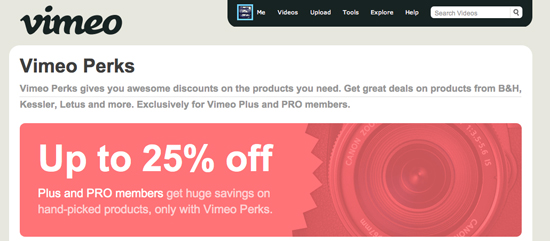
Blake Whitman presents Vimeo Perks

From Blake Whitman, Vimeo’s VP of Creative Development —

“One of the main goals of the Vimeo community is to embrace the creative nature of the users. We encourage them to ask how something was made, with what equipment and software, in order to inspire others to go out and be able to expand on their filmmaking abilities. It’s that opportunity to interact and see what cameras and editing tools are being used that makes the Vimeo community such a collaborative environment.

We at Vimeo wanted to say thanks to our creative community by offering them something that was both useful and could not be found anywhere else on the web. Vimeo Perks is a new member rewards program for our existing PRO and/or Plus community that provides unique discounts on camera, software and video accessory products. Our goal is to help our premium members take the next step in their filmmaking and creative journey — without breaking the bank. The Vimeo Perks program will offer great discounts on a wide variety of products that can range from 5-25% off the real world price.

We partnered with companies the Vimeo community knows and trusts to offer great products at a uniquely discounted rates. Partners include B&H, with select packages of cameras and accessories, as well as great products and software from Kessler Crane, Red Giant, GarageCube and Letus.

For more information about Vimeo Perks and to subscribe to Vimeo PRO or Vimeo Plus, please visit www.vimeo.com/perks“.