Categories
Truly Free Film

The Next Step Towards Your Personalized Pleasure Planet

Suggestion engines tell you what might appeal to you: i.e. you loved “REPULSION” and “CACHE”, so you will also like “MARTHA MARCEY MAY MARLENE”. But if you are at all like me, you’ve already found enough movies to get you well past your life expectancy rate. It’s now more you crave, but less!

Now that we mastered the “find”, is it time, to start the “ditch”? How do we get rid of that which has no applicability to our lives? Should we remove that which might not be to our liking forever from our discovery threshold?

Categories
These Are Those Things

I Love NYC (& Time-lapse Photography)

Thanks to Gothamist for the tip on Josh Owens aka Mindrelic.com ‘s time-lapse photography!

NYC – Mindrelic Timelapse from Mindrelic on Vimeo.

Categories
The Next Good Idea

This Is A Better Way To Tie Your Shoes

Even adults have been doing it wrong too.

Sometimes small changes can yield big results!

Categories
Truly Free Film

The New Digital Repertory Mode

In a recent post on his excellent blog, Ira Deutchman asks

“Why not recreate the repertory cinema model for the digital age–program different strands of films on different nights, day-part them if you will. Why not stage national events to showcase those strands and have audiences feel like that are part of something larger–something they can’t get on TV or from a DVD?”

But Ira not only asks, he explains in detail how he is doing just that with the series FromBritainWithLove.

I am such a believer in this model. Read how it was done.

Categories
Truly Free Film

The Next Wave Of Media Companies

I don’t like to say I am a “content creator”, because I think it reduces the quality of what I do. I prefer to say I am a “storyteller”, even though I think that sounds a bit smarmy too, and really just covers one aspect of — along with the ultimate result thereof — my endeavors. “Film producer” is certainly a term that no longer is truly applicable to my ambitions, but still probably works best to capture what I do. One day I may finally stumble across the correct term for how I use my labor, but for now I just generate within an industry in total transformation.

We all know that the film industry is changing in many ways. But are we at all prepared for how it is going to change in even more rapid ways in the days ahead?

Categories
Truly Free Film

Guest Post: Hal Siegel “My Film Has a Virus? WTF?”

How do you make your film go viral? That may be one of the questions that filmmakers ask most these days. And today we have the answer for you… sort of.

Hal Siegal guest posted here awhile back and today he explains the concept and practice of social loops. If you want people to engage and share with your work, you best read up now.

In my previous post regarding my experimental social film, HIM, HER AND THEM, I mentioned that I’ve been spending a lot of time thinking about “social loops”. So what the heck is a social loop, anyway? It’s not just an academic or rhetorical question—an understanding of social loops is absolutely critical for any filmmaker looking to build or engage an audience through the use of social media.

The notion of a social loop is derived from the term “viral expansion loop”. These loops or “hooks” are a key driver of the massive growth of many web 2.0 companies including Facebook, Twitter and YouTube, and more recently casual game companies like Zynga. However, the concept is not new: Tupperware parties were an early example of a viral loop in action. A viral expansion loop uses specific ideas from biology that describe the spread of viral diseases and combines this with the more generalized concept of a positive feedback loop (compounding interest in a bank account is the classic example of positive feedback: interest payments add to your balance and the result in turn increases the amount of interest).

What does a social loop look like? Consider the way Facebook works. Facebook is absolutely useless to you unless your friends are on it. Once a few friends have joined it is somewhat useful, and as more friends join, it becomes more useful—and the same thing is true for each friend in turn. The point here is not just that this creates growth, but that it can create exponential growth. (Note that this is just one simple example. Facebook incorporates many loops and even levels of loops—a social game like Cityville contains another set of loops built on top of Facebook itself).

It seems that filmmakers are beginning to understand the potential value inherent in social loops. For example, in support of his latest film NEWLYWEDS, Ed Burns held a crowdsourced poster contest and song contest. At their core, these types of contests employ a simple social loop: a participant submits an entry and then naturally encourages all his or her friends to vote for it. That’s the first half of the loop. The second half is where the friends learn about the contest and then submit their own entries, thus starting the loop over again (and this is where this particular example breaks down—the set of people interested in a given film + having the skills to create a decent original poster or piece of music is relatively small. Filmmakers would be wise to consider other types of social engagement that have lower barriers to entry).

Of course, efforts like these still fall into the realm of marketing. With HIM, HER AND THEM, we took the next step and added a social loop into the film experience itself. This took the form of simple text additions that viewers and their friends could add to the film, thereby customizing and altering it. But of course these text additions are only meaningful if your friends can see them. So viewers are encouraged to invite friends to also watch and add to the film, and in turn they invite their friends to watch and add—and there’s the loop.

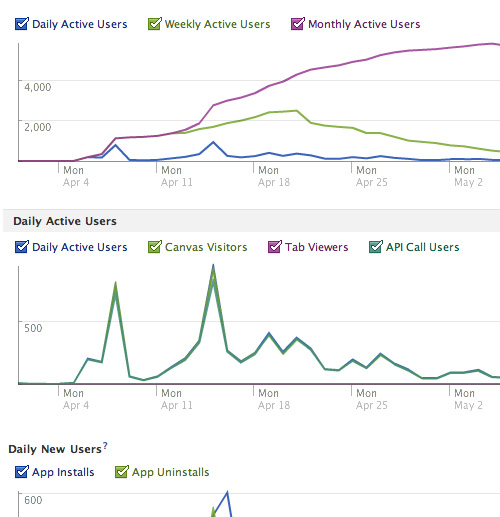
Since the film was released as a Facebook application, we are able to measure our audience engagement in ways that would be impossible in a traditional film. So how did we do with our first project? Our results were mixed. First the positive:

– We had approximately 6,000 viewers in the first month (with zero marketing dollars behind it)
– Of these, 50% interacted with the film socially in some way (by liking, sharing or commenting)
– 25% added to the story
– Average number of visits per user: 2. We assume that most people were viewing the film once, then returning to see what they friends added.

And now the negatives:
– We lost approximately 50% of our inbound viewers at the Facebook Permissions prompt. Ouch. We attribute this to the fact that a large number of inbound links were generated by StumbleUpon where users had no context that this was a Facebook application. This shows the importance of contextualizing your links and marketing. It also shows the hurdle that the Facebook Permissions screen represents—we did predict that this would be an issue.
– We had a lowly 3.33% conversion rate of friend requests to confirmations. This was very disappointing. We attribute it to Facebook’s new notification process and the fact that we weren’t able to invite friends via status updates on their walls or via email (in their defense, Facebook made the changes because social games were getting quite spammy with regards to email and wall notifications).
– Finally, viral growth is measurable as mathematical formula known as the viral coefficient. For growth to be viral, the coefficient has to be greater than 1. Ours was .07. That’s not so great in terms of growth and nowhere near exponential growth. In fairness though, this first project was largely a proof of concept. For our next projects we are thinking about deeper and more sophisticated social loops that will be specifically tailored to the nature of the story.

Social loops are clearly powerful, but the challenge is to use them with consideration and not in an exploitative manner (game mechanics face a similar challenge right now). Designed poorly, social loops will be perceived as a crass and manipulative tool. Designed well, with clear value and meaning for the user, social loops can be a gateway to entirely new kinds of engagement. This is our goal as we explore the possibilities of social films.

Hal Siegel is a partner in Murmur, a hybrid studio/technology company that creates and distributes social films. He wrote and directed HIM, HER AND THEM.

Categories
Truly Free Film

Guest Post: Hank Blumenthal “Towards An Aesthetics Of Producing Indie Movies”

What is a Producer’s “Vision”? How does she keep it all together and manage to lead all the various pursuits to a common goal? Do different approaches assure different results? Does different content require a different process?

Hank Blumenthal is old school NYC production. We’ve known each other a long time. He’s done it all. Recently he went back to school and has been focusing on new media. He’s a regular commenter on this blog; his comments lead me to ask him to take the lead at times, and today he offers us his first guest post.

Ted asked me to write a post about what it means to be a creative indie producer and the aesthetics of producing an independent movie. I can’t fully answer that question but I can start to address the main elements of that creative process and aesthetic. One approach might be to organize our thinking around four aesthetic aspects of producing: vision, community, logistics, and perspective.

A producer must have aesthetic vision. He literally has to be able to see the finished film in his mind’s eye. He has to grapple with the way it will situate meaningfulness in the culture a year in the future. And he must be able to share that vision with people so that they can be inspired enough to invest time, money, or spirit in a project.

Sometimes a film’s vision comes from a producer who conceives an idea, reads a book, or experiences a gestalt; and sometimes he embraces that from another creator. In either case this becomes the aesthetic basis for a project. This is the crucible where meaning is created. This meaning is informed by an argument or dialogue we want to have about how we perceive the world and how we share that understanding. This dialogue is grounded in artistic pleasure, emotional empathy, intellectual discourse, politics and economics.

On my last project, The Ghost Club, the idea for the story and most of the particulars came in a flash of inspiration and few hours of copious scrawling in my journal. My goal was to push the boundaries of storytelling to include a new form I call a storyscape – a story that is greater than the sum of movies, games, experiences and conceived as a whole. The storyscape is the medium, like a novel, that transmedia storytelling plays out on.

I had to conceive a whole universe with rules and connections between media like augmented reality games, websites, ghostpedias, and webisodes. Certainly there were only glimpses of what some of those elements were to be but the vision of the producer is to provide that scaffolding to the other artists – writers, directors, programmers, user experience designers – and to define the map where our efforts would go. Good producing, like modern transmedia, is about leaving gaps for our collaborators to fill in.
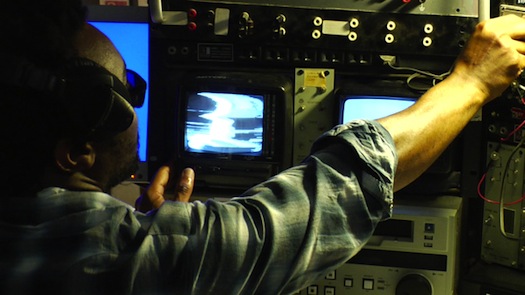
The producer must now form the aesthetic community that enforces that vision and interpretation. The key creatives on a movie – director, writer, producer – must disseminate and encompass all the other creative visions – actors, animators, designers, musicians, etc. – to make a community of meaning. The producer must take responsibility for this community and the coordination that scales the cinematic vision to the divisions of labor in making a movie. That is how the set decorator can choose the perfect flower or the composer the amazingly perfect cue. The producer, being responsible for the creation of an aesthetic ecology, must mediate translations of core principles across the various people involved, both communicating the larger vision while still respecting the particular area of the production.

I cannot stress this point enough, the aesthetics of the community’s collaboration is owned by the producer. The producer is responsible for who and how that team comes together. Providing an environment where people can excel and collaborate is fundamental to a producer’s role. Flexibility, openness, and respect for everyone in the process are a critical aesthetic of a producer’s community.

I was fortunate enough to work as a script supervisor with Spike Lee on music videos and commercials and see how he married a clear director’s vision with a producer’s openness to his collaborators to create the best works. Often crew, any crew (occasionally myself), would step up to him and make a suggestion. He would graciously and ruthlessly compare that against his vision and accept or reject it. More often it was rejected but the joy of collaboration was when he said “yes.” Movies are a collaborative medium and the way that process is curated defines the finished work. At the level of production, great indie movies can be traced to well-coordinated aesthetic ecologies, and therefore to careful translation from the producer.

To frame the next point, aesthetics and logistics, consider what Stanley Kubrick said in Sight and Sound in 1972: “I don’t think in terms of big movies, or small movies. Each movie presents problems of its own and has advantages of its own. Each movie requires everything that you have to give it, in order to overcome the artistic and logistic problems that it poses.” The aesthetics of logistics are where the producer’s collaboration with the ecology of production becomes artistic. Choices are not solely artistic but also exist within a larger economy that focuses attention and resources. This is where producing becomes artistic, and that art is not simply creative but economic. Where your resources are applied and to what aesthetic result becomes a large part of what the finished product looks like.

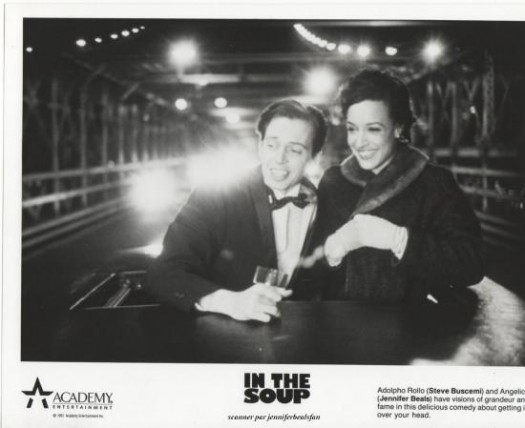
I still kick myself for not spending a thousand dollars (that I didn’t have anyway) on a location for “In the Soup” that was 200 ft closer to a view of Manhattan. The producer balances the artistic demands of the picture and makes hundreds of creative choices about crew, locations, props, sets and wardrobe – not to mention the actors who can have a huge artistic contribution of their own to make. The ability to translate creative vision down the line of production, then, is also the ability to translate final decisions – driven by who, where, how, and how much – to harmonize these points of production.
Finally there is perspective. When everyone else is up to their necks in the muck of production and post production it is essential that someone maintain the agreed upon artistic vision and keep their attention focused on the ultimate goal. The producer is the one who reminds the director of what the vision is as the director sinks into the serendipity of artistic creation often pulled by the brilliant thoughts of his collaborators. The producer is responsible for the direction of the picture through his aesthetic consistency.

Vision, community, logistics, and perspective can provide a beginning for how we can analyze the aesthetics of producing. I hope this can begin a deeper discussion into each of these areas and what that aesthetics entails. As to what a creative producer does, I think this touches on the many areas he must supply the aesthetics and vision. Movie making and meaning making are an ecology of aesthetic choices and the producer defines the nodes of that ecology.

—Hank Blumenthal

Hank Blumenthal is a producer and director of movies (The Ghost Club, In the Soup, Strawberry Fields) a creative director and producer for interactive television and digital media (Microsoft, Google, Viacom, R/GA, Bravo and IFC,) and a PhD student in digital media at Georgia Institute of Technology investigating transmedia storytelling and new paradigms for stories.