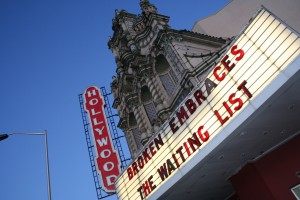
The opening number felt so inappropriate that I first hoped that the show would keep up a feel of a high school spoof of the Spirit Awards. Shouldn’t such a celebration of art & entertainment aim to contextualize all that is great about this Dream Factory? Okay, if they can’t figure out how to do that, I would be fine with several hours of pure crass classless puns like the song & dance intro promised too, but no. We get 4 hours of dullness instead. The fun of the show becomes critiquing all the mistakes.
Author: Ted Hope
MCN tipped me to this article in Barrons on Creative Capital’s practice of investing in the artist, and not the project.
BRENT GREEN WAS 25 AND ABOUT to relinquish his dream of becoming a filmmaker when he discovered Creative Capital.
Green had been looking high and low for a $14,000 grant to finish an animated film. Creative Capital, a nonprofit based in New York, sized him up and offered something entirely different: $43,000 to help support his career over the next three years. It would go toward everything from equipment to transportation to the cost of a publicist. In return, Green would give Creative Capital a small cut of any profits.
In the five years since then, Green’s work has been shown at the Sundance Festival and a number of museums and film festivals in North America and Europe. He has even found himself turning down galleries eager to represent his work.
The Lego version has already made it into the bowl, so why not the virtual tour now?
I love that the Tribeca Film Festival has facilitated an immediate VOD launch for some of the films premiering there this year. This is a key step in freeing festivals from their geographic limitations. With the collapse of print and the firing of local film critics, festivals have become our most vital curatorial voice. Whether we like this or not, it is the time we are living in, and it requires festivals to aggregate their audiences and expand their base; that is if they really want to help film culture grow and deepen, which I thought was their mandate (maybe that no longer is what it about; maybe it is now, like everything else, primarily financially motivated).
Unfortunately though the VOD experiment as currently structured (or at least as I understand it) is not the distribution or marketing solution for filmmakers that is necessary. I worry that the lack of prior promotion,non-existant window, and filmmaker-led marketing will lead Tribeca’s bold step forward to mirror the popular (and negative) wisdom that came from the Sundance YouTube experiment (i.e. Fail!). This is totally avoidable. We already have better answers.
I probably have posted this before, but what can I say? Blu has been one of my favorite filmmakers since stumbling across his work in a Chelsea Gallery. Do yourself a favor and dig around here for more of his work.
Today’s guest post is from Mike Vogel.
I recently premiered my first microbudget feature The Waiting List in my hometown of Portland, Oregon. I’ve read a lot of blogs and tweets about how important it is to turn your screening into an event. There are many well thought-out reasons for this, but the only true reason is that no one wants to see your crappy indie film. Or my crappy indie film. I’m not saying yours–or mine–is actually a crappy film, but since it didn’t get into Sundance and doesn’t have any recognizable stars from Entertainment Weekly, it must be plotless, poorly acted and guaranteed to be boring. Like a foreign movie or something. I assume that’s the mindset of 95% of the people I’m trying to convince to watch my movie–let alone pay to watch it. So the amazing opportunity to see my movie at an out-of-the-way theater on a weekday evening has got to be pretty compelling. Here are a few small things I did to make it interesting for someone who has never heard of me or my movie.
Bruce Sterling has a great post in Wired on “Atemporality for the Creative Artist”.It speaks accurately of the present, and offers a great prescriptive for what comes next. What’s “Atemporality”? Look at how problems are dealt with these days. I know I come fairly close to what Sterling lays out here, and it goes a long way to answering that first question:
‘Step one – write problem in a search engine, see if somebody else has solved it already.
Step two – write problem in my blog; study the commentory cross-linked to other guys.
Step three – write my problem in Twitter in a hundred and forty characters. See if I can get it that small. See if it gets retweeted.
Step four – open source the problem; supply some instructables to get me as far as I’ve been able to get, see if the community takes it any further.
Step five – start a Ning social network about my problem, name the network after my problem, see if anybody accumulates around my problem.
Step six – make a video of my problem. Youtube my video, see if it spreads virally, see if any media convergence accumulates around my problem.
Step seven – create a design fiction that pretends that my problem has already been solved. Create some gadget or application or product that has some relevance to my problem and see if anybody builds it.
Step eight – exacerbate or intensify my problem with a work of interventionist tactical media. And step nine – find some kind of pretty illustrations from the Flickr ‘Looking into the Past’ photo pool.’