Categories
These Are Those Things

We All Have To Sell Out Sometime…

Maybe my day will come. To make our art, we need someone to give us money, generally speaking. Hell, to pay for our health insurance or our kids’ education, we need some to pay for us to make some kind of art.

Even Jean Luc Godard made commercials. Here’s one he did for Schick Aftershave:

Categories
Truly Free Film

The End Of The Auteur Era Of Film?

People like to get credit for their work, but have they been getting the right credit for it? Are we able to recognize when something is a collaboration as opposed to a work of an individual who has hired a team to execute it?

I pride myself on having produced films that could only have been the product of the unique vision of the director. That said, I have had a front row seat on how culture in general has been drifting and leaping into something more collaborative and think it just may represent the end of an era.

One of my early jobs in the film business was working as a Script Analyst for many of the NYC-based film production companies. I was always impressed by how many seemingly unique ideas were shared by many writers. There was a month way back when when I read five scripts all featuring dwarf bowling (okay, so some of the companies I read for were schlock producers, but you get the general idea). It became clear that we all harvest our information from similar sources and process it in not-so-unique manners. If all we are doing is acting as a filter, does it make sense to claim authorship still?

I was impressed with James Gunn, the director of SUPER, when he specified that “A Film By” credit would be false due to the collective efforts of all those involved. SUPER is very much “A James Gunn Movie” though, as that credit is more of a brand — if you know James Gunn, you know what you want to expect from “A James Gunn Movie”. Utilizing a brand is a much different thing than claiming authorship. Brands do help filter content for audiences. False authorship confuses things for communities everywhere.

I was similarly impressed — moved actually — when years ago I watched OUR SONG, Jim McKay’s great film following three girls growing up in Brooklyn (and Kerry Washington’s first role). In the opening credits, the “Film By” credit comes up, and then everyone who contributed to the film is credited. Nonetheless, having now recognized how unique McKay’s work is (particularly here in America), it would not have been wrong to call it “A Jim McKay Film”.

I frequently practice a form of blog writing that Bruce Sterling coined as a “Atemporality for the creative artist” (video here). The method goes a bit like this:

  • I have an idea or feeling about something, and spontaneously tweet it.
  • I witness what response the comment gets on Twitter and ponder it.
  • The comment is auto-posted to Facebook where those that it intrigues have more room to discuss it coherently.
  • I contribute on FB new thoughts on the subject that have been informed by the Twitterverse.
  • I consider all the conversations and write a post for my blog.
  • The blog goes up automatically onto the various social media sites and I see what response it gets.
  • I consider the comments (if any) that the post has and refine my ideas still further, possibly for a future tweet, update, or post.
  • With such a collaborative culture at work, it would be wrong to claim most ideas as my own, or even of a single author. I was heartened to see this recognition in Megan Garber’s Neiman Lab response to Gabler’s NYT Sunday Mag article last month “The Elusive Big Idea“. It still surprises me how much our culture and media industry wants to promote egotism. I do not believe that credit grabs motivate creative thinking and such see no logical reason to hang onto false credits. In fact, it is the false credits that most reveal both the egotism and lack of creative thinking. With only one exception, can I think of any time that a credit discussion I engaged in was warranted (even if even then what was done was counter to industry-standard). But I digress…

    Garber writes:

    “Increasingly, though, the ideas that spark progress are collective, diffusive endeavors rather than the result (to the extent they ever were) of individual inspiration. Ideas increasingly resist branding. The idea of the idea is evolving. We don’t treat Google like a Big Idea — though, of course, that’s most definitely what it is; we treat it like Google. Ditto Facebook, ditto Twitter, ditto Reddit and Wikipedia. Those new infrastructures merge idea and practice, ars and tecnica, so seamlessly that it’s easy to forget how big (and how Big) the ideas that inform them actually are. Increasingly, the ultimate upshot of the Big Idea — the changed world, the bettered world — is bypassing the idea stage altogether. As we build new tools and, with them, a new environment, blueprints are byproducts rather than guideposts. We’re playing progress, increasingly, by ear. And, in the process, we’re becoming less self-conscious about change itself — and about our role in effecting it.”

    I truly admire how this column and others like it have become community soap boxes to discuss the state of our industry and culture, to call attention to issues and options, and hopefully find some solutions. The plight of the independent filmmaker has progressed to the evolution of a truly free film community, and we are building it better together. The spirit of the collective endeavor is raging stronger every day and the results of this change of action and focus are shining brightly.

    As much as I was inspired to work in what I saw as the art form and medium that best defined contemporary existence, that inspiration came from those works of the great film auteurs. As difficult as it is to maintain this practice, I am inspired to keep pushing forward to help find some solutions by the commitment, labor, knowledge, and generosity displayed by the COMMUNITY on a general basis. Let’s keep it up and lift it up to all that this culture and industry can truly be.

    Beautiful stories will be written by gifted individuals. Our greatest movies will be helmed by unique and committed visionaries. But neither is all that our world needs or even wants these days. In this time of superabundance and open access, it is the shared endeavor of communities that give to the culture they want, share what they love, and contribute to the efforts of many, that will carry us through to a better future. We are on our way and can not shy away from the hard work ahead of us, even if we do not receive credit for it.

    Categories
    Truly Free Film

    John T Trigonis on “The Tao of Crowdfunding: Twitter Tips for Crowdfunders”

    I think you know how enthusiastic I am about all the tools and services out there to get our work done and share it with the community. We have moved from the Era of How to one of How To Do It Well. It is time to truly develop best practices.

    Luckily this blog has become a bit of a platform for the community to share what we’ve learned. We are recognizing that we can build something better together. Today, filmmaker John T. Trigonis shares what he’s learned marrying Twitter to his IndieGoGo crowdfunding campaign.

    Perhaps the most time-consuming part of any crowdfunding campaign is getting the word out about your project. Fortunately, we’re lucky to live during a time that’s made promotion as easy as sending an email or updating your Facebook status.

    Twitter, in particular, has become a powerful force in the universe of marketing your campaign because of its real time nature. The challenge, however, is to keep from succumbing to the dark side of promotion––Spamotion.

    Here are a few tips that I’ve learned through my own experiences crowdfunding my short film Cerise and by keeping a keen eye on other IndieGoGo campaigns.

    Twitter Tip #1: Be a Prologue Before a Petition
    IndieGoGo co-founder Slava Rubin says it best: “The world is shifting from a world of transactions to a world of relationships.” That said, it’s probably not the best idea to jump into promoting your campaign on Twitter if you don’t already have a strong following.

    I joined Twitter on May 4th, 2009. I began crowdfunding for Cerise on February 2nd, 2010, nine months after I had birthed a modest following. The first people I followed were friends, of course. Then I started searching hashtags (#film and #filmmaking, for example) and following handles like @grking and @kingisafink––people who shared similar interests. Before long, I was engaging in meaningful 140-character conversations about obscure directors like Jodorowsky and sharing my insights on filmmaking with those who followed my tweets.

    It would later be these same followers who would make up my core of initial funders for Cerise. But had I not given myself ample time to genuinely get to know them, to forge actual relationships instead of networks, I would have come across as a spam artist once my campaign had begun.

    Twitter Tip #2: Creativity is King
    It’s important to be creative when phrasing your tweets. It takes a little more time, but your followers will appreciate it since they’ll see that you’re not a @CampaignBot but an actual person who painstakingly crafts each and every promotional tweet as a affirmation of the passion he or she feels for it.


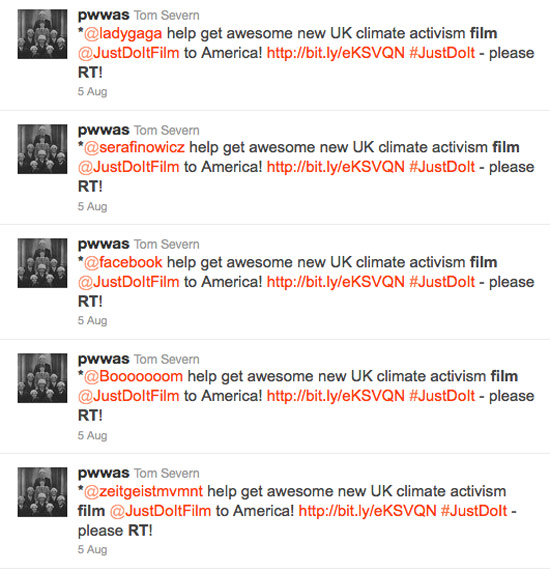
    This is a pretty standard, run-of-the-mill tweet.


    This tweet, however, shows a bit more pizazz and character!

    But even a fun, quirky tweet like @Tearsinrain78 and @grahaminman’s will lose its charm if you see it three times in a row. Linking your personal Twitter account with your project’s can be detrimental to your crowdfunding efforts. Chances are the majority of your followers are also following your project, so if your accounts are linked, your tweets will quickly become redundant. Put in that extra effort and make every tweet from every account something special and worth reading.

    Twitter Tip #3: Always Include Your (Shortened) Link
    When tweeting about your campaign, always include a link to its home page so that the first thing a potential funder sees after they click the link is your pitch video.

    And because every letter and space is precious on Twitter, you should always use a link shortener like Bit.ly or Ow.ly. I use Bit.ly the most because aside from its tracking capabilities, the site also allows users to customize their links, so your link could read bit.ly/TaoCF, which will bring you to my first Tao of Crowdfunding post “Three Ps for a Successful Film Campaign.” This way, it’s easy to remember while on the go and when using a mobile Twitter client.

    Another favorite of mine is Hootsuite’s Hootlet, which allows users to shrink and share a link from a page they’re currently viewing. The Google Chrome-based web browser RockMelt has similar features for maximizing your social media output, though for now it’s a close third for me since it’s still in its most primitive beta stages.

    Twitter Tip #4: #Hashtag #Everything #Relevant to your #Project
    In every tweet you send, be sure to hashtag words and phrases related to your project and campaign. This makes it easy for random people to find your project on Twitter or through a Google search.

    One thing you’ll want to do is find out what words or phrases bring specific communities together on Twitter. They’re sort of like little galaxies in a vast cosmos. For instance, if you’re making a movie, I’ve found that #film, #indiefilm and #filmmaking are popular hashtags for connecting to these communities.


    Right away I know that this is a romantically comedic film based in Oregon.

    If you’re working on a #vampire #film that’s got elements of #filmnoir and #comedy, then you’re quadrupling your outreach into the seemingly endless depths of the Twitterverse.

    Twitter Tip #5: Remember––Don’t Solicit, Elicit
    I introduced this nifty slogan in my previous blog post “A Practical Guide to Crowdfunder Etiquette” and it’s here as well because it’s doubly true when using Twitter.

    Asking people to visit your IndieGoGo page will only get you so far in your campaign, but if your aim is to raise upwards of $15,000, you’ll need to expand your network and start eliciting responses from potential funders and supporters.

    So what’s the difference between soliciting and eliciting? Well, here’s an example of a tweet that solicits, or asks, for help:

    Now there’s nothing wrong with a tweet like this, of course; it’s very similar to the “Make it happen for (fill in your campaign here)” tweet we saw at earlier. But look at this example of a tweet that elicits, or evokes a response:

    Obviously, this tweet for finishing funds for the film Jenny is meant to intrigue and make you want to click the link to see just what this campaign is all about.

    Twitter Tip #6: People Need Their Space
    Some people (myself included) still prefer to append their own messages before an “RT” and as much of your original message as possible. However, if by the time you click “Send” your character count is at zero, you risk possibly losing a personalized retweet that could elicit funds from other people’s followers.

    The retweet button can seem a bit cold a way of spreading the word about your campaign, especially if the person doing the retweeting feels strongly about your project. A well-crafted tweet is no accident, but remember to keep it short and simple and leave at least 15 characters available for that super passionate backer to RT with ease.

    Twitter Tip #7: @Everybody
    Whenever you thank a contributor, be sure to mention (@) that person on Twitter. If you’re not sure if they have a Twitter account or don’t know that person’s handle, do a quick Google search of that person’s name and “on Twitter” and you’ll find him or her fairly easy.


    The crowdfunders behind Jenny are thanking by name and by Twitter handle.

    Even if they don’t use Twitter much or if their little pastel egg of a profile picture hasn’t hatched into the person you know and follow, show your appreciation anyway so it’s on the record, transparent and in plain site of everyone.

    Bonus Tip: Avoid “The Flood” at All Costs!
    Charlie Chaplin said it best in his famous speech at the end of The Great Dictator: “You are not machines, you are men” (and women!) That said, do not flood your feed with tweets exclusively about your campaign.


    This example speaks a thousand words.

    While crowdfunding is a full-time job and you should maintain a steady presence on Twitter while you’re campaigning, you should still be interacting with your followers in ways unrelated to your #Project. Remember, people give to people, not @bots. Once you nurture and maintain those relationships as a person more than a campaigner, you build a network that will walk beside a person they’ll forever be proud to know and support.

    At the end of the day, it’s really all about personalization. That’s the most important thing to walk away from after reading this Tao of Crowdfunding blog post aside from a handful of helpful Twitter tips that will make your campaign a bit more approachable and more likely to reach its IndieGoGoal.

    Categories
    Truly Free Film

    CINEDIGM DIGITAL CINEMA LAUNCHES INDIE DIRECT™

    Everyday brings a better world for the independent filmmaker. Why should today not be like all others?

    I was glad to receive today’s press release announcing Cinedigm’s new endeavor. I was even gladder though to learn of it, which is why I gave them this quote expressing it!

    CINEDIGM DIGITAL CINEMA LAUNCHES INDIE DIRECT™, A FULL SERVICE THEATRICAL DISTRIBUTION AND MARKETING SOLUTION FOR INDEPENDENT FILMS

    Utilizing the Digital Cinema Backbone, Indie Direct™ Navigates Indies Through Theatrical Release Process

    Woodland Hills, CA, September 7, 2011 – Cinedigm Digital Cinema Corp. (NASDAQ: CIDM), the global leader in digital cinema, today announced the formation of Indie Direct™, a full service distribution and marketing solution for independent film producers and distributors.
    Utilizing the digital cinema backbone, Indie Direct™ provides independent producers access to Cinedigm’s long-time industry standard services for managing theatrical digital distribution, including booking software, content delivery, sales, distribution strategy, marketing planning and execution and box office recoupment.

    “From day one of digital cinema, Cinedigm has been at the forefront of deployment and installations,” said Chris McGurk, Chairman and CEO of Cinedigm Digital Cinema. “With Indie Direct™, we have tapped into our many years of experience and expertise to pioneer a turnkey method for indie producers to benefit from the flexible, precise and efficient distribution model digital cinema enables. Now, indie producers can reap the benefits of a full service studio in a one-stop shop.”

    “Cinedigm is offering independent film makers autonomy to control their own destiny with Indie Direct™,” said Ted Hope, acclaimed independent producer of such films as 21 Grams, American Splendor and In the Bedroom. “Anything we can do to strengthen the indie community is vital to the health of the entertainment industry overall and I applaud their efforts.”

    The first two production entities to sign up for Indie Direct™ are ARC Entertainment and Seven Arts Pictures. ARC is using the highest level of Indie Direct™ for eight titles it is releasing by the end of the year, including a horror film double feature with Zombie Diaries and Hellraiser, Smell of Success, Revelations, Killing Bono, Bunraku, Greening of Whitney Brown, Sundance Film Festival pick-up Knuckle, and Snowmen. Seven Arts Pictures will be using Indie Direct™ for the US release of The Pool Boys on September 30, 2011.

    ”A theatrical run tremendously enhances the value of the ancillary downstream revenue opportunities for our projects,” said Trevor Drinkwater, CEO of ARC Entertainment. “Cinedigm’s Indie Direct™ makes that theatrical play both efficient and affordable.”

    ”We are pleased that Indie Direct™ promotes the independent film community by putting a theatrical release within reach, both financially and from an execution perspective, ” said Jill Newhouse Calcaterra, Chief Marketing Officer, Cinedigm. “Previously producers had to go to multiple vendors for these services that are now available under our one roof.”

    Completely customizable based on scope of needs and project release, the suite of services provided by Indie Direct™ includes:
    · Booking software
    · Distribution strategy
    · Sales
    · Content management and delivery
    · In theatre marketing
    · Box Office tracking, settlement and collections
    · Marketing strategy planning
    · Marketing execution
    · Publicity campaign strategy and execution

    About Cinedigm

    Cinedigm is a leader in providing the services, experience, technology and content critical to transforming movie theatres into digital and networked entertainment centers. The Company partners with Hollywood movie studios, independent movie distributors, and exhibitors to bring movies in digital cinema format to audiences across the country. Cinedigm’s digital cinema deployment organization, software, satellite and hard drive digital movie delivery network; pre-show in-theatre advertising services; and marketing and distribution platform for alternative content such as CineLive® 3-D and 2-D sports and concerts, thematic programming and independent movies is a cornerstone of the digital cinema transformation. Cinedigm™ and Cinedigm Digital Cinema Corp™ are trademarks of Cinedigm Digital Cinema Corp. www.cinedigm.com

    Categories
    Truly Free Film

    Michael Collins on “Utilizing Your First Ever Film Festival”

    Toronto International Film Festival begins tomorrow. Getting you film to a festival is a dream come true for most filmmakers. But it is so easy to overlook the great opportunities that are right before you when you attend a festival. Today, doc filmmaker Michael Collins shares some of the lessons he’s learned from his initial experience at Tribeca.

    GIVE UP TOMORROW (Tribeca)
    Written by Michael Collins (Director/Producer)

    For us, the road to Tribeca was extremely long, and sometimes quite grueling. Give Up Tomorrow is our first documentary feature and it took us more than 6 years to complete. Along the way as we navigated overseas productions, unraveled the mysteries of the funding world, and learned what post-production really entails, there are countless lessons that we learned – most thanks to a supportive community of filmmakers and advisors who have been there for us at every turn. But we quickly realized that the adventure doesn’t end when you finish the film and get into a festival, it is just the mark of a new chapter.

    When we got the news that we would be premiering at Tribeca Film Festival, it was truly a dream come true. But along with all the excitement came a healthy dose of fear. We realized we still had a tremendous amount of work ahead of us, and we’d only have one chance to get this right. We immediately reached out to friends and advisors who had premiered at Tribeca in recent years and got some invaluable advice.

    By no means are we experts, in fact quite the opposite.

    Here are a few things that we feel made our experience at Tribeca a rich one:

    We got to know everyone working at the festival
    At all festivals there are so many people working tirelessly behind the scenes to give you the best possible launching ground for your film. Introductions are usually made via email, but it’s so much better to put a face to the names. Leading up to the festival make an effort to stop by the offices if you can. Say a quick “Hello” and see if you can help them out in any way. Let them know you are available and eager to participate in any opportunities that arise, such as industry panels. And get to know the volunteers and theater managers at the screening venues. When you do need their help, it will usually be under serious time-constraints, so get to your screening very early and introduce yourself.

    Utilize your networks, don’t be afraid to ask for help.
    Someone needs to take photos, video, hand out tickets to your guests, etc. You can easily get so caught up in all the legwork surrounding your screenings that you can’t be present to talk with press, talk with key guests, and maybe even enjoy yourself. Reach out to your network and see if you can get a few extra hands to be around at each screening to help with whatever comes up, because something always will.

    Hire a professional publicist
    For doc filmmakers, a photo finish seems to be the norm, and we were no exception. Finishing a film for most of us means a whole lot of post-production expenses piling up at the very end. Hiring a professional publicist was one of the best decisions we made. We were blown away by Tribeca Film Festival’s press office and all the wonderful exposure they generated for us, but the fact remains we were one of nearly 100 films they were responsible for. We chose to work with veterans Winston and David at David Magdael & Associates. They already had relationships with many of the top publications and media outlets, and they also had a great working relationship with the festival.

    Turn each screening into an event
    We invited high profile guests to join us, and organized a place to continue the conversation after the screenings. It was especially important to have a private reception following the premiere because we had all our film subjects with us, our family, friends, representatives from our media funders and foundations who supported us over the years. It was important to celebrate together as a way to thank them, and also to reconnect as we start planning for the next phase. Additionally, having this formal event made it easier to invite many key people such as distributers, NGOs, policy-makers, embassies and politicians who could directly impact the issues raised in the film.

    A reception venue doesn’t have to be expensive. Take the time to check out the bars and restaurants within walking distance of the theater and get to know the managers. Tell them you have a limited budget and see what they can offer. Ask the festival if they have relationships with certain venues and about potential beverage sponsors. Reach out to your media funders and see if they are able to contribute. If you have a film about a particular issue or cause, reach out to organizations that might want to co-host the event. They may just give you a few hundred dollars, but it all adds up. If you have no budget at all, you can usually work something out with a local bar that would allow you to show up with a big crowd and get discounts on drinks.

    Lay the groundwork for a social campaign
    If you made a film that you hope will change the world, take the opportunity to establish campaign partnerships early. There is so much excitement and good energy at festival premieres, so be sure to get key people from organizations you are hoping to partner with into that theater. It was at our reception when Larry Cox, the executive director of Amnesty International, was inspired to stand on a chair and give a passionate speech about his commitment to the film and to getting justice for those involved. We had been in conversations with Amnesty ever since we participated in the Good Pitch in 2009, but having him experience the premiere definitely sealed the deal.

    Bring partners to every screening
    Establishing and maintaining relationships with partner organizations can be time-consuming and take expertise that not all filmmakers have. We decided to make the investment and work with Tracy Fleischman and Lisa Smithline at Cultural Front Productions on this. They helped us formalize the campaign and bring partners to every screening who would join our Q&A discussions. This elevated conversations by exploring larger issues raised in the film, and it also helped to fill seats because these partners were promoting to their networks.

    Stay connected with your audiences
    If you have a social issue film, audiences are going to want to help immediately. Find a way to harness that positive energy by giving them a call to action. In our case we have audiences sign a petition. We gather their email and give them the opportunity to write a note to Paco, the main subject of our film who is in prison. We now stay connected with the audiences through Facebook, twitter and newsletter updates. As our journey continues, and Paco’s case evolves, they are with us.

    I’m writing this from the filmmaker’s café at Dokufest in Kosovo (excited for our outdoor screening tomorrow evening under the stars for 450 people!) and it is exactly 3 months to the day after our premiere. This is our 5th festival and we have many more lined up for the fall. I know that the success of the film today is largely due to the time, energy and resources everyone put into launching at Tribeca. We try to replicate our experience at Tribeca, on a smaller scale, at each new festival. We never just assume that audience will show up, or that the press will feature us, so we do our best to arrive early and get to work. But now we take a little extra time to enjoy these beautiful new cities that we were lucky enough to find ourselves in – because we know this chapter will soon be over as well.

    — Michael Collins

    Categories
    Truly Free Film

    Masterlist of PMDs (“Producer” Of Marketing & Distribution)

    Okay, I am not truly a fan of the term “Producer Of Marketing & Distribution”, but I am even more NOT a fan of how easy we throw around the term “Producer” in general. To me the Producer of a film is the individual or team that is there from the very beginning until the very end — there is no in between — and ultimately responsible for EVERYTHING. If you were not involved in any aspect of either the development, financing, casting, production, post, sales, marketing, distribution, and reporting, then you are not a “producer” and should not take that credit. There: I said it. But a nickel is bigger than a dime, and we drive on the parkway and park in the driveway, so who am I to say that this world or a job title does not really make sense?

    And frankly, if the collaboration between a “PMD” and a film works the way I dream it can, that individual is certainly there from at the very least VERY CLOSE to the beginning and all the way to the end — like a producer is.

    Regardless of how I feel, at this moment in time we are calling those that work in DIY/DIWO films, the PMD, and the world knows they need all the incentives we can provide to do this necessary work, so who am I to quibble over semantics? But the real question really is, who are the people that do this work and where can you find them? Today I launch the Masterlist of PMDs. I will allow someone else to take it from here.

    Two weeks ago I asked “Can We Create The Future Of Indie Film Marketing & Distribution — Or Is It Already Dead?“. Ultimately it was a plea for the indie world to take serious the training & utilization of people specializing in DIY/DIWO marketing and distribution. The readers of this column started a lively discussion (check out the comments). Many revealed themselves to be precisely the sort that is gaining this expertise from actual experience in the field. Jon Reiss kept the conversation going with a subsequent post.

    If you are prepping a new film, you should budget to collaborate with them, and bring them aboard. Jon Reiss contributed a great post last week on the why and also another on the responsibilities of a “PMD”. I wrote out a list of all the services a “PMD” could utilize (now at 31!). I thought that the excuse of why I wasn’t collaborating with a “PMD” on my last production, was because I didn’t know who they were. I won’t let you get away with the same excuse. Nor will I use it in the future.

    The important thing is to recognize that PMD’s are not simply for-hire service providers. They are collaborators. They are intimate with the production and can speak with an authorial voice. Community building and audience outreach are VERY personal endeavors. To do the job, not even to do it well, but just to do it, requires a tremendous amount of earned-trust from the creative heads. It should be recognized as a job that involves creativity as well as tactics and strategy.

    So… Wondering who does PMD Marketing & Distribution work? This is what I found (please add to the list by posting some comments). Many thanks to Jon Reiss who provided several of these in his recent post on the subject.

    I have listed contact information when I had it and when the filmmakers okayed it. The credits have not been confirmed. It is a start though…

    NOTE: By request some of the names once on the list have been removed.  If I add any, I will date when they are added (05.21.13)

    J.X. Carrera

    Bill Cunningham

    I am a PMD who has created, developed and executed over 75 motion picture marketing and distribution campaigns (both international and domestic) for clients including Omega Entertainment, York Entertainment, Peace Arch Entertainment, and Artist View Entertainment.

    In addition to my motion picture marketing and distribution experience:

    I was the Associate Producer of .COM FOR MURDER (Starring Nastassja Kinski)
    I was the Producer of SCARECROW as well as its co-writer.
    I was the producer and co-writer for its sequel, SCARECROW SLAYER.

    I have also been hired to write screenplays for several production companies here in Hollywood. In other words, I have a background that makes me useful on set, in post, and developing marketing plans to sell a producer’s movie.

    My specialty is high-concept, low budget movies – horror, science fiction, action, etc…

    I am well-versed in setting up promotional web media, creating exceptional, compelling marketing materials and making sure a motion picture is ready for delivery to a distributor, or ready for a producer to distribute himself. I attend the AFM every year, and keep close ties with the buyers there.

    Bill can be reached at this email address: cinexploits@gmail.com
    Or at the office:

    Bill Cunningham
    Pulp 2.0
    2908 Allesandro St. Los Angeles, CA 90039
    323.662.2508
    skype: madpulpbastard

    Stephen Dypiangco (@Dypiangco) PMD “How to Live Forever” & Oscar winning short “God of Love”
    Contact: Email – Dypiangco@gmail.com
    Website – StephenDypiangco.com
    Twitter – @Dypiangco
    Facebook – http://www.facebook.com/thepmd

    As a PMD, I must serve multiple functions on a film: strategist, project manager, communicator, problem solver and entrepreneur. But first and foremost, my primary goal as a PMD is to create and execute a customized marketing and distribution strategic plan (MDSP). I created this term, MDSP, to acknowledge the need for all film productions to have a concrete document from which to work. The term, “strategy,” is just too vague. This MDSP is a concrete strategic plan, a roadmap (a real physical document) of ALL OF THE WORK that needs to be done in the coming days, months and even years, before, during and after the film’s production. By moving forward without creating this roadmap beforehand, a PMD can become sidetracked and eventually get lost. If you don’t know exactly where you’re going, you’ll never get there.

    Audrey Ewell
    Contact :Stay tuned for the website launch, and in the meantime Audrey can be found at audrey[at]cyborgpr.com, 347-495-1476, or at Union Pool in Brooklyn.

    “I position a film so that distribution is both more likely and then more successful. As a filmmaker (and one who’s done all this for myself), there are nuances to the interactions between film, filmmaker and audience that I just get, a level of engagement that comes naturally and doesn’t reek of marketing.

    I start by helping filmmakers identify and engage their audiences. Then I tailor multi-platform digital outreach campaigns that organically amplify core audience excitement to reach new and larger audiences. I strategize and coordinate transmedia elements and game/incentive-based audience development (when desired), do website consultation with an eye toward social and new media optimization, and implement social media campaigns with an emphasis on peer to peer marketing. During festival runs, sneak peaks, premieres, launches and theatrical or semi-theatrical engagements (whether booked by me or an outside party), I consult on promotional materials, coordinate their manufacture and distribution, develop and coordinate street teams, and set up co-promotions with localized partners to cost effectively access targeted local audiences, push early ticket sales, and build awareness and excitement. I seek out new ideas and avenues of engagement and exhibition across multiple platforms.

    I help the filmmaker demonstrate audience support and then leverage that visibility and fan support during the theatrical engagement. Once that infrastructure is there the filmmaker can build on it, use it to drive distribution in other markets, and help leverage their success into the next project.

    Laree’ Griffith
    Ambient Muse Production Services
    310-986-0177
    www.lareegriffith.com

    Specializing in social media and promotional admin services for entertainment industry.
    Consulting with filmmakers and producers to create, implement and maintain an online presence for their productions.
    Other services are, email campaign maintenance, promotional material handling, and event organization.

    Laura Hammer
    PMD @unicornsmovie http://unicornsthemovie.com/crew.html |
    contact: http://laurahammer.com/contact/

    As Producer of Marketing and Distribution I work closely with the creative team to develop a Marketing and Distribution Strategy translating the goals of the team into a plan; identify and engage with the film’s core audience and target markets; secure brand sponsorships; assemble and supervise all necessary specialists and consultants. I believe that a successful marketing and distribution plan enhances and supports the overall vision of the film’s director. I prefer to work with a film from pre-production through distribution but also offer a la carte PMD services. I have produced several narrative, experimental and documentary shorts that have screened at festivals, BAMcinématek, and the legendary Two Boots Pioneer Theater. At MUBI Garage I curate short films, produce interviews with established industry, and promote emerging filmmakers. I have set up and developed successful social media campaigns and web sites for individuals, small businesses, and feature films. I have additional experience in marketing, public relations, and audience outreach working with Broadway producers and Off-Broadway theater companies. I graduated with a B.F.A. in Drama from New York University Tisch School of the Arts and trained with Atlantic Theater Company. While an undergrad, I focused on Interdisciplinary Studies and graduate courses in Web Design at NYU’s Interactive Telecommunications Program.

    I am currently PMD for I BELIEVE IN UNICORNS from Student Academy Award nominated director Leah Meyerhoff (Slamdance Grand Jury Prize winning short Twitch), executive producers Allison Anders (Gas Food Lodging, Things Behind the Sun), David Kupferberg (Magic Valley) and Robin Leland (4th and Goal) and producers Heather Rae (Oscar nominated Frozen River) and Mark G. Mathis (Oscar winning Precious, Brick). I am also PMD for GRIOT, a feature documentary in post-production from Volker Goetze, Victor Kanefsky (Style Wars), and Samuel D. Pollard (Emmy winning When the Levees Broke: A Requiem in Four Acts).

    http://www.unicornsthemovie.com
    http://www.griotmovie.com

    Sally Hodgson
    @SallyHodgson or sally@pipocapictures.)com, also see http://www.indiegogo.com/sounditoutdoc

    Joe Jestus (via Jon Reiss’ post)

    Michele Elizabeth Kafko – PMD “Revenge of the Electric Car”

    Eddie Kahlish – “Happiness”

    Jason Kohl – “Acting Like Adults”; currently 3rd Year student at UCLA.

    Adam Daniel Mezei

    About Adam Daniel Mezei’s PMD-For-Hire:

    PMD-For-Hire (www.pmdforhire.com) is a full-service, full-time, 6-days/week film marketing and distribution shop.

    I serve the needs of indie documentary and features clients (mostly docs, truth be told), working intimately with production crews on a strictly embedded basis as part of a minimum 3-month introductory commitment — or longer — to help get projects needed audience traction and off the ground.

    The overall aim of the service is to help filmmakers brand their films accordingly. I harp on the need to develop sound traditional marketing, blogging, and social media evangelism techniques — among a dozen others — to painstakingly replicate in “micro-version” what mini-studios devote hundreds of thousands — millions, even — of dollars to achieve.

    My techniques are custom-designed to inculcate solid habits from the get-go for filmmakers who are deathly serious about their long-term career prospects and who wish to harness the boundless power of the newly-democratized filmmaking milieu in true DIY/DIWO-style. Moreover, the point of the exercise is to get filmmakers generating a steady cash flow from their work so they can continue to shoot films.

    The techniques I employ are varied, yet standardized because they work.

    While every project’s ultimate marketing and distribution goals are indeed different, demanding a bespoke approach each time out after a critical evaluation of a project’s current marketing assets and personnel, the methodologies I leverage are similar depending upon which stage of the production process I’m parachuted in.

    Several approaches I’ve applied for clients in the past include:
    organizing themed live events from “soup to nuts” as a way to promote a project and sell product at the event.
    conceiving of and assembling the pieces for a comedy documentary’s entire behind-the-scenes DVD Special Features section.
    managing a team of half a dozen editing and marketing interns as part of a film’s post-production rapid rollout.
    representing a client at a marquee L.A.-area film festival as part of that picture’s world premiere, taking potential distribution meetings in the process.
    providing coverage on a spec script with suggestions for possible location improvements with the aim of potentially capturing better co-branding prospects in the future.
    My rates are monthly, comprised of a flat fee, first and last’s months paid in advance (one month is always on deposit), and I no longer accept month-to-month contracts as past experience has shown not much of impact can be achieved in just 30 days. Clients wishing to sign me for 30-day periods are throwing away perfectly good marketing budget, and I tell them so. I also tell clients I can’t help projects which don’t move me personally. So if I’m not “method acting” certain aspects of the production role, there’s no PMD in the business who can help you.

    PMD-For-Hire is proudly Toronto-based and to my knowledge I’m one of the few Canadians who does this for a living. Given how public funding bodies like Telefilm Canada have now committed to releasing grant money only to those co-produced projects with a clear audience engagement or transmedia strategy in place, the need for PMDs on indie production crews has never been more imperative.

    Since I only work the projects where I think I can be of assistance, genres like soft snuff, horror, or certain types of foreign dramas are out of my league. Furthermore, I collaborate with only a limited number of projects each quarter, so once that quota is filled don’t take on new clients until the current period is over.

    For custom requests or to find out when the next opening is, info@pmdforhire.com, or dial 416-827-4196. I answer my phone almost always. Thank you.

    And of course, client references available upon request.

    Errol Nayci – PMD working in the Netherlands

    John Oravec

    I worked with Jon Reiss as he was releasing his film Bomb-It, helped him with flyering, distributing merch, coordinating deliverables, updating social media sites etc. I also did the same for a USC Grad Thesis film Carpet Kingdom by Michael Rochford and also for the feature documentary Danny Greene by Tommy Reid. I am based out of Santa Monica, CA and my contact info is Johnny Oravec 323 698 6900 johnoravec@gmail.com and my website is http://www.facebook.com/l/RAQCRrkJkAQDWj7UqyQgPYCC0R8M3

    Diana Iles Parker PMD on “Eat The Sun”.
    Spoken Media
    Contact:
    415.225.8121 (c)
    415.388.8281 (o)
    diana@spokenmedia.com
    www.spokenmedia.com
    www.eatthesunmovie.com
    www.desertrunnersmovie.com

    I am a PMD who partners with documentary filmmakers as early as possible in their filmmaking process so we can develop a strong, cohesive and well-supported launch for their film. I specialize particularly in hybrid models of distribution that focus on splitting rights and maximizing profits; festival strategy, publicity and marketing.

    Amy Slotnick – PMD for “The Business of Being Born” (she received producer credit for her work); outreach for “Red State”; “Wake Up”.
    Contact: aslotnick@mac.com

    As a PMD I work with filmmakers to help them build, manage and optimize digital and traditional marketing and distribution, allowing them to better engage their audiences. This includes strategizing and executing marketing, publicity and distribution of independent films, often aimed to reach a niche audience or to promote a particular cause. Partnerships with organizations, brands and businesses as well as planning screenings with non-profit, student and regional groups has proved effective for raising awareness for a film. Creating and managing social networks, mobile and online promotions and overseeing online distribution, theater bookings and licensing deals are all part of the PMD position. A plan that is specific to a particular film’s subject matter and perspective can be crafted and implemented to leverage its assets and build momentum. Titles for which I have worked in this manner include Kevin Smith’s RED STATE (pre-release 15 city tour), THE BUSINESS OF BEING BORN and WAKE UP.

    Lila Yomtoob
    lila@yomtoob.com
    Lila Yomtoob is a Brooklyn based producer specializing in marketing in distribution. She’s got 12 years in different areas of the industry, a statuette named Emmy, and has produced three features, “Hidden Battles”, “Foreclosure”, and “High Life,” which she also directed. As an independent filmmaker in her own right, she understands and respects directors’ needs, and is especially passionate about getting good films seen by their audiences.


    Categories
    Truly Free Film

    The Costs Of Crowdfunding

    Filmmakers speak of crowdfunding as if it is free money. It isn’t. In some instances it isn’t even close to being so.

    In Indie Film, where filmmakers are routinely asked to take blood from a stone, you’d think the costs would leap from everyone’s tongue.

    So what platform, puts the most money into your pocket? Well, the answer ain’t so easy.

    As this is now the era of the six figure crowdfund raise, the answer is a combination of low fees and high user base. How many campaigns truly open up beyond the friends and family base?

    The hard facts are a little easier to come by. Costs, in ascending order:

    Kapipal • Currently no fee + PayPal processing fee (~2-4%), (must use PayPal, Italian)
    IndieGoGo • 4% fee if you make your goal, 9% otherwise, +3% credit card processing fee
    Kickstarter • 5% fee, +3-5% credit card fee (only funded if you make your goal)
    Eppela • 5% fee + PayPal processing fee (~2-4%), (must use PayPal, only funded if you make your goal, Italian)
    RocketHub • 4% fee if you make your goal, 8% otherwise, +3-5% credit card fee
    SoKap • 5% fee, 10% fee on product sold via their marketplace, +3% credit card fee
    United States Artists • 15% fee + 4% credit card fee